

3 Family Tested No Sugar Granola Bar Recipes Using Yacon Syrup
Your two best routes to granola bars without sugar are homemade bars built on dates or a low glycemic binder, or packaged bars sweetened only with whole fruit or near zero glycemic sweeteners. Whichever route you take, check the label for sugar alcohols like maltitol and make sure each bar carries real fiber and protein, not just an empty “no sugar added” sticker.
TL;DR:
- Bars made with dates or low glycemic sweeteners rely on fiber and protein to stay intact, not added sugars or sugar alcohols, which can cause digestive issues.
- Proper pressing and chilling are crucial for the structural integrity of no-bake and baked bars, with more nut butter or dates needed if bars crumble.
- The glycemic index of store-bought bars varies widely, influenced more by formulation than sugar content, making ingredient quality and fiber content key for blood sugar control.
- Checking ingredient lists for maltitol or high sugar alcohol content is more important than the front-label claims of “sugar-free” or low sugar.
- Homemade bars using oats, nut butters, dates, and low-glycemic syrups offer a cost-effective, customizable, and healthier alternative to packaged options.
Table of Contents
- How to Make Granola Bars Without Sugar at Home
- What Makes a No-Sugar Granola Bar Actually Hold Together?
- Choosing a Sweetener: Dates, Yacon Syrup, and Sugar Alcohols Compared
- Buying Guide: How to Read a “Sugar-Free” Granola Bar Label
- Why Do Some Granola Bars Spike Blood Sugar More Than Others?
- A Slow-Morning Family Approach to Low-Sugar Snacks
- What the Research Actually Supports Here
- Shop Yakonow: The Syrup Behind These Recipes
- Sources
- FAQ
How to Make Granola Bars Without Sugar at Home
The kitchen counter at 6:45 a.m., lunchboxes lined up, one kid already asking what’s for snack. This is where a good no-sugar granola bar earns its place. All three recipes below use dates, nut butter, oats, and a light hand with a low-glycemic syrup instead of the corn syrup and brown sugar that anchor most box-mix bars.
No-bake chewy date and nut butter bars
This is the bar for a Sunday afternoon when you want something ready by Monday morning.
- Pulse 1½ cups pitted Medjool dates in a food processor until they form a sticky paste.
- Add ½ cup nut butter (almond, peanut, or sunflower seed for a nut-free version) and pulse again.
- Fold in 1½ cups rolled oats, a pinch of salt, and 2 tablespoons of a low glycemic syrup like yacon syrup for a touch of caramel flavor and extra pliability.
- Press firmly into a parchment-lined 8x8 pan, chill for at least two hours, then cut into 10 bars.
Total time is about 15 minutes of hands-on work plus chilling. Swap the nut butter for tahini if you’re feeding a nut-free classroom.
Toasted oat and nut bars
For a bar with more snap and a toasted, nutty depth, the oven does the work here.
- Toast 2 cups rolled oats and ¾ cup chopped nuts at 325°F for 10 minutes, stirring once.
- Whisk one egg white (or an extra tablespoon of nut butter for an egg-free version) with 3 tablespoons yacon syrup and 1 teaspoon vanilla.
- Combine with the toasted oats, press into a lined 9x9 pan, and bake for 18 to 20 minutes until golden at the edges.
- Cool completely in the pan before cutting. Cutting warm bars is the fastest way to end up with crumbs instead of bars.
This version holds up best in backpacks because the light bake sets the structure. Store in an airtight container.
Crunchy puffed cereal bars
This one is for the kid who wants cereal-box crunch without the cereal-box ingredient list.
- Warm ½ cup date paste with 2 tablespoons yacon syrup and 2 tablespoons nut butter over low heat until loose and pourable.
- Stir in 3 cups puffed rice or puffed quinoa until every piece is coated.
- Press into a lined pan (a light hand here keeps the texture airy) and chill for 30 minutes before cutting.
Add mini dark chocolate chips or a spoonful of shredded coconut for a flavor kids will ask for by name. All three recipes are vegan-friendly if you skip the egg white option, and every one avoids the added sugars found in typical store-bought breakfast options.
What Makes a No-Sugar Granola Bar Actually Hold Together?
Getting a bar to hold its shape without refined sugar comes down to understanding what each binder actually does, not just following a recipe blindly.
Dates work as a whole-food glue. Their natural stickiness comes from fiber and intrinsic sugars, and they bind cold, no cooking required. The tradeoff is chewiness that borders on dense if you use too many.
Nut butter adds fat, which softens texture and helps a bar hold together without becoming gummy. It also slows staling, so nut-butter-heavy bars tend to stay soft longer in the fridge.
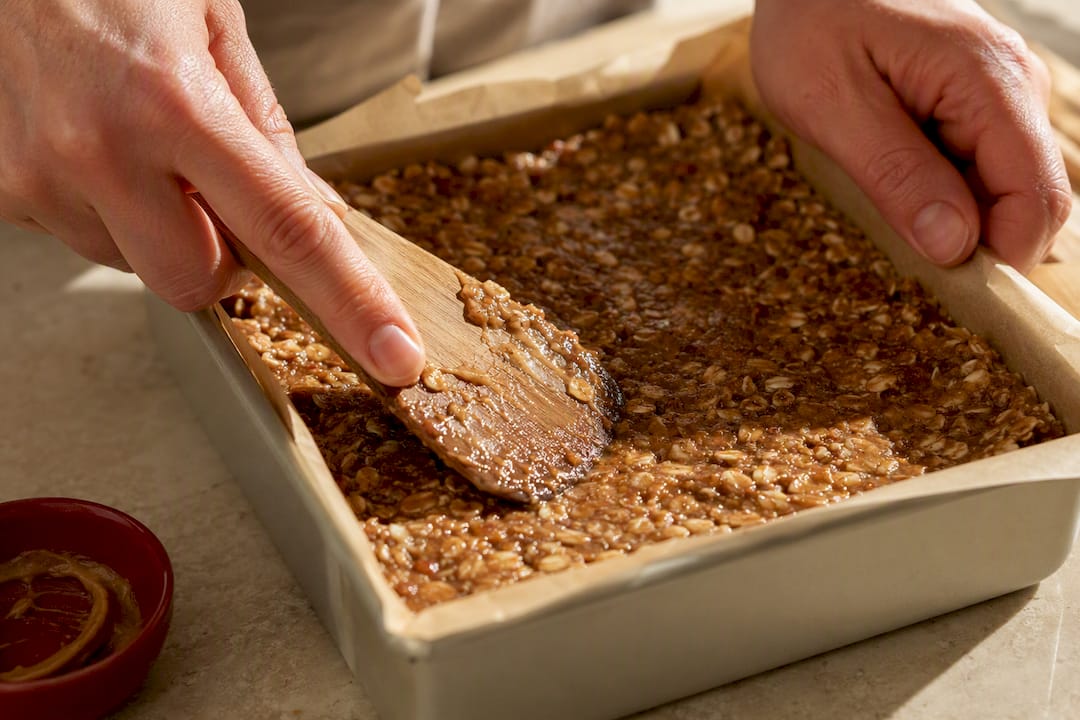
Syrup, including a low-glycemic option like yacon, thins a mixture just enough to coat oats or puffed grains evenly. It’s the ingredient that turns a crumbly mix into something that presses cleanly into a pan.
Here’s the practical method:
- Mix wet binders (dates, nut butter, syrup) before adding dry ingredients, so the coating is even.
- Press the mixture firmly with the back of a measuring cup or a second sheet of parchment. Weak pressing is the number one reason bars fall apart.
- Chill no-bake bars for at least two hours before cutting; overnight is even better for clean edges.
- For baked versions, let bars cool completely in the pan. Cutting into warm bars guarantees crumbles.
- Use a sharp knife and wipe it clean between cuts for bakery-style edges.
For batch prep, work on a full sheet pan instead of a small square dish. You’ll get more bars per batch, and freezing individual portions wrapped in parchment means you always have a stash ready for a rushed morning.
Pro Tip: If your bars turn out too crumbly, the fix is almost always more nut butter or one more date, not more oats. If they’re too sticky to cut cleanly, they need more time in the fridge, not more flour or oats.
Common troubleshooting comes down to two fixes. Crumbly bars need more fat or more date paste. Bars that won’t release from the pan need a longer chill and a proper parchment lining with overhang you can lift by.
Choosing a Sweetener: Dates, Yacon Syrup, and Sugar Alcohols Compared
Not every low-sugar sweetener behaves the same way once it hits your bloodstream, and that difference matters more than the sugar count on the label.
Dates and fruit paste are whole foods, so they never show up as “added sugar” on a nutrition label. But they still contain real, intrinsic sugar grams, and a date-heavy bar will read higher on total sugar even though nothing was added beyond the fruit itself.
Yacon syrup functions in bars the way maple syrup or honey would structurally, as a binder and light sweetener, but with a very different metabolic footprint. A tablespoon or two swapped into any of the recipes above adds moisture and a mild caramel note without relying on refined sugar. In baked versions, start with a one-to-one swap for whatever liquid sweetener a recipe calls for, then adjust by a tablespoon depending on how wet your mix looks.
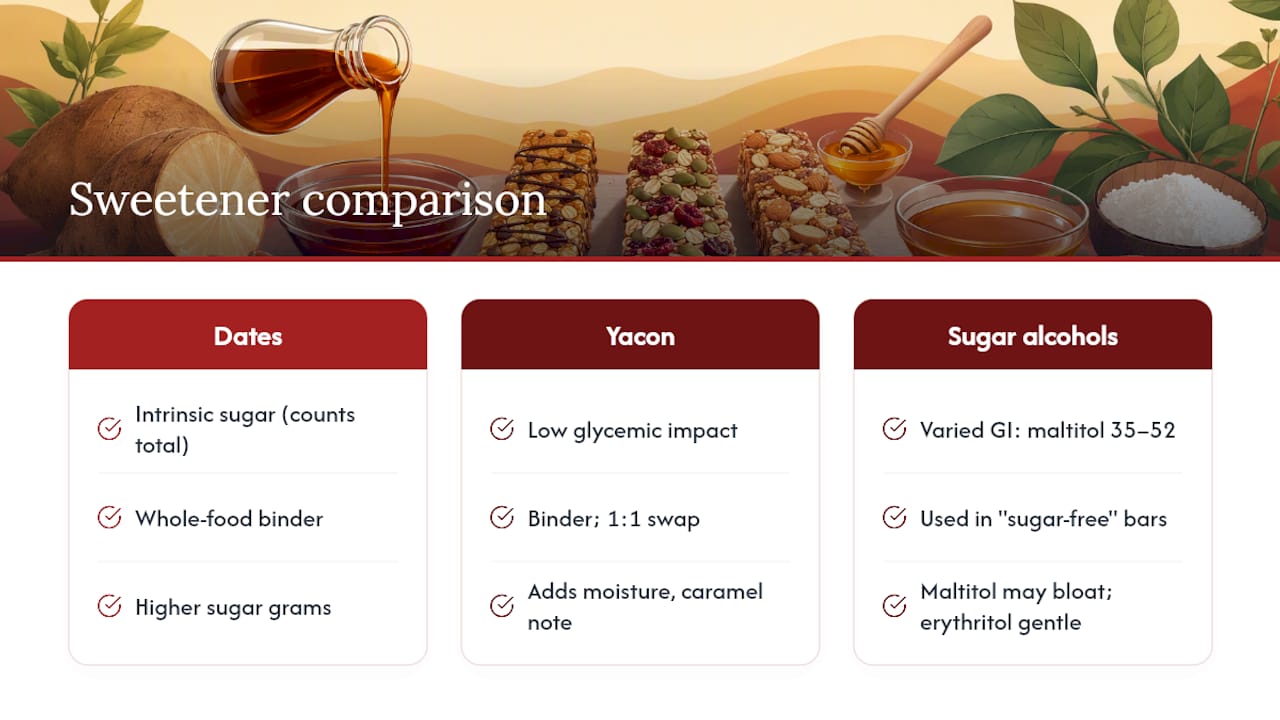
Sugar alcohols are where labels get tricky. Maltitol, common in “sugar-free” packaged bars, actually carries a moderate glycemic index of roughly 35 to 52 and is a frequent cause of bloating or digestive discomfort. Erythritol sits much closer to zero glycemic impact and tends to be gentler on digestion, though individual tolerance still varies.
Allulose, stevia, and monk fruit each bring their own baking quirks. Allulose browns similarly to sugar and works well in baked bars; stevia and monk fruit are far more concentrated, so a little goes a long way, and using too much can leave an aftertaste in a delicate oat bar. For a deeper breakdown of how these stack up against yacon, the comparison of yacon syrup against agave, stevia, and monk fruit is worth a look before you commit to a pantry staple.
The sweetener, not the sugar count, drives the metabolic outcome. A bar sweetened with maltitol and one sweetened with dates can carry similar sugar-gram numbers on paper and behave completely differently once you eat them.
Buying Guide: How to Read a “Sugar-Free” Granola Bar Label
Packaged bars can absolutely fit into a low-sugar routine, but the marketing language on the front of the box is often designed to distract from what’s happening on the ingredient list.
Start with these checks every time:
- Serving size first. A bar that looks impressively low in sugar may simply have a tiny stated serving; check the grams and compare to what you’d actually eat.
- Fiber and protein per serving. Dietitians point to 3 to 5 grams of fiber and 10 to 15 grams of protein as a reasonable target for a bar that will keep you satisfied rather than spiking hunger an hour later.
- Scan for maltitol. If it’s near the top of the ingredient list, expect a moderate glycemic response and possible digestive upset for sensitive stomachs.
- “No added sugar” is not the same as “low sugar.” A date-and-fruit-based bar can legally claim no added sugar while still carrying 15 or more grams of intrinsic sugar per serving.
- Watch for sugar alcohol blends. Some labels list maltitol syrup, sorbitol, and glycerin together, which adds up fast even though none of them are technically “sugar.”
Homemade bars win on cost and ingredient control, especially if you’re already stocking oats, dates, and nut butter for other meals. Packaged bars win on convenience for travel days or when a lunchbox needs to be assembled in ninety seconds flat. Neither is wrong; the label checklist above is what keeps either choice honest.
Why Do Some Granola Bars Spike Blood Sugar More Than Others?
The glycemic index of tested granola and energy bars swings wildly, from roughly GI 31 up to GI 93 depending on the product. That range tells you something important: the category name “granola bar” means almost nothing on its own. Formulation is what decides whether a bar spikes blood sugar or barely moves it.
Processing plays a bigger role than most shoppers assume. Extrusion, syrup concentration, and whether oats are left intact or ground into flour all shift how fast a bar digests. A bar built on intact rolled oats and nuts digests more slowly than one built on puffed, extruded grains held together with a concentrated syrup, even if both call themselves granola bars.
The fiber and protein targets mentioned earlier aren’t arbitrary. Both nutrients slow gastric emptying, which blunts the glucose spike that follows eating a carbohydrate-heavy snack on its own. A bar with 4 grams of fiber and 12 grams of protein behaves very differently in your body than a bar with 1 gram of fiber and 3 grams of protein, even at matched calories.
A few practical takeaways worth keeping in mind:
- Glycemic index measures how fast a food raises blood sugar; glycemic load factors in the actual carbohydrate amount in a real serving, which is often a more useful number for a snack-sized portion.
- Always normalize by serving size before comparing two bars; a smaller bar with a higher GI can still produce a smaller total glucose response than a larger bar with a lower GI.
- Individual response varies, so what spikes one person’s blood sugar may barely register for another.
If you’re managing diabetes, start with a small portion of any new bar, avoid products heavy in maltitol, and check your blood glucose one to two hours after eating to see how your body responds. That single habit tells you more than any label ever will.
Storing and Packing Your Bars for Busy Mornings
Storage depends entirely on the binder you used. No-bake, date-based bars keep well in the fridge for one to two weeks and freeze beautifully for months, which makes a double batch on Sunday a genuinely useful habit, not just a nice idea. Nut-butter-forward bars tolerate room temperature in a sealed container for a few days if your kitchen isn’t especially warm.
For the freezer, wrap bars individually in parchment or wax paper, then store them together in a labeled freezer bag with the date written on it. Thaw at room temperature for about 20 minutes before packing a lunchbox. Wrapping each bar separately also solves the sticking problem that puffed cereal and date bars are prone to, and it makes portioning for smaller kids effortless.
A Slow-Morning Family Approach to Low-Sugar Snacks
Some of the best mornings in our house start with something as small as a granola bar on the counter, already cut, waiting. Choosing low-sugar snacks for the kids has never felt like a project. It’s just what ends up on the table when you care about what fills it.
A single-ingredient yacon syrup, hand-harvested and bottled in an FDA-compliant facility, with a glycemic profile far gentler than most syrups on a pantry shelf, lets a busy morning stay simple.
Three quick swaps worth trying: add a tablespoon to the no-bake date bar mix for a rounder caramel note, brush a thin layer over toasted oat bars before baking for extra shine, and warm two tablespoons into the puffed cereal bar coating for a lighter, glossier finish. Small adjustments, same easy morning.
What the Research Actually Supports Here
The conventional advice on sugar-free snacking tends to obsess over the word “sugar” itself, and that’s the wrong fixation. The sugar-gram count on a label is a weak predictor of how a bar will actually behave once it’s eaten. A date bar and a maltitol bar can list nearly identical sugar numbers and produce completely different results in your body and your gut.
What the evidence actually supports is a shift in attention: fiber and protein targets first, sweetener system second, total sugar grams a distant third. A bar with real fiber and protein, built on whole-food binders like dates and nut butter, will usually outperform a “sugar-free” bar loaded with maltitol, even if the second bar’s label looks cleaner at first glance.
If you take one thing from this, let it be this: read the ingredient list before the front-of-box claim, every time. That habit alone will do more for your family’s snack drawer than any single recipe or product swap ever could.
— Celeste
Shop Yakonow: The Syrup Behind These Recipes
Yakonow is the alternative to conventional pancake syrups and refined sweeteners for anyone building granola bars, oatmeal toppers, or weekend brunch spreads at home. It’s naturally sweet, sourced from a single ingredient, and formulated with a far lower glycemic footprint than the syrups most families already have in the pantry.
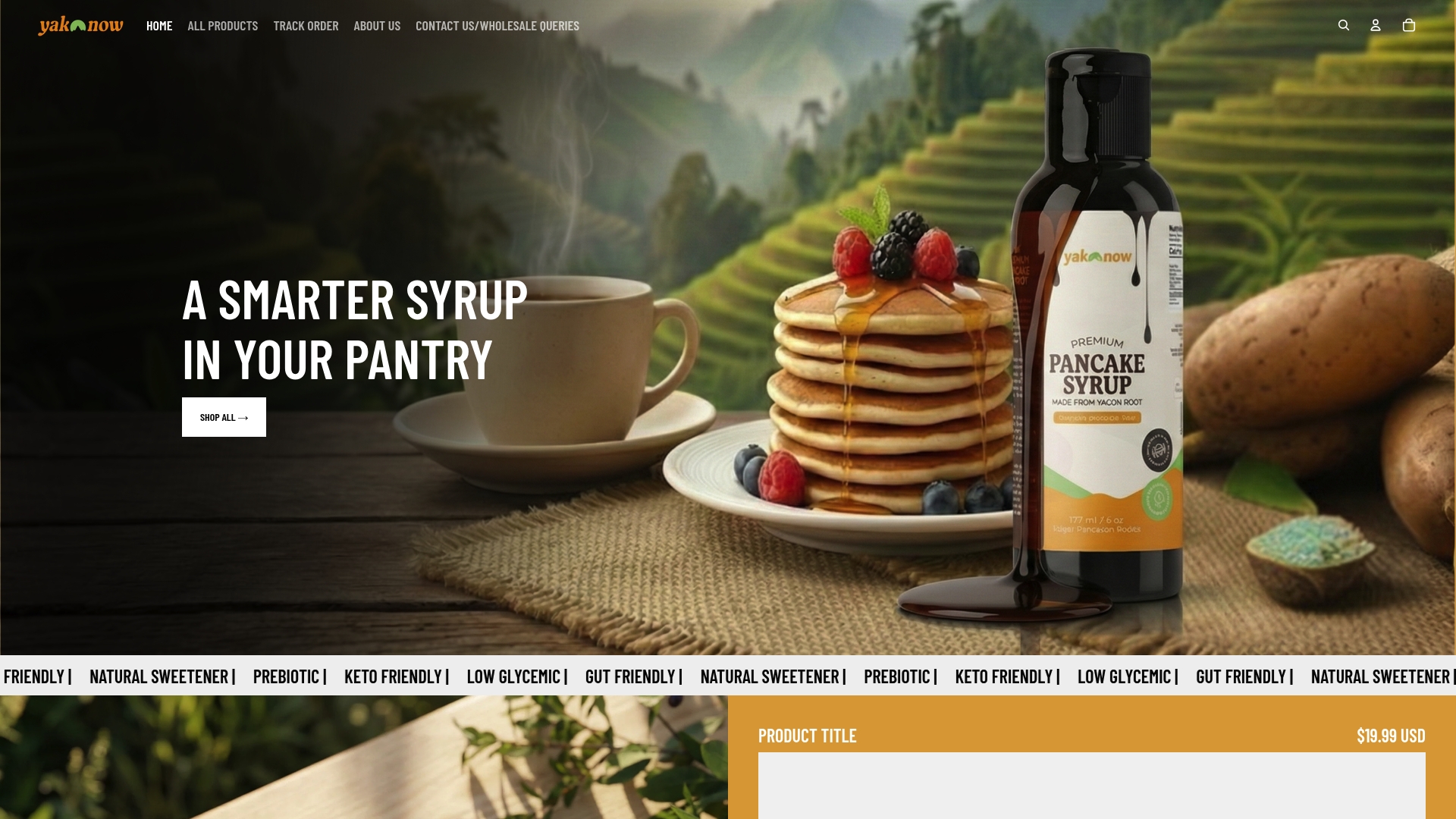
If you’re just testing the waters, the single 6oz bottle is the easy way to try it in one batch of bars before committing further. Busy households that go through syrup fast will get more mileage from the pack of 2, one bottle for the pantry, one for backup. And if granola bars become a weekly ritual in your kitchen, the pack of 4 keeps you stocked without a mid-month grocery run. Browse the full collection of Yakonow yacon syrup and pick the size that fits your morning rhythm.
Sources
- How to choose a protein bar, according to dietitians — EatingWell (2026-03-15)
- Glycemic-index
- Protein Bar & Shake Sweeteners Explained (2026) — HighProteinSnacksPro
FAQ
Which Granola Has No Sugar Added?
Granola and granola bars made with dates, nut butter, oats, and puffed grains as the primary binders carry no added sugar, relying instead on the fruit’s own intrinsic sugar. Look for an ingredient list where dates, nuts, and oats appear first, with no cane sugar, corn syrup, or maltitol syrup listed at all.
What Is the Healthiest Granola Bar?
The healthiest granola bar for most people combines 3 to 5 grams of fiber and 10 to 15 grams of protein per serving with a whole-food sweetener like dates or a low glycemic syrup. Homemade versions using oats, nut butter, and a swap like yacon syrup typically hit those targets more reliably than many packaged options.
What Is the Healthiest Granola Bar for a Diabetic?
A bar with high fiber, meaningful protein, and a sweetener system that avoids maltitol tends to produce a gentler blood sugar response. Since tested granola and energy bars range from roughly GI 31 to GI 93, checking the ingredient list matters more than trusting a “sugar-free” label, and monitoring blood glucose one to two hours after eating gives the clearest individual answer.
Does Anyone Make a Healthy Granola Bar Without Sugar?
Yes. Homemade no-bake bars built on dates, nut butter, and oats are a reliable, widely used option that avoids refined sugar entirely while staying naturally sweet. A tablespoon or two of a low-glycemic syrup like yacon syrup can round out the flavor in these recipes without introducing refined sugar.