

How to Read Syrup Nutrition Labels: A Family Guide
Reading syrup nutrition labels is the clearest way to understand what you are actually pouring over your family’s pancakes on a slow Saturday morning. The Nutrition Facts panel, the term regulated by the FDA, tells you serving size, total sugars, added sugars, and Percent Daily Value (%DV) at a glance. These four numbers do more work than any front-of-package claim ever will. This guide walks you through each one so you can stand in the grocery aisle, or reach into your pantry, and know exactly what you are choosing for the people you love.
What are the key components of syrup nutrition labels?
Every syrup label carries the same FDA-regulated structure. Knowing what each line means turns a confusing grid into a simple decision tool.
Serving size sits at the very top of the Nutrition Facts panel. It defines the exact portion that all the numbers below it describe. For most syrups, a serving is two tablespoons. That sounds modest, but it is easy to pour twice that amount without noticing.
Calories per serving give you the total energy in that portion. For syrups, calories come almost entirely from sugar, so the calorie count and the sugar count tend to move together. A high-calorie syrup is almost always a high-sugar syrup.
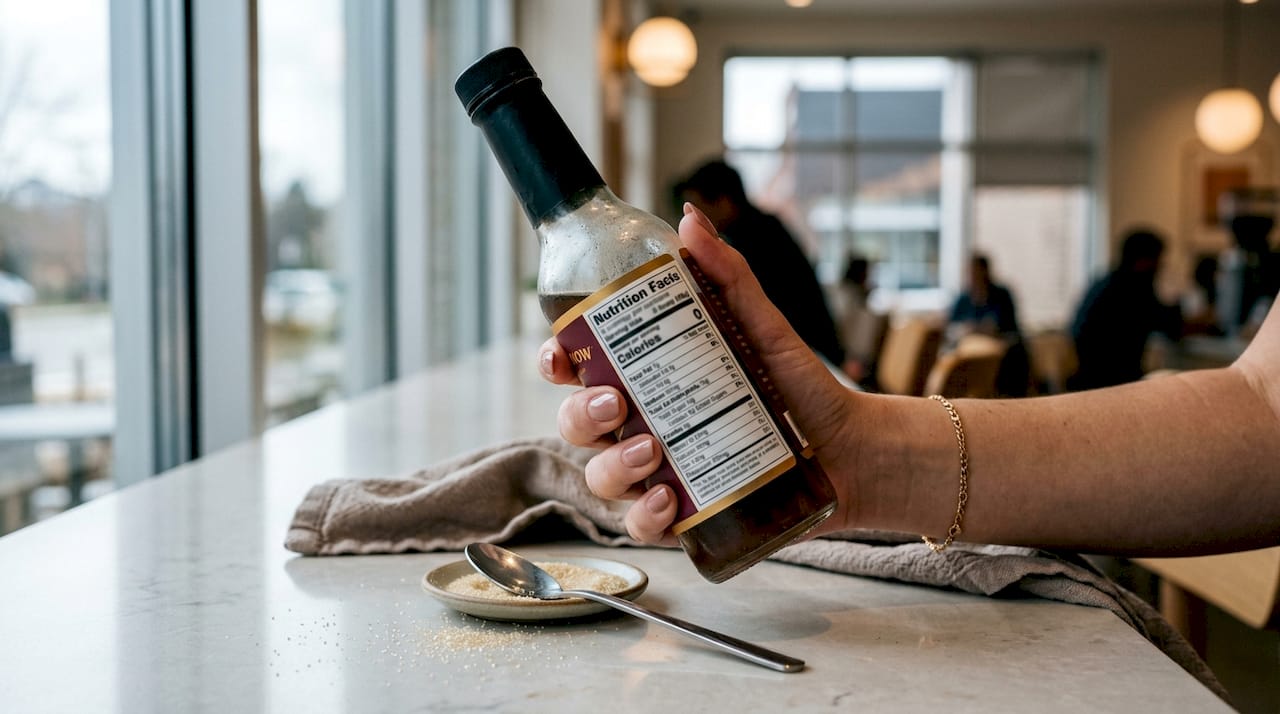
Total sugars and added sugars appear together, with added sugars listed as a sub-line. The distinction matters. Total sugars include both naturally occurring sugars and those added during processing. Added sugars represent empty calories with no essential nutrients, which is why the FDA requires them to be called out separately.
Percent Daily Value (%DV) puts the added sugar number in context. The FDA bases %DV on a 50g daily added sugar limit for a 2,000-calorie diet. The American Heart Association sets stricter limits: no more than 25g per day for women and 36g for men. A single serving of some conventional syrups can consume a significant portion of that budget in one pour.
Here is what to check on every syrup label before buying:
- Serving size: Note the exact measurement and compare it to how much you actually use.
- Total sugars: The full sugar picture, natural and added combined.
- Added sugars and %DV: The number that tells you how much of your daily limit one serving uses.
- Servings per container: Multiply this by the per-serving numbers to understand the full bottle.
- Ingredients list: The first ingredient listed is present in the greatest amount by weight.
How do you interpret sugar information on syrup labels?
The single most useful line on a syrup label is “Includes Xg Added Sugars.” That number tells you exactly how much sugar was put in during processing, separate from anything naturally present in the base ingredient.
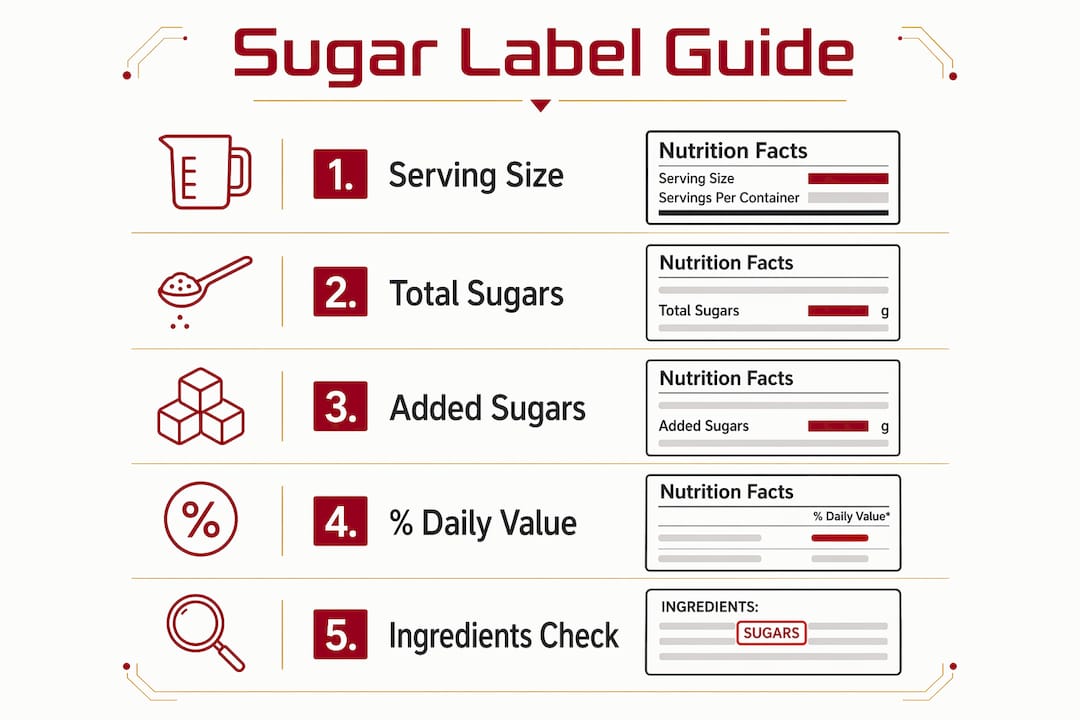
Labels with 5% DV or less in added sugars are considered low. Labels showing 20% DV or more are considered high. Most conventional pancake syrups land well above that 20% threshold per serving, which means one breakfast can push a child close to their daily sugar ceiling before lunch.
A common misconception is that “natural” syrups are automatically a better choice. Natural sugars in syrups still cause rapid blood sugar spikes similar to added sugars, because they lack the fiber found in whole fruit to slow absorption. A syrup labeled “all natural” can carry the same glycemic impact as a processed one.
Pro Tip: Ignore the front of the package entirely when evaluating sugar content. Words like “natural,” “pure,” or “wholesome” are marketing language. The Nutrition Facts panel is the only regulated, accurate source for sugar information on a syrup label.
The added sugars line also helps you cut through label noise on products marketed as healthier options. A syrup with a clean, minimal front label can still carry a high %DV for added sugars. Front-of-package claims can be misleading; the Nutrition Facts panel is where the real story lives.
Here is a quick framework for reading sugar information on any syrup:
- Find the “Includes Xg Added Sugars” sub-line under Total Sugars.
- Check the %DV next to it. Under 5% is low; over 20% is high.
- Compare that %DV to the AHA daily limits: 25g for women, 36g for men.
- Remember that children have lower daily limits than adults.
What to check beyond nutrition facts: the ingredients list
The ingredients list is the second document on every syrup label, and it rewards a closer look. Ingredients appear in descending order by weight, so whatever is listed first makes up the largest share of the product. If “corn syrup” or “cane sugar” appears first, sugar is the dominant ingredient.
The more interesting pattern is when multiple sugar names appear scattered through the list: cane sugar, high-fructose corn syrup, fruit juice concentrate, dextrose. Each one individually looks like a minor ingredient. Cumulatively, they can represent the majority of the product by weight. This is a legal and common practice, not a labeling error.
Pro Tip: Count the number of sugar aliases in the ingredients list. If you find three or more, add their positions together mentally. A product with sugar in positions two, four, and six likely has more total sugar than one with sugar listed once in position three.
One labeling nuance deserves special attention. FDA rounding rules allow any product with less than 0.5g of added sugar per serving to label that amount as 0g. A syrup that reads “0g added sugar” can still contain a small but real amount of sugar. For most people this is negligible, but it is worth knowing when you see a zero and wonder how it is possible.
The table below shows common sugar aliases to watch for in syrup ingredient lists:
| Sugar alias | Also known as |
|---|---|
| High-fructose corn syrup | HFCS, corn syrup solids |
| Cane sugar | Evaporated cane juice, raw sugar |
| Fruit juice concentrate | Apple juice concentrate, grape juice |
| Dextrose | Glucose, D-glucose |
| Maltose | Malt sugar |
Single-ingredient syrups like pure honey or pure maple syrup do not count their natural sugars as added sugars under FDA rules. Their sugars are intrinsic to the ingredient. Processed syrups with sweeteners added during manufacturing must declare those separately. This distinction is why two syrups with the same total sugar count can look very different on the added sugars line.
How does serving size affect your actual sugar intake?
Serving size is the quiet variable that changes everything else on the label. Nutrition data applies per serving; consuming two servings doubles both the calories and the sugar. Most people pour more than two tablespoons of syrup on a stack of pancakes without measuring, which means the label numbers can underrepresent actual intake by a factor of two or more.
Checking “servings per container” helps you understand the full picture. A bottle that contains 16 servings and is used up in four breakfasts means four servings per meal, not one. That math changes the sugar story significantly.
A few practical habits make serving size work in your favor:
- Use a measuring spoon the first few times you pour a new syrup. You will quickly learn what one or two tablespoons looks like in your specific bottle and on your specific plates.
- Check servings per container before buying. A smaller bottle with the same serving size as a larger one is not necessarily a better deal if you use more per sitting.
- Compare syrups at the same serving size. If one label uses a one-tablespoon serving and another uses two tablespoons, multiply the one-tablespoon numbers by two before comparing sugar content.
- Teach children to recognize a serving. A small visual cue, like a quarter-sized drizzle, helps build awareness without turning breakfast into a math lesson.
The AHA daily sugar limits of 25g for women and 36g for men are easy to exceed at breakfast alone if serving sizes go unchecked. A syrup with 12g of added sugar per serving becomes 24g at two servings, which is nearly a full day’s worth for many adults.
Key Takeaways
Reading syrup nutrition labels gives you the clearest, most reliable picture of sugar content, and the added sugars line is the single most important number to check.
| Point | Details |
|---|---|
| Added sugars line is the priority | Look for “Includes Xg Added Sugars” and its %DV before any other number. |
| 5% DV is low, 20% DV is high | Use this FDA benchmark to quickly classify any syrup as low or high in added sugar. |
| Ingredients list reveals hidden sugars | Multiple sugar aliases listed separately can add up to a high total sugar load. |
| Serving size changes everything | Consuming more than the labeled serving multiplies sugar and calorie intake proportionally. |
| Single-ingredient syrups label differently | Natural sugars in pure syrups are not counted as added sugars under FDA rules. |
Why I stopped dreading the label and started trusting it
By Celeste
For a long time, reading a nutrition label felt like homework I did not want to do before breakfast. The numbers seemed designed to make food feel complicated, and the last thing I wanted on a Sunday morning was to second-guess the syrup while the waffles went cold.
What changed for me was realizing the label is not a verdict. It is just information. Once I understood that the added sugars line and the %DV were the only two numbers I actually needed to check for syrup, the whole panel stopped feeling overwhelming. Thirty seconds of reading, and I knew what I was working with.
The bigger shift was understanding that label literacy is not about restriction. It is about confidence. When I know a syrup has 0g of added sugar and a glycemic index of 1, I do not pour it with guilt. I pour it with intention. That changes the whole mood of the table. The syrup becomes part of the pleasure, not a compromise.
I also stopped trusting front-of-package language entirely. “Pure,” “natural,” and “wholesome” are words that cost nothing to print. The Nutrition Facts panel, on the other hand, is regulated. That is where I go now, every time, and it takes less time than reading the front label anyway.
If you are a parent trying to make good choices without turning every meal into a nutrition audit, start with just two numbers: added sugars and %DV. Everything else is secondary. The table will still be warm, the pancakes will still be golden, and you will know exactly what you chose to put on them.
— Celeste
A syrup that makes label reading easy
When a syrup has one ingredient, the label conversation gets very short. Yakonow yacon syrup is made from a single ingredient: yacon root, hand-harvested in Peru. Its glycemic index is 1, compared to 54 for maple syrup, and it contains zero added sugar. The Nutrition Facts panel reflects that clearly, with no hidden aliases in the ingredients list and no added sugars line to worry about.
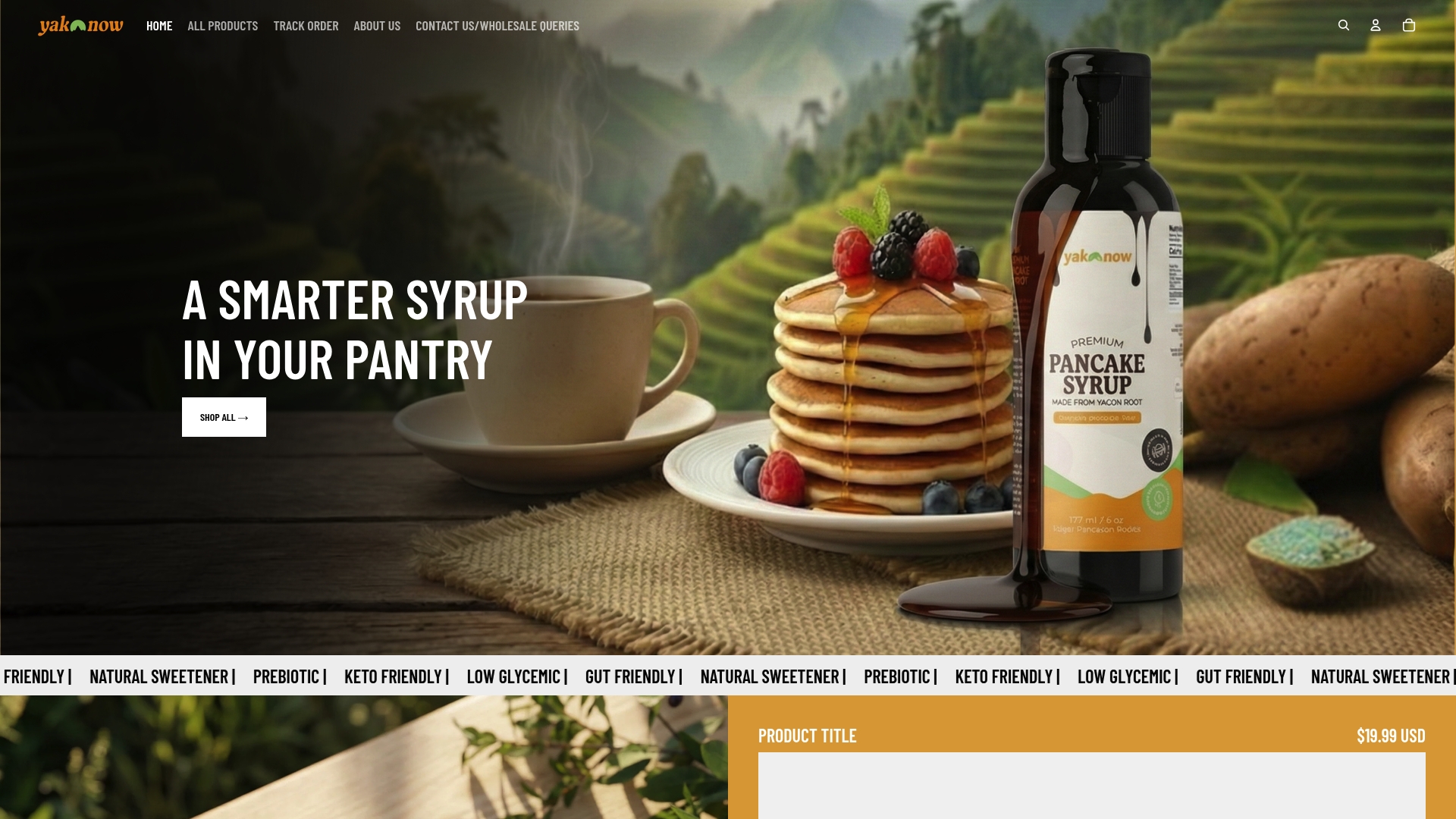
Yakonow also contains up to 50g of prebiotic FOS fiber per 100g, which is the compound that gives yacon root its naturally sweet taste without the blood sugar spike. For families who want to drizzle something beautiful over pancakes, oatmeal, or yogurt on a slow morning, it is a syrup that holds up to exactly the kind of label scrutiny this guide describes. You can find Yakonow in a single 6oz bottle or in a family pack of four for mornings that come around every week.
FAQ
What does %DV mean on a syrup nutrition label?
%DV stands for Percent Daily Value and shows how much of a nutrient one serving contributes to a standard 2,000-calorie daily diet. For added sugars, 5% DV or less is considered low and 20% or more is considered high.
What is the difference between total sugars and added sugars?
Total sugars include both naturally occurring sugars and those added during processing. Added sugars are only the ones introduced during manufacturing and represent empty calories with no nutritional benefit.
Can a syrup label say “0g added sugar” and still contain sugar?
Yes. FDA rounding rules allow products with less than 0.5g of added sugar per serving to round down to 0g on the label. A “0g added sugar” claim does not guarantee the product is completely sugar-free.
Why do some syrups list many different sugar names in the ingredients?
Multiple sugar aliases like cane sugar, corn syrup, and fruit juice concentrate may each appear lower on the ingredients list individually, but together they can represent a high total sugar content. Counting the number of sugar names in the list is a reliable way to spot this pattern.
How do I compare two syrups fairly using the label?
Always compare syrups at the same serving size. Check the added sugars %DV on both labels, and look at the ingredients list for the number of sugar aliases. A low-sugar syrup choice will show 5% DV or less for added sugars and a short, recognizable ingredients list.