

What Does Single Ingredient Mean in Food?
Single-ingredient food is defined as any food product whose ingredient list contains only one item — the food itself — with no additives, preservatives, or processing agents. An apple, a raw almond, a chicken breast, and an egg each qualify. Understanding what does single ingredient mean in food matters because the ingredient list reveals what the nutrition label cannot: exactly what you are putting into your body and your family’s meals.
What does “single ingredient” mean on food labels?
Single-ingredient food means a food whose ingredient list contains only one item, the food itself, without any additives or preservatives. That definition sounds simple, but food labeling rules add real complexity.
Packaged foods sold in the US must carry an ingredient list whenever more than one ingredient is present. The FDA requires ingredients to appear in descending order by weight. A jar of peanut butter listing “peanuts, salt, sugar” is not single ingredient. A jar listing only “peanuts” is.

Some foods are legally exempt from ingredient list requirements. Fresh fruits, vegetables, water, and vinegar are common examples. That exemption does not make them less pure. It simply means regulators consider their composition self-evident.
The distinction between the ingredient list and the nutrition facts label matters here. The nutrition facts panel tells you calories, fat, and sodium. The ingredient list tells you what is actually in the product. The ingredient list provides clarity beyond nutrition facts, and that clarity is what health-focused shoppers need most.
Compound ingredients complicate things further. Small added elements like water or salt count as additional ingredients and remove a product from single-ingredient status. A chicken breast sold with a saline solution injected for moisture is no longer single ingredient, even if the label says “chicken.”
- Look for products where the ingredient list has exactly one entry.
- Avoid products where the single listed ingredient is itself a compound (e.g., “seasoned almonds”).
- Check for phrases like “contains: salt, citric acid” even when the front label implies purity.
- Fresh, unpackaged produce at the grocery store is almost always single ingredient by nature.
Pro Tip: Flip every package over before buying. If the ingredient list has more than one line, the product is not single ingredient, regardless of what the front label claims.
How do single-ingredient foods compare to minimally processed and ultra-processed foods?
The NOVA food classification system divides foods into four groups: unprocessed, minimally processed, processed culinary ingredients, and ultra-processed. Single-ingredient foods overlap most with the first two groups, but the categories are not identical.
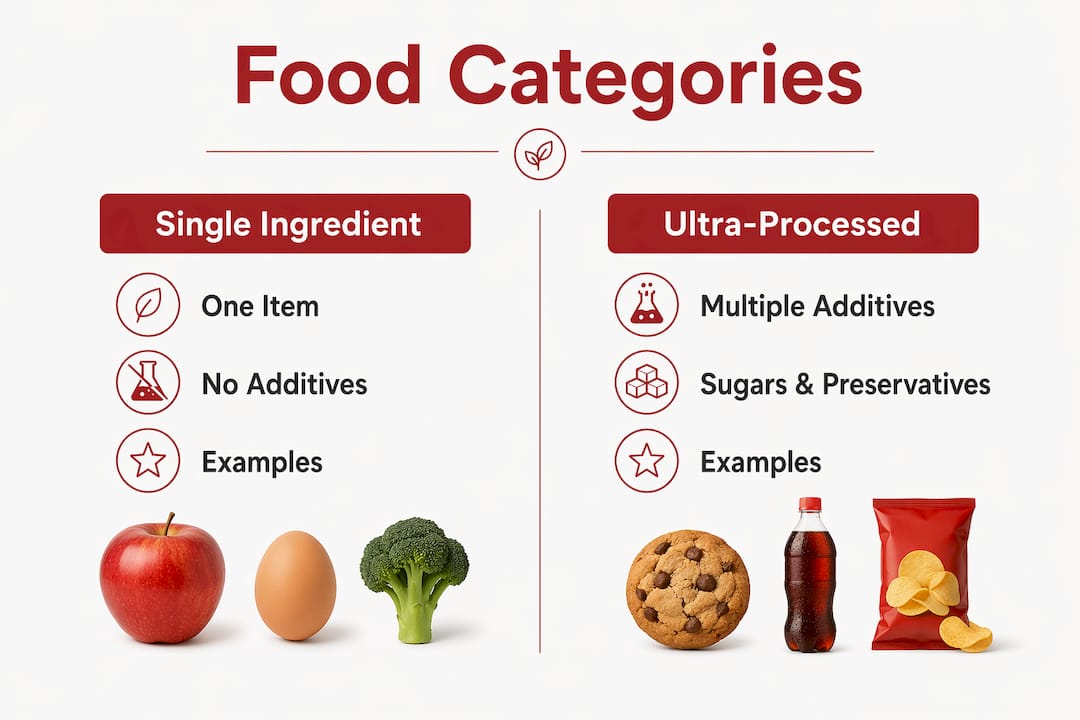
Minimally processed foods have undergone physical changes like washing, freezing, or cutting, but contain no additives. Frozen spinach with no added salt is minimally processed. A fresh spinach leaf is single ingredient. The difference is subtle but real.
Ultra-processed foods sit at the opposite end. They contain added sugars, preservatives, artificial flavors, and industrial formulations. A flavored yogurt with fruit syrup, stabilizers, and modified starch is ultra-processed, even though plain yogurt made from only milk cultures is single ingredient.
The overlap creates confusion. Single-ingredient foods tend to be closer to whole or minimally processed foods and typically carry lower added sugars and fewer additives. But a single-ingredient food can still be processed. Refined white sugar, for example, lists only “sugar” as its ingredient. It is technically single ingredient but highly processed.
| Category | Definition | Examples |
|---|---|---|
| Single ingredient | One item, no additives | Raw almonds, fresh salmon, whole egg |
| Minimally processed | Physical changes, no additives | Frozen peas, pasteurized milk, rolled oats |
| Processed culinary ingredient | Derived from whole foods, used in cooking | Olive oil, butter, table salt |
| Ultra-processed | Industrial formulations, multiple additives | Flavored chips, packaged cookies, diet sodas |
Pro Tip: When comparing two products, check the NOVA category alongside the ingredient list. A food can pass the single-ingredient test and still be nutritionally poor if the one ingredient is heavily refined.
Examples of single-ingredient foods and how to identify them
Whole foods like fresh fruits and vegetables are the clearest examples of single-ingredient foods. The category is broader than most people realize, though, and some products that seem simple are not.
Fresh and whole foods that are genuinely single ingredient:
- Fruits: apples, bananas, blueberries, mangoes, oranges
- Vegetables: broccoli, carrots, kale, sweet potatoes, zucchini
- Proteins: raw chicken breast, wild salmon, whole eggs, plain tofu
- Nuts and seeds: raw almonds, walnuts, chia seeds, sunflower seeds
- Grains: plain rolled oats, brown rice, quinoa, whole wheat berries
- Dairy: plain whole milk (one ingredient: milk)
Products that look single ingredient but often are not:
- Flavored nut butters (added oils, sugar, or salt)
- Packaged deli meats (often contain sodium nitrate, water, and flavorings)
- Canned beans (frequently include salt and calcium chloride)
- Bottled fruit juices (may contain citric acid or added vitamins)
- Syrups labeled “natural” (many contain corn syrup, caramel color, or natural flavors)
Combining single-ingredient foods transforms them into multi-ingredient meals. The term applies to standalone components or packaged foods at the ingredient list level, not to the finished dish on your plate. A bowl of oatmeal topped with blueberries and almonds uses three single-ingredient foods, but the bowl itself is a multi-ingredient meal.
The most reliable shopping habit is reading the ingredient list on every packaged product, not just the front label. Words like “pure,” “natural,” or “simple” on the front of a package carry no legal definition in the US and do not guarantee single-ingredient status.
What are the nutritional benefits of single-ingredient foods?
Single-ingredient foods reduce ambiguity in food choice by revealing exactly what you consume, avoiding hidden additives, sugars, and chemicals. That transparency has real nutritional consequences.
- Fewer additives. Single-ingredient foods contain no artificial preservatives, colorants, or flavor enhancers by definition. Reducing additive exposure matters for people managing food sensitivities or chronic conditions.
- Higher nutrient density. Whole foods like eggs, salmon, and leafy greens deliver vitamins, minerals, and protein without the caloric padding that comes from fillers and added sugars.
- Better digestion. Foods without emulsifiers, gums, or synthetic fibers are generally gentler on the gut. Plain oats, for example, provide natural beta-glucan fiber without the additives found in flavored oat packets.
- Improved nutrition literacy. Replacing a few processed snacks with single-ingredient options can meaningfully improve diet quality and awareness. Knowing what is in your food builds the habit of reading labels across all purchases.
- Support for weight management. Whole, single-ingredient foods tend to be more satiating per calorie than ultra-processed alternatives, partly because they retain their natural fiber and protein structures.
Not all single-ingredient foods automatically confer health benefits. Nutritional content depends on the specific food and the overall diet. Refined white sugar is single ingredient. Lard is single ingredient. Coconut oil is single ingredient. Each has a different nutritional profile, and none should be consumed without context.
How to use single-ingredient foods in everyday cooking
Cooking with single-ingredient foods simplifies meal preparation and sharpens ingredient awareness. The goal is not to eat every food in isolation. The goal is to build meals from components you can name and trust.
A practical approach starts at the grocery store. Fill the cart with single-ingredient staples first: eggs, fresh vegetables, a protein, whole grains, and a natural sweetener. Then add prepared items only where they genuinely save time without compromising quality.
- Batch cook grains. Brown rice, quinoa, and oats are all single ingredient. Cook a large portion at the start of the week and use them as a base for multiple meals.
- Use whole proteins. Raw chicken thighs, salmon fillets, and eggs are single ingredient. Season them yourself with salt, herbs, and spices rather than buying pre-marinated versions.
- Sweeten with intention. When a recipe calls for a sweetener, choose one with a clean ingredient list. Yacon syrup, for example, is a single-ingredient sweetener derived from the yacon root with no added sugars or colorants.
- Snack on whole foods. A handful of raw almonds or a piece of fresh fruit replaces a packaged snack bar with a dozen ingredients.
Pro Tip: Shop the perimeter of the grocery store first. The outer aisles hold fresh produce, proteins, and dairy. The center aisles hold most of the ultra-processed products. A cart built from the perimeter is naturally rich in single-ingredient foods.
Key takeaways
Single-ingredient food is defined by one item on the ingredient list, no additives, and no processing agents. That standard is the most reliable filter for cleaner, more transparent eating.
| Point | Details |
|---|---|
| Single ingredient definition | One ingredient, no additives or preservatives, verified on the ingredient list. |
| Label reading is non-negotiable | Front-of-pack claims like “natural” carry no legal definition in the US. |
| Not all single-ingredient foods are healthy | Refined sugar and lard qualify; nutritional value depends on the specific food. |
| Overlap with minimally processed | Single-ingredient foods align closely with NOVA Group 1 but are not identical. |
| Small additions remove the status | Added water, salt, or citric acid in a packaged product ends single-ingredient classification. |
Why I think most people are reading labels backward
Celeste’s perspective
Most people start with the nutrition facts panel. They check calories, fat grams, and sodium, then put the product in the cart. The ingredient list is an afterthought, if it gets read at all. That habit is backward.
The ingredient list is the more honest document. It tells you what the manufacturer actually put in the product, in order of quantity. The nutrition facts panel tells you the result of those choices, but not the choices themselves. A granola bar can show reasonable macros and still contain 14 ingredients, including three types of sugar and two emulsifiers.
What I have found, after years of paying attention to this, is that the shift to single-ingredient foods does not require a complete diet overhaul. It starts with one swap. Replace a packaged snack with a handful of raw walnuts. Swap a flavored yogurt for plain whole-milk yogurt. Use a clean, single-ingredient sweetener instead of a syrup with a paragraph-long label.
The perfectionism trap is real. People hear “single ingredient” and assume it means eating plain chicken and raw vegetables forever. That is not the point. The point is building a foundation of foods you can actually identify, then cooking with them in ways that bring people together at the table. That combination of clarity and pleasure is where the real benefit lives.
— Celeste
A single-ingredient sweetener worth knowing about
Yakonow is a single-ingredient yacon syrup, hand-harvested from yacon root in Peru and bottled in an FDA-compliant facility in Texas. The ingredient list has exactly one entry: yacon syrup. No added sugars, no colorants, no artificial sweeteners.

Yakonow carries a glycemic index of just 1, compared to 54 for maple syrup, and delivers up to 50g of prebiotic FOS fiber per 100g. That profile makes it a genuinely different option for families who want a clean sweetener for pancakes, waffles, oatmeal, and yogurt. If you are building a pantry around single-ingredient staples, Yakonow belongs on that list. A family-sized pack keeps the breakfast table stocked without compromise.
FAQ
What is the single ingredient definition in food?
A single-ingredient food contains exactly one item on its ingredient list, the food itself, with no additives, preservatives, or processing agents. Examples include raw almonds, fresh apples, whole eggs, and plain rolled oats.
Are fresh fruits and vegetables always single ingredient?
Yes. Fresh, unpackaged fruits and vegetables are single ingredient by nature and are often exempt from ingredient list labeling requirements in the US. Packaged versions may include added salt or citric acid, which removes that status.
How do I identify single-ingredient foods while shopping?
Check the ingredient list on every packaged product. If it contains more than one entry, the product is not single ingredient. Front-of-pack terms like “pure” or “natural” carry no legal definition and are not reliable guides.
Is single ingredient the same as healthy?
Not automatically. Refined white sugar and lard are both single-ingredient foods. The term describes ingredient simplicity, not nutritional quality. Each food’s nutrient profile must be evaluated on its own merits.
Can I cook with single-ingredient foods and still make complex meals?
Yes. Cooking with single-ingredient foods creates multi-ingredient dishes, but each component remains traceable and clean. The term applies to individual ingredients, not to the finished meal.