

Can Yacon Syrup Really Ease Constipation?
Yes, yacon syrup can help relieve mild constipation for many people when you use it consistently, thanks to the fructooligosaccharides (FOS) it carries in generous amounts. A meta-analysis of 17 randomized controlled trials covering 713 participants found FOS meaningfully increases bowel movement frequency and softens stool. A separate trial published in the Journal of Medicinal Food tracked a yacon-based product over 30 days and saw real gains in evacuation frequency. Yakonow fits into that picture as a food-first way to work FOS into an ordinary breakfast.
The doses that worked in these studies are modest. Most trials used somewhere between 6 and 14 grams of FOS per day, and 20 grams of yacon syrup delivers a typical amount of FOS used in studies.
- Studies show measurable benefits at doses most families can fit into a morning routine.
- Results build over days to weeks, not overnight.
- Starting low and increasing slowly limits the bloating some people notice at first.
Key Takeaways
Yacon syrup relieves mild constipation for many people because its concentrated FOS ferments quickly in the colon, feeding beneficial bacteria and softening stool within days to weeks of consistent use.
| Point | Details |
|---|---|
| FOS drives the effect | sc-FOS ferment fast, raising Bifidobacterium and short-chain fatty acids that soften stool. |
| Trial doses are modest | Studies used roughly 6 to 14 grams of FOS daily, often from 20 grams of yacon syrup. |
| Results take time | Expect changes over days to weeks, not from a single serving. |
| Mild bloating is common | Gas and bloating typically fade as tolerance builds; go slow with dosing. |
| Choose single-ingredient syrup | Yakonow offers FOS-rich, zero-added-sugar yacon syrup bottled in the US for family mornings. |
This article is general information, not a substitute for advice from a qualified doctor. Consult a qualified healthcare professional about your own circumstances before acting on anything here.
Table of Contents
- How Does Yacon Syrup Help With Constipation?
- What Does the Clinical Research Actually Show?
- How Should You Actually Try Yacon Syrup for Constipation?
- What Side Effects Should You Expect From Yacon Syrup?
- What Makes a Good Yacon Syrup Worth Buying?
- Where Can You Find a Yacon Syrup Worth Trying?
- Sources
How Does Yacon Syrup Help With Constipation?
The mechanism comes down to fermentation, not fiber bulk. Short-chain fructooligosaccharides, the specific type concentrated in yacon syrup, are small enough that gut bacteria break them down quickly. That speed matters: longer-chain fibers can take much longer to ferment, while sc-FOS often produce noticeable changes in stool within a shorter window.
Here’s the sequence. Bacteria in the colon, especially Bifidobacterium, feast on the FOS and multiply. As they ferment it, they produce short-chain fatty acids like acetate, propionate, and butyrate. Those compounds lower colonic pH and pull water into the stool, which increases moisture and softens texture. The combined effect tends to speed up transit.
One 30-day trial using a yacon-based product documented this directly: participants showed higher Bifidobacterium counts and lower counts of less favorable bacteria alongside improved stool consistency. That’s the microbiome shift researchers point to when explaining why a spoonful of syrup can move the needle on something as physical as bowel regularity.
- sc-FOS ferment faster than many long-chain fibers, which can mean quicker results.
- Fermentation raises beneficial bacteria while lowering colonic pH.
- Softer, more hydrated stool often follows within the same window.
What Does the Clinical Research Actually Show?
The short version: multiple RCTs and at least two meta-analyses report that FOS, including the FOS naturally concentrated in yacon syrup, increases bowel movement frequency and softens stool consistency, though the effect size and study quality vary.
The clearest data point comes from that pooled analysis of 17 randomized trials and 713 participants, which found a statistically significant increase in bowel movements (95% CI: 0.80 to 1.50) and a meaningful softening of stool consistency, with mild bloating showing up as the most common side effect. A separate 12-trial meta-analysis focused on yacon root reported reduced fecal pH and notably softer stools, with a standardized mean difference of 0.94 for stool softening and 4.03 for ease of defecation, alongside acknowledged heterogeneity across the included studies.
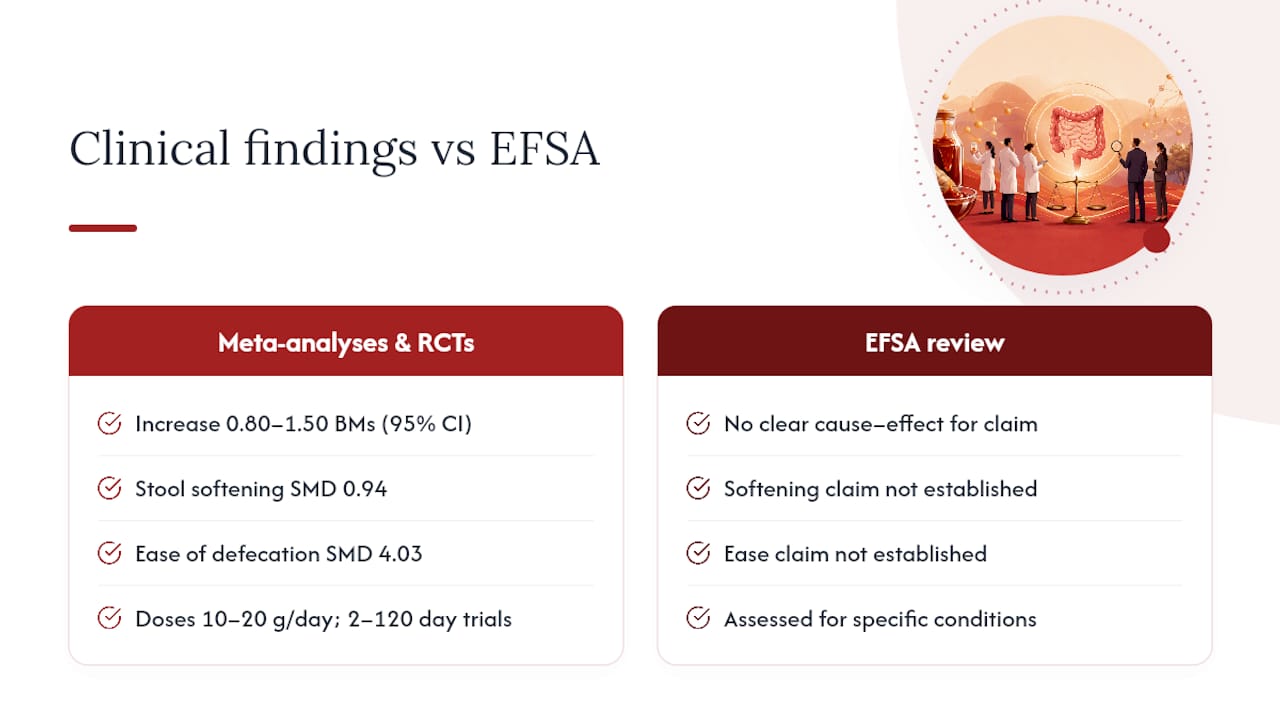
Individual trials fill in the timeline. The Journal of Medicinal Food study ran for 30 days at 10 grams of FOS daily and produced improved evacuation frequency and lower constipation scores. A separate review of yacon syrup specifically found that 20 grams a day, an amount consistent with trial dosing, reduced colonic transit time over two weeks. Longer trials, including one running 120 days in obese women at 0.14 grams of FOS per kilogram of body weight daily, showed sustained improvements in bowel frequency.
Not every regulatory body agrees the case is closed. The European Food Safety Authority reviewed scFOS from sucrose and concluded the evidence didn’t establish a clear cause-and-effect relationship for the specific claim and conditions of use it was assessing. That’s a useful reminder that “the research is promising” and “the research is proven” are two different sentences, and the honest read sits closer to the first.
How Should You Actually Try Yacon Syrup for Constipation?
Start small, then build up over one to two weeks. Most of the benefit shows up gradually rather than after a single dose, so give it time before deciding whether it’s working.
A simple titration plan looks like this:
- Days 1 to 3: one teaspoon (about 5 grams of syrup) stirred into yogurt or oatmeal.
- Days 4 to 7: one tablespoon (about 15 to 20 grams), which lands near the 6.4 grams of FOS used in several published trials.
- Week 2 onward: hold steady at that tablespoon amount, or adjust slightly based on comfort and results.
Clinical trials often dissolved yacon-based products into orange juice or other daily beverages to make dosing painless, and that’s a trick worth borrowing at home. Drizzle it over pancakes or waffles, swirl it into a morning smoothie, or stir it into plain yogurt, the same way you’d work in honey or maple syrup. It disappears into the flavor of whatever it’s mixed with.
Pro Tip: Pair your daily syrup with a glass of water and one extra piece of fruit. Fiber needs fluid to do its job, and skipping that step is the most common reason people feel more bloated instead of more comfortable.
Because everyone’s gut bacteria respond a little differently, tolerance and results can vary from person to person, so treat the numbers above as a starting map, not a fixed prescription.
What Side Effects Should You Expect From Yacon Syrup?
The most common effects are mild and predictable: gas and bloating, especially in the first few days. These symptoms tend to fade as your gut bacteria adjust to fermenting more FOS.
Dose matters here. The 17-trial meta-analysis flagged mild bloating as the most frequent adverse event across studies, and a separate systematic review found that higher yacon syrup intakes were tied to more frequent flatulence, and in some cases diarrhea or noticeable abdominal distension. That’s the practical argument for the slow titration described above rather than diving straight into a full tablespoon.
- Mild gas or bloating in the first several days is common and usually temporary.
- Higher intakes raise the odds of flatulence, loose stools, or distension.
- People with FODMAP sensitivity or certain IBS subtypes may react more strongly and should talk to a clinician first.
- Pregnant readers or anyone on medication that affects gut motility should check in with a doctor before adding a new prebiotic.
Most people find their tolerance improves within one to two weeks as gut bacteria adapt to the new fuel source.
What Makes a Good Yacon Syrup Worth Buying?
Look for a single-ingredient syrup with a clearly stated FOS content, no added sugar, and a transparent sourcing story. Those three things determine both how well it works and how well your family tolerates it.
FOS concentration is the number that actually matters for results, since that’s the compound doing the fermenting. Check the label for FOS grams per 100 grams or per serving, confirm the ingredient list has nothing added beyond yacon root, and look for a stated country of origin. Syrups diluted with cane sugar or corn syrup dilute the prebiotic effect too.
- Single ingredient: yacon root, nothing else.
- FOS content listed per serving, not just a vague “prebiotic fiber” claim.
- Bottled in a facility that meets FDA standards for food safety.
- Sourced from Peru, where yacon has been part of Andean food culture for generations.
Yakonow fits that checklist: single-ingredient syrup with up to 50 grams of FOS per 100 grams, a glycemic index of just 1, and no added sugar or artificial sweeteners.
When Should You See a Doctor Instead?
Stop the trial and check in with a clinician if you notice severe abdominal pain, blood in your stool, unexplained weight loss, or constipation that persists beyond a few weeks despite home efforts. Those symptoms need evaluation, not another spoonful of syrup.
- Severe or worsening abdominal pain
- Blood in the stool or black, tarry stools
- Unexplained weight loss alongside bowel changes
- No improvement after several weeks of consistent use
People managing IBS or known FODMAP sensitivity should loop in a doctor before adding any new prebiotic, since fermentable fibers can occasionally intensify symptoms in those conditions.
A Morning Ritual Worth Keeping
Some mornings, the whole house slows down around a bowl of oatmeal and a small glass bottle on the table. I like knowing that the syrup my kids drizzle over their pancakes is doing quiet work in the background. The clinical research on FOS backs up what feels intuitive: a little consistency at breakfast supports gentler, more regular digestion over time. Mostly, though, it’s just a good reason to sit down together before the day gets away from everyone.

Where Can You Find a Yacon Syrup Worth Trying?
Once you know what to look for, the decision gets simple. Yakonow checks every box on that list: single-ingredient yacon syrup, generous FOS content, zero added sugar, and bottled in an FDA-compliant facility in Texas from root hand-harvested in Peru.

For a household just starting out, the single 6oz bottle is the easy way to see how it fits into your mornings. Busy families who go through syrup fast tend to reach for the pack of 2 so breakfast never stalls out mid-week, and larger households often land on the pack of 4 or the pack of 12 to keep a steady supply on hand without reordering every month. Pick the size that matches how often your table gathers, and let the syrup do its quiet work while everyone just enjoys the pancakes.
Sources
- Short-chain fructooligosaccharides and gut function (PMC review)
- Yacon-Based Product in the Modulation of Intestinal Constipation
- Fructooligosaccharides for Relieving Functional Constipation: A Systematic Review and Meta-Analysis of Randomized Controlled Trials
- Yacon root is a functional food beneficial for human health: a meta-analysis of clinical trials
- Impacts of Yacon Syrup (Smallanthus sonchifolius) on Human Health: A Systematic Review of Scientific Evidence from the Last Decade - PMC