

Yacon Syrup FODMAP: What People With IBS Need to Know
Yacon syrup is untested for FODMAPs by Monash University, and most dietitians treat it as high-risk for people with IBS. The reason comes down to one ingredient: fructooligosaccharides, or FOS, a prebiotic fiber that yacon syrup carries in unusually large amounts. If your gut is sensitive, that’s worth knowing before it ends up on your pancakes.
Here’s the practical takeaway: don’t rule it out entirely, but don’t pour it freely either. Treat yacon syrup the way you’d treat any untested high-fructan food, something to test in a small amount, on a calm digestive day, with a plan for what to do if things go sideways. The sections below walk through why FOS behaves this way, what human trials have actually measured, and exactly how to run a low-risk taste test at your own table.
Key Takeaways
Yacon syrup’s high FOS content makes it a likely fructan trigger for IBS, so cautious, stepwise testing beats either full avoidance or unrestricted use.
| Point | Details |
|---|---|
| Untested, not cleared | Monash hasn’t tested yacon syrup, so treat it as high-risk rather than assumed safe. |
| FOS drives the risk | Fructooligosaccharides ferment in the colon, producing gas and bloating in sensitive guts. |
| Trial doses ran high | Studies used 20 to 40 g/day, far above a typical home drizzle, with notable dropout rates due to gastrointestinal symptoms. |
| Test in small steps | Start under 1 g, wait 48 to 72 hours, and log symptoms before increasing. |
| Skip it during flares | Active IBS, SIBO, or recent gut surgery are reasons to wait and consult a dietitian. |
| Yakonow fits a careful trial | Its single-ingredient 6 oz bottle is sized for a slow, small test rather than daily unrestricted use. |
Table of Contents
- Why Yacon Syrup Is Suspected to Be High in FODMAPs
- What Do Clinical Studies Say About Yacon Syrup and Gut Symptoms?
- How to Test Your Tolerance for Yacon Syrup Safely
- Who Should Avoid Yacon Syrup for Now?
- Low-FODMAP Sweetener Swaps for Family Breakfasts
- What Actually Matters Here, and What Gets Overstated
- Trying Yacon Syrup Thoughtfully at Your Table
- Where to Check the Evidence Yourself
- Frequently Asked Questions
- Sources
Why Yacon Syrup Is Suspected to Be High in FODMAPs
FOS belongs to the same family as inulin, a group of carbohydrates your small intestine can’t break down. They travel intact to the colon, where gut bacteria ferment them. That fermentation is exactly what makes FOS a prebiotic. It’s also exactly what makes it a FODMAP.
Composition analyses of yacon root syrup show FOS and inulin can account for a striking share of its total carbohydrate content, which means even a modest drizzle can deliver a meaningful fructan load. That’s very different from something like white sugar, which your body absorbs long before it reaches the colon.
- For a healthy gut, that fermentation feeds beneficial bacteria and supports regularity.
- For a sensitive gut, the same fermentation produces gas and stretches the intestinal wall, which reads as bloating and cramping.
- The dose matters: a teaspoon and a tablespoon are not the same conversation for someone with IBS.
Think of it as one mechanism with two outcomes. FOS feeds bacteria, bacteria ferment it, fermentation produces gas, and in a reactive gut that gas shows up as bloating within hours. FODMAP Everyday lists yacon syrup as untested but presumed high-FODMAP for exactly this reason.
What Do Clinical Studies Say About Yacon Syrup and Gut Symptoms?
Human trials back up the caution, even though they weren’t designed around IBS specifically. A systematic review pooling seven trials and 161 participants found real metabolic upside, including improved satiety and reduced fasting insulin, alongside gastrointestinal effects that scaled with dose: more frequent bowel movements and mild initial discomfort that some participants adjusted to over time.
The doses used in those trials give a useful reference point for what “too much, too fast” looks like:
| Study dose | FOS content | Reported effects |
|---|---|---|
| 20 g/day yacon syrup | High FOS content | Faster colonic transit, generally tolerated |
| 40 g/day yacon syrup | Varies by product | Mixed glycemic results, more frequent GI complaints |
| Higher per-kg FOS intake | Varies by body weight | Increased flatulence and bloating in some participants |
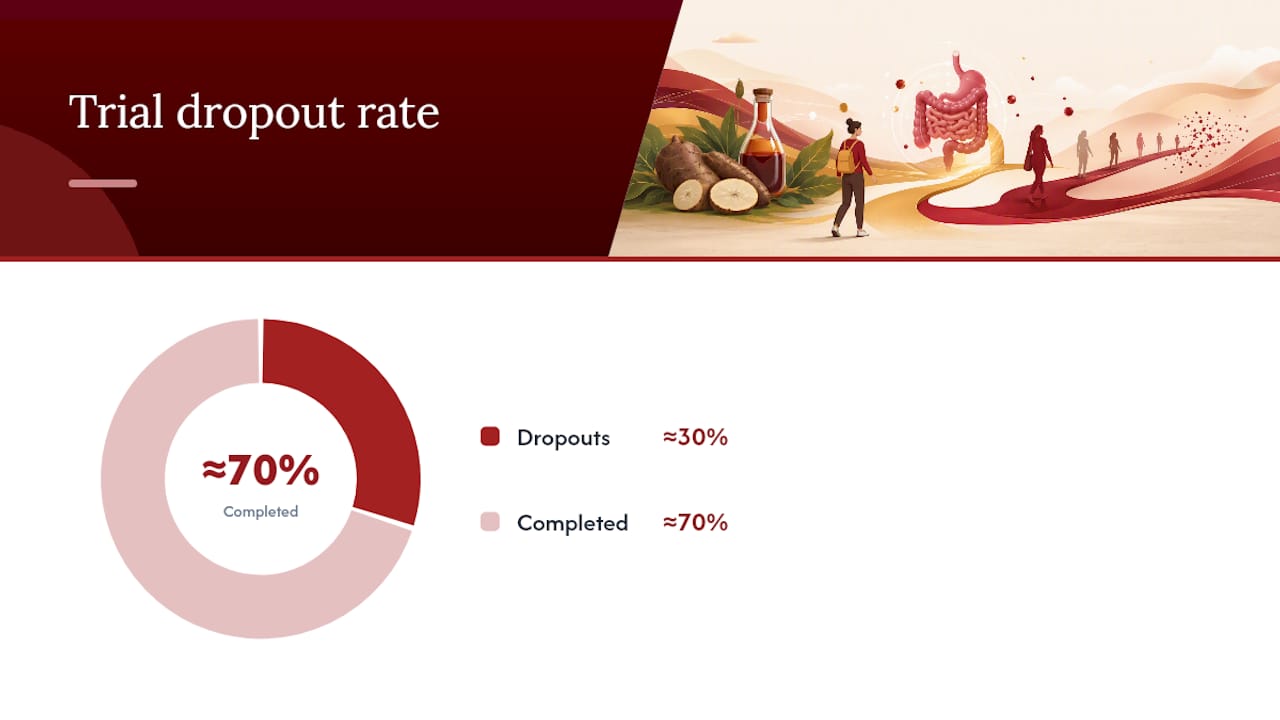
Not everyone tolerated it well. Cleveland Clinic notes that some trials saw dropout rates near 30%, almost entirely from flatulence, nausea, or diarrhea. That’s a meaningful signal: even in general trial populations, not selected for IBS, roughly one in three participants found the GI effects hard enough to quit. For someone whose gut already reacts strongly to fructans, that number should carry real weight.
Because commercial syrups vary in how they’re extracted and concentrated, the USDA FoodData Central database and published trial tables only give a baseline. Two bottles labeled “yacon syrup” can carry different FOS loads, which is one more reason to treat any new bottle as an unknown quantity the first time you try it.
How to Test Your Tolerance for Yacon Syrup Safely
Short version: start with less than a gram, wait several days, and only move forward if nothing happens.
- Pick a stable week. Only start when your gut is calm, not during a flare, a stressful week, or right after a symptom episode.
- Start at roughly ¼ teaspoon. That’s a small enough amount to stay well under the doses linked to GI complaints in trials.
- Wait 48 to 72 hours. Fructan reactions can be delayed, so judging tolerance after a few hours is misleading.
- Log what happens. Note bloating, gas, stool changes, or cramping on a simple 0 to 72 hour timeline.
- Increase only if symptom-free. Move up gradually, roughly doubling each time, never jumping straight to a full tablespoon.
- Cap your test serving conservatively. Stay well below the 20 g doses used in clinical trials until you have several clean trials behind you.
Pro Tip: Keep the log boring on purpose. A one-line note each evening, “no change,” “mild gas around hour 6,” is more useful than trying to remember details three days later.
Stop the test immediately if you notice severe cramping, diarrhea, or bloating that doesn’t ease within a day. Those are signs your gut isn’t ready for fructans at that dose, and a FODMAP-trained dietitian can help you figure out the next step rather than guessing.

Who Should Avoid Yacon Syrup for Now?
Some readers should skip the test altogether, at least for now. That includes anyone in an active IBS flare, anyone with diagnosed SIBO, anyone recovering from recent gut surgery, and anyone still in the early reintroduction phase of a low-FODMAP elimination diet. If you already know fructans trigger you, yacon syrup is very likely to do the same.
Prebiotic doesn’t mean gentle. Cleveland Clinic’s clinical review points out that for people focused on symptom management, the discomfort risk from FOS-rich foods often outweighs any prebiotic benefit, especially early on. If you fall into any of these groups, the smarter move is a conversation with a FODMAP-trained dietitian before you experiment, not after a bad reaction.
Low-FODMAP Sweetener Swaps for Family Breakfasts
Skipping yacon syrup for now doesn’t mean skipping the syrup moment at the table. A few swaps hold up well for sensitive guts:
- Pure maple syrup, kept to a small serving, is Monash-tested and low-FODMAP at typical portions.
- Table sugar carries no fructans and works fine stirred into oatmeal or yogurt.
- Monk fruit and stevia add sweetness with essentially no fermentable carbohydrate load.
A light drizzle over pancakes behaves differently than syrup mixed into a batter, since heat and blending spread the FODMAP load through the whole dish rather than keeping it on top where you control the amount. If you’re rotating between yacon syrup and maple syrup at home, keep the pours separate rather than combining them in one recipe.
Pro Tip: Keep the ritual and swap the syrup. Same warm plate, same slow Sunday, just a different bottle on the table until you know how your gut responds.

What Actually Matters Here, and What Gets Overstated
The conventional advice on yacon syrup tends to swing to extremes. Either it gets marketed as a blanket-healthy sugar substitute, or FODMAP forums treat it as something to avoid outright. Neither read holds up well against the evidence. The systematic review shows genuine metabolic promise sitting right next to a consistent, dose-linked pattern of GI symptoms. Both things are true at once, and pretending otherwise does readers a disservice.
What gets underrated is dose. Most of the fear around yacon syrup comes from studies using 20 to 40 grams a day, doses far beyond what anyone drizzles on a Saturday pancake. What gets overrated is the idea that “prebiotic” automatically means “gut-friendly for everyone.” For a stable gut, fine. For an IBS flare, that fermentation is the whole problem.
If you manage IBS, prioritize the test protocol over the marketing claims on either side. A quarter teaspoon and a three-day log will tell you more about your own body than any label ever will.
Trying Yacon Syrup Thoughtfully at Your Table
If you decide to test yacon syrup, the ingredient list matters as much as the amount. Yakonow is a single-ingredient syrup, hand-harvested from yacon root in Peru and bottled in the US, with nothing added to dilute or complicate what you’re testing. That matters when you’re trying to isolate how your gut responds. No colorants, no blended sweeteners muddying the results.

A trial run doesn’t need a commitment. The single 6 oz squeezable bottle is sized for exactly this: a quiet Sunday morning, a quarter teaspoon over yogurt or oatmeal, and a few days of paying attention before you decide if it earns a permanent spot on the table. Start slow, follow the testing steps above, and let your own gut set the pace.
Where to Check the Evidence Yourself
- Monash FODMAP app: the reference standard for tested serving sizes.
- Systematic review on yacon syrup: the source for study doses and GI outcomes.
- Cleveland Clinic’s yacon syrup summary: a clinician-reviewed overview of benefits and risks.
- Food Is Good’s ingredient note: practical, dietitian-reviewed testing guidance.
Frequently Asked Questions
Is yacon syrup FODMAP friendly? Not confirmed. Monash hasn’t tested it, and its high FOS content puts it in the same suspect category as other fructan-rich sweeteners like agave and honey in large amounts.
Can I use yacon syrup if I have IBS? Some people can tolerate a small amount, but it depends on your individual sensitivity. Test cautiously, starting under a gram, and stop if symptoms appear.
How much yacon syrup causes bloating? Clinical trials linked GI symptoms to doses of 20 to 40 grams a day. A quarter teaspoon is far below that, which is why small test servings matter.
What’s a good low-FODMAP alternative to yacon syrup? Pure maple syrup in small servings, table sugar, monk fruit, and stevia are all reasonable swaps that don’t carry the same fructan load.
Should people with SIBO avoid yacon syrup entirely? Yes, for now. FOS is a prebiotic fiber that can worsen SIBO symptoms, so it’s best to avoid it until your provider clears fermentable fibers again.
This article is general information, not a substitute for advice from a qualified doctor. Consult a qualified healthcare professional about your own circumstances before acting on anything here.
Sources
- Systematic review: effects of yacon syrup on metabolic and intestinal health
- Is yacon syrup healthy? (Cleveland Clinic)
- Sugar & sweeteners — Yacon syrup (FODMAP Everyday)
- Is yacon syrup low FODMAP? (Food Is Good)