

Yacon Syrup Waffles: A Family Breakfast Recipe Worth Slowing Down For
Use yacon syrup as a warm drizzle over waffles, or replace up to about 25% of the sugar and liquid in your batter once you make a few small adjustments. Straight drizzle is the easiest way in, especially the first time your family tries it. Its flavor lands somewhere between molasses and caramel, with none of maple syrup’s sharpness, and it carries a low glycemic index worth knowing about even though this is a breakfast story, not a health lecture.
A few quick rules before you start:
- Topping first: Drizzle it warm over hot waffles the same way you’d use any syrup. No recipe changes required.
- Batter swap: Replace roughly a quarter of the sugar or liquid sweetener called for, then dial back another liquid ingredient slightly to keep the batter from thinning out.
- Check with your doctor if you or your child manage a medical condition or take medication, before making yacon syrup a regular part of meals.
Key Takeaways
Yacon syrup works best as a warm drizzle on waffles, and can replace up to about a quarter of a batter’s sugar or liquid once you adjust for its extra moisture.
| Point | Details |
|---|---|
| Start as a topping | Drizzle warmed yacon syrup over finished waffles before attempting any batter substitution. |
| Adjust liquids when swapping | Reduce another liquid by about half a tablespoon for every tablespoon of yacon syrup added to batter. |
| Fix pale waffles | Add a pinch of brown sugar or extend cook time slightly since yacon browns less than table sugar. |
| Introduce gradually | Start with small amounts for children or sensitive diners to ease digestive adjustment. |
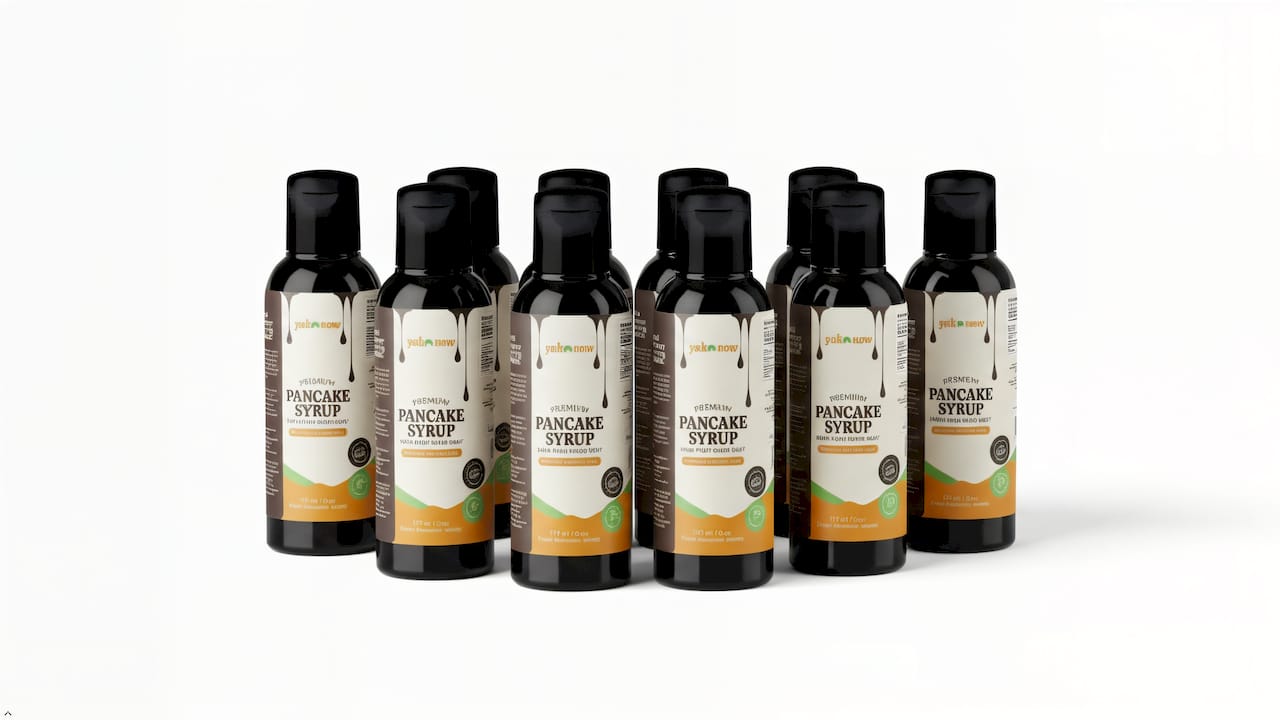
| Choose Yakonow by need | Pick the single bottle for occasional use, the pack of 2 or 4 for regular family mornings, and the pack of 12 for households that never want to run out. |
Table of Contents
- The Yacon Syrup Waffles Recipe Your Family Will Ask For Again
- Why Yacon Syrup Changes How Your Waffle Batter Behaves
- What Pairs Well With Yacon Syrup on Waffles
- Common Waffle Problems and How to Fix Them
- Where Yacon Syrup Comes From and What to Look For
- Why the “Healthy Syrup” Conversation Misses the Point
- Bring Yacon Syrup to Your Own Breakfast Table
- Sources
The Yacon Syrup Waffles Recipe Your Family Will Ask For Again
This makes four Belgian-style waffles, takes about 25 minutes start to finish, and works whether you’re feeding two sleepy teenagers or a table full of Saturday guests.
Ingredients
- 2 cups all-purpose flour
- 1 tablespoon baking powder
- ½ teaspoon salt
- 1 teaspoon ground cinnamon
- 2 large eggs, separated
- 1¾ cups whole milk
- ⅓ cup melted butter, cooled slightly
- 2 tablespoons granulated sugar (or 1½ tablespoons if using the batter variation below)
- 1 teaspoon vanilla extract
- Yakonow yacon syrup, for drizzling and (optional) for the batter
Method
- Whisk the flour, baking powder, salt, and cinnamon in a large bowl.
- In a separate bowl, beat the egg yolks with the milk, melted butter, sugar, and vanilla.
- Pour the wet mixture into the dry ingredients and stir just until combined. A few lumps are fine; overmixing is what makes waffles tough.
- In a clean bowl, whip the egg whites to soft peaks, then fold them gently into the batter. This is what gives you that light, crisp waffle instead of a dense one.
- Let the batter rest for 5 minutes while your waffle iron heats.
- Cook according to your iron’s instructions, usually 3 to 4 minutes, until deep golden and crisp at the edges.
- Serve immediately, drizzled generously with warmed yacon syrup.
Two ways to make it
Classic, drizzle-only: Follow the recipe exactly as written above. Warm the syrup slightly in a small saucepan or microwave-safe cup before serving. It pours more evenly warm, and it soaks into the waffle’s crevices the way you want.
Batter variation: Cut the granulated sugar to 1½ tablespoons and stir in 2 tablespoons of yacon syrup along with the wet ingredients. Reduce the milk by 1 tablespoon to keep the batter from turning too loose. That swap covers about a quarter of the total sweetness in the recipe, which is the upper range worth trying before you start noticing texture changes.
Storage and reheating: Cooked waffles keep well in the refrigerator for up to three days in an airtight container, or in the freezer for two months with parchment between layers. Reheat in a toaster or a 375°F oven for a few minutes to bring the crisp back. Don’t reheat in the microwave alone. It works, but you lose the crunch, and crunch is half the point of a waffle. To scale the recipe, everything doubles cleanly. Just cook in batches so the iron stays hot enough to crisp each one properly.
Why Yacon Syrup Changes How Your Waffle Batter Behaves
Yacon syrup isn’t a one-to-one swap for sugar, and the reason comes down to simple kitchen chemistry, not anything mysterious.
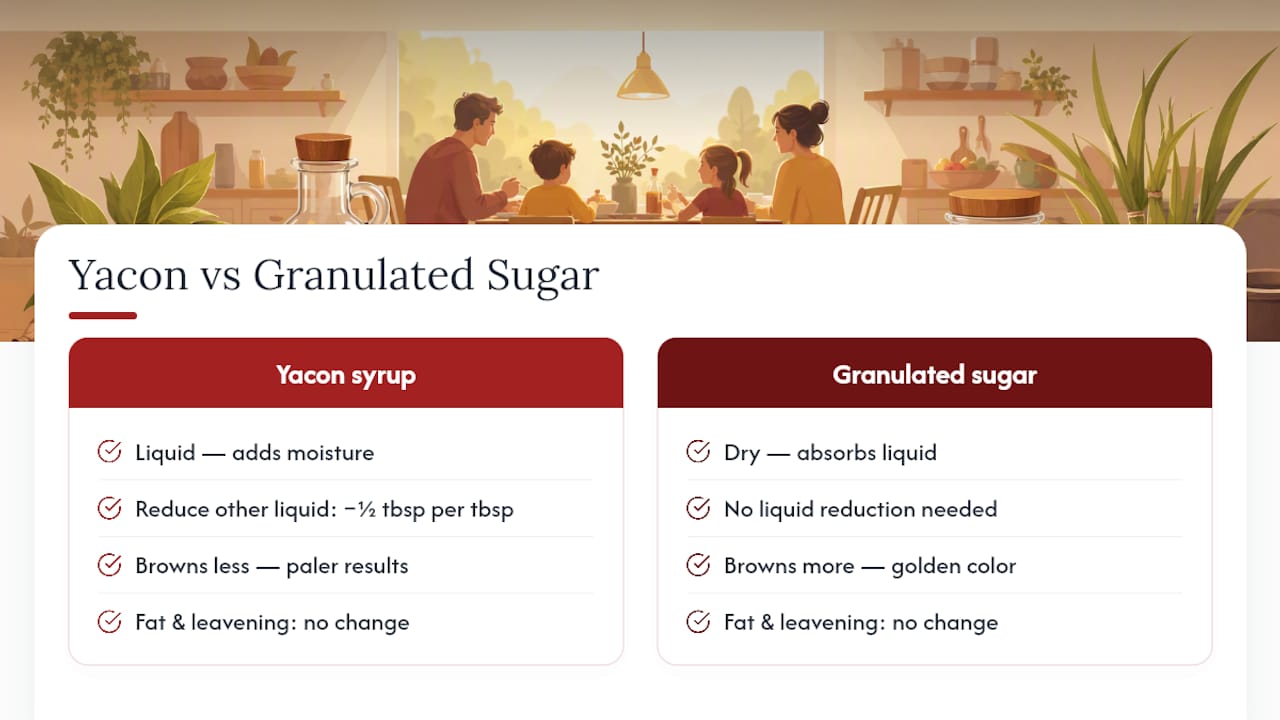
Sugar in a recipe does more than sweeten. It absorbs liquid, and it browns. Yacon syrup is already liquid, so every tablespoon you add is also a tablespoon of moisture you need to account for elsewhere. As a working rule, pull back another liquid in the recipe, usually milk, by about half a tablespoon for every tablespoon of yacon syrup you stir into the batter. Skip that step and you’ll end up with batter that spreads too thin in the iron and waffles that steam instead of crisp.
Browning is the other piece. Yacon’s natural sugars behave differently in the Maillard reaction that gives baked goods their golden color, so batter-variation waffles can come out slightly paler than a classic sugar recipe. Two easy fixes: add a scant teaspoon of brown sugar back into the dry mix, or simply let the waffles cook 30 to 60 seconds longer than usual, watching for that deep gold rather than timing it by the clock.
Fat and leavening don’t need much adjustment. The separated-egg method already does the heavy lifting for lift and crispness, so you can leave baking powder and butter quantities as written.
If you’re baking something delicate, like a thin crepe or a meringue-based recipe where sugar structure really matters, skip adding yacon syrup directly to the batter and keep it strictly as a finishing drizzle instead. For more detailed baking math across different recipes, Yakonow’s guide to baking with yacon syrup walks through substitution ratios for cakes, muffins, and pancakes too.
Pro Tip: If your batter looks slightly thin after adding yacon syrup, let it rest an extra five minutes before cooking. The flour has time to absorb the extra liquid, and you won’t need to add more flour, which can toughen the waffle.
What Pairs Well With Yacon Syrup on Waffles
Yacon’s caramel depth wants company that leans warm and a little rustic, not sharp or citrus-forward on its own.
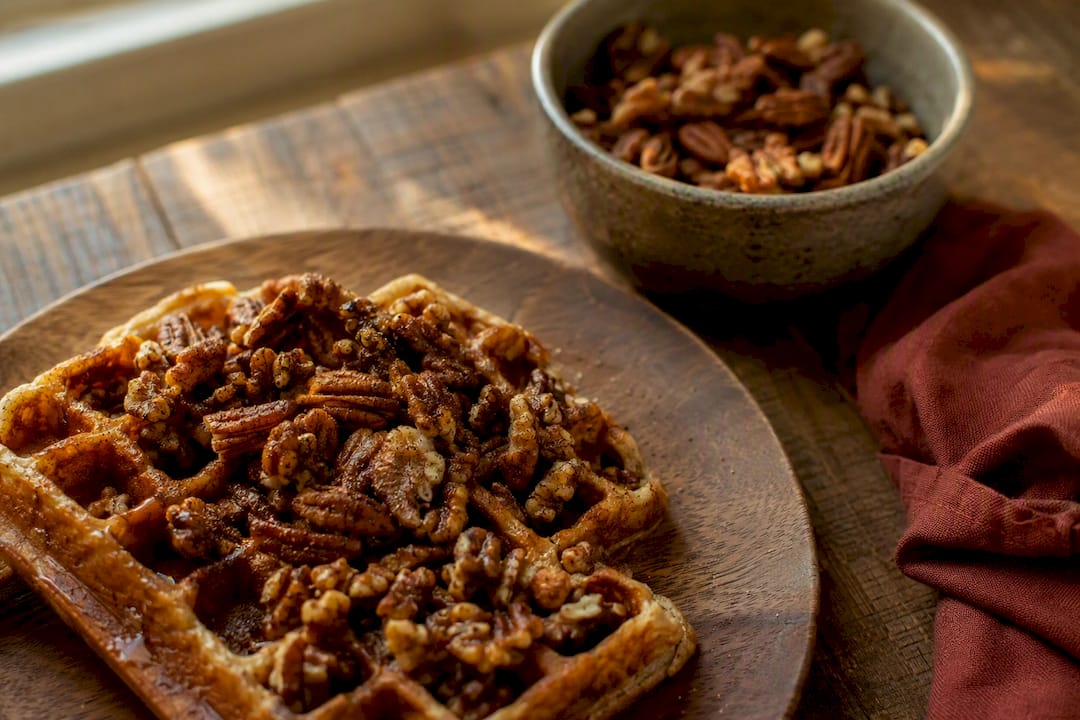
Cinnamon, nutmeg, and toasted oats echo the syrup’s roasted, almost molasses-like undertone, which is why they show up in the batter itself as well as on top. A spoonful of toasted pecans or walnuts adds crunch against the soft waffle, and it’s an easy way to dress up a Tuesday morning without any extra cooking.
For a heartier plate, Greek yogurt with fresh berries balances the sweetness with something cool and slightly tart. Ricotta with lemon zest and toasted hazelnuts turns the same waffle into something you’d happily serve to brunch guests. If your table leans savory some mornings, a few strips of crisp bacon alongside a yacon-drizzled waffle plays the same sweet-and-salty note that maple syrup usually holds down.
Coffee with a splash of oat milk or a simple black tea both sit nicely against the caramel notes rather than competing with them.
For kids, warm the syrup and let them “paint” their own waffle sections, one of those small rituals that turns breakfast into something they look forward to rather than rush through. Toppings like whipped cream or chopped fruit can be prepped the night before and stored in the fridge, so weekday mornings still feel a little unhurried. If you’re planning a fuller spread, Wild Foodz’s seed-based meal ideas offer good inspiration for rounding out the table with something beyond the waffle itself.
Common Waffle Problems and How to Fix Them
A thin, runny batter usually means too much added liquid. Stir in an extra tablespoon of flour and let it rest five minutes before checking again.
Underbrowned waffles come from yacon’s milder Maillard reaction. Add a small pinch of brown sugar to the dry mix or extend cook time by 30 seconds.
Sticking is almost always a cold or under-oiled iron. Preheat fully and brush the plates lightly, even on nonstick models.
Soggy leftovers happen when waffles cool in a sealed container while still warm. Let them cool uncovered on a rack first.
If you’re introducing yacon syrup to children or anyone with a sensitive stomach, start with a small drizzle rather than a generous pour. WebMD notes that yacon’s high fiber content can cause mild digestive upset in some people at larger amounts, and easing in gives the gut time to adjust.
A 2025 systematic review found that around 20 grams a day, roughly a tablespoon, was the amount studied in trials looking at digestive comfort and metabolic markers, which is a useful everyday reference point rather than a rule.
Where Yacon Syrup Comes From and What to Look For
Good yacon syrup starts with how it’s grown and processed, and that part of the story is worth knowing before you pour it.
Yakonow’s syrup is made from yacon root hand-harvested in Peru, where the crop has grown for generations, then bottled in a Texas facility that follows FDA-compliant standards. Processing at mild temperatures matters more than most people realize. Analysis published in Food Chemistry found that vacuum concentration at controlled temperatures preserves more of the syrup’s natural fiber and plant compounds than aggressive heat processing does, which is part of why single-ingredient sourcing shows up on the label as more than a marketing line.
The difference between a syrup that tastes thin and one that tastes deeply of caramel and root often comes down entirely to how gently it was reduced, not which farm it came from.
For families who pour syrup a few mornings a month, the single 6oz bottle covers plenty of ground. Households running through waffles and pancakes weekly tend to land on the two-pack, and larger families or anyone who hosts brunch regularly usually reaches for the four-pack or the twelve-pack to avoid running out mid-batch. For more ways to use it beyond the waffle iron, Yakonow’s recipe collection and its ingredient guide both go deeper into flavor and sourcing.
Why the “Healthy Syrup” Conversation Misses the Point
Most articles about yacon syrup lead with numbers: glycemic index, fiber grams, calorie counts. None of that is wrong, but it’s not why families actually keep a bottle on the table.
The real case for yacon syrup on waffles is that it does what a good pantry staple should do. It shows up, it tastes rich without apology, and it lets you feel good about breakfast without turning breakfast into a project. The conventional advice treats swapping sweeteners like a chemistry experiment you need to get exactly right. In practice, most families do best starting with the drizzle version for a few weeks before ever touching the batter. Confidence with an ingredient matters more than precision on day one.
What gets underrated is the pairing conversation. Nutrition callouts and flavor pairings get treated as separate topics, but they’re the same decision. A waffle drizzled with yacon syrup and topped with toasted hazelnuts tells a different story than one from a bottle with a cartoon character on it, and that story is part of what makes a Sunday table feel different from a Tuesday one.
Start with the drizzle. Let the batter come later, if it comes at all.
— Celeste
Bring Yacon Syrup to Your Own Breakfast Table
Yakonow makes this easy to try without overthinking it. Every bottle is the same single-ingredient syrup, hand-harvested in Peru and bottled in a Texas facility that follows FDA-compliant standards, just in the pack size that fits how often your family actually sits down to eat.

If waffles are an occasional weekend ritual, the single 6oz bottle is enough to find out whether your family loves it before committing further. Busy households running through breakfast syrup most weeks tend to reach for the pack of 2, and families who host often or simply hate running out mid-batter usually land on the pack of 4. For the household that never wants to think about restocking, the pack of 12 keeps the pantry covered for months.
Every bottle ships the same way, sealed and ready for the table. Pick your pack, and let the next slow Saturday morning do the rest.
Sources
- Impacts of Yacon Syrup on Human Health: systematic review (2025)
- Is Yacon Root Good for You? | WebMD
- Evaluation of nutritional and chemical composition of yacon syrup | Food Chemistry (2017)