

Is Agave Good for a Sore Throat? What the Evidence Shows
Agave can soothe a sore throat, but only in the way a warm drink or a spoonful of any thick syrup does: it coats the throat and offers temporary comfort, not a cure. The relief comes from viscosity, not chemistry. Agave’s syrupy texture forms a thin, protective layer over irritated tissue and triggers extra saliva, which helps ease the raw, scratchy feeling that makes swallowing uncomfortable.
That’s worth knowing before you reach for the bottle expecting something medicinal. Agave doesn’t fight infection or shorten a cold. It just makes the next hour or two more bearable.
- Good candidates: adults and children over one year with mild throat scratchiness or a nagging nighttime cough who want a plant-based, honey-alternative option.
- Use caution: anyone managing blood sugar closely, since agave is a concentrated, high-fructose sweetener.
- Avoid entirely: infants under 12 months, for whom no added sugars are recommended regardless of botulism risk.
Key Takeaways
Agave offers real but modest, temporary throat comfort through its thick texture and sweetness, not through any medicinal or antimicrobial effect.
| Point | Details |
|---|---|
| Comfort, not cure | Agave coats and soothes a raw throat but doesn’t treat infection or shorten illness duration. |
| Honey often edges it out | Honey retains antioxidant compounds agave typically lacks after processing, per Healthline. |
| Skip it under 12 months | No added sugars, agave included, are recommended for infants in their first year. |
| Use it sparingly | One teaspoon to one tablespoon as needed, rinsing afterward to protect enamel. |
| A gentler everyday option | Yakonow’s low-glycemic yacon syrup works the same way in tea or on toast, without the added-sugar tradeoffs of agave. |
Table of Contents
- Is Agave Good for Sore Throat Relief, According to Research?
- How Does Agave Soothe a Sore Throat?
- Agave vs. Honey for Sore Throat: Which Works Better?
- Who Should Avoid Agave, and What Are the Risks?
- How to Use Agave for Throat Relief the Right Way
- What Else Helps, and When Should You See a Doctor?
- Why the Sore Throat Study Results Are More Mixed Than They Look
- What a Sore Throat Really Calls For at Home
- A Gentler Syrup for the Family Table
- Frequently Asked Questions
- Sources
Is Agave Good for Sore Throat Relief, According to Research?
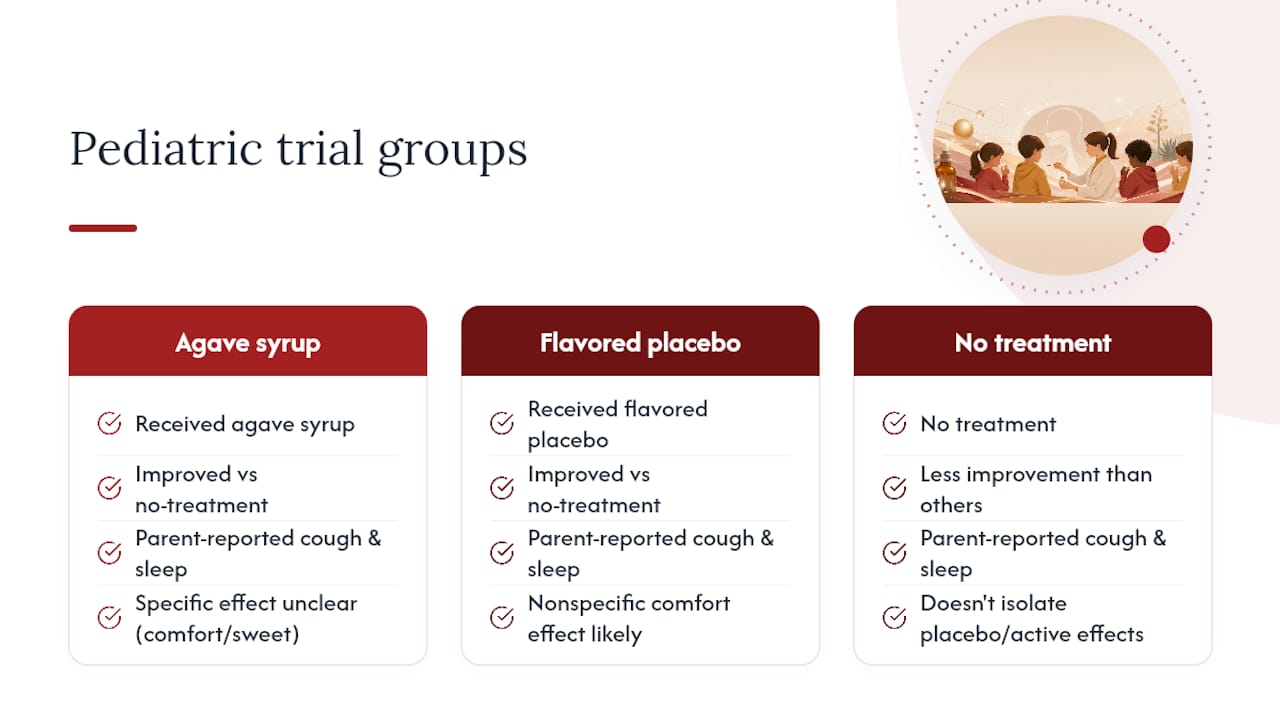
The most relevant clinical evidence on agave for throat and cough symptoms comes from a pediatric trial that tested it against a flavored placebo and against no treatment at all. Both agave and the placebo eased nighttime cough and improved children’s sleep compared with doing nothing, according to the Clinicaltrials for the study. Neither treatment reliably beat the other.
That result deserves a second look, because it tells you something important about how these remedies actually work. The trial enrolled young children between 2 and 47 months and measured outcomes parents could report: how often the child coughed at night, how well everyone slept. Reuters coverage of the trial put it plainly: a placebo version of agave worked about as well as the real thing.
The headline finding: agave and placebo both outperformed no treatment for nighttime cough and sleep disruption in young children, with no statistically significant edge for agave itself on most measures.
That doesn’t mean agave does nothing. It means the benefit is likely tied to the syrup’s texture and sweetness rather than any special compound in the plant. Parent-reported outcomes are also inherently subjective, sample sizes in pediatric cough trials tend to run small, and short follow-up windows limit how much any single study can prove. Treat agave as a comfort measure with modest, symptomatic support behind it. Confidence should sit closer to “this can help you feel better” than “this treats your cough.”
How Does Agave Soothe a Sore Throat?
Agave’s syrupy consistency does most of the work. High viscosity means it clings to the lining of the throat longer than a thin liquid would, forming a temporary barrier over inflamed or irritated tissue. That coating action, known as a demulcent effect, is the same mechanism behind cough drops and honey.
Sweetness plays a supporting role too. Tasting something sweet triggers reflex salivation, and that extra saliva helps moisten a dry, scratchy throat on its own. Agave contains a high proportion of fructose, making it very sweet and smooth in texture. Combined, those two traits explain why a spoonful feels immediately comforting even though nothing about the syrup fights the underlying cause of the irritation.
Here’s what that means in practice:
- The relief is temporary and needs to be repeated every few hours as the coating wears off.
- It addresses the feeling of a sore throat, not a virus, bacteria, or inflammation driving it.
- It works about as well for comfort as any other thick, sweet substance, which is exactly what the placebo-controlled trial data suggests.
Agave vs. Honey for Sore Throat: Which Works Better?
For pure symptomatic comfort, agave and honey perform similarly. Both are viscous, both are sweet enough to trigger salivation, and both coat the throat the same physical way. Where they diverge is in what else they bring to the table.
Honey carries antioxidant and mild antimicrobial compounds that survive minimal processing, while agave syrup is typically filtered and heat-processed in ways that strip out most bioactive plant compounds, according to Healthline’s comparison of agave and honey. That’s why many clinicians lean toward honey as the first choice for older children and adults, when it’s safe to use.
| Dimension | Agave | Honey |
|---|---|---|
| Soothing effectiveness | Comparable comfort via viscosity and sweetness | Comparable comfort via viscosity and sweetness |
| Safety for infants/children | No infant botulism risk, but added sugar should still wait until after 12 months | Never give to infants under 12 months due to botulism risk |
| Nutrient/sugar composition | High fructose content; minimal micronutrients, per USDA FoodData Central | Blend of fructose and glucose; trace antioxidants and enzymes |
| Antimicrobial/anti-inflammatory properties | Largely absent after processing | Present in modest amounts, varies by honey type |
The table points to a practical split. Honey is the better everyday pick for anyone over one year old who isn’t avoiding honey for allergy, dietary, or personal reasons. Agave becomes the sensible substitute when someone wants a plant-based option, is managing a honey allergy, or simply prefers its milder flavor. Neither one replaces a doctor’s visit if red-flag symptoms show up, which we’ll cover shortly.
Who Should Avoid Agave, and What Are the Risks?
Infants under 12 months should not be given agave, honey, or any added sugar. Agave doesn’t carry honey’s specific infantile botulism risk, but pediatric guidance still advises against introducing added sweeteners in the first year regardless of the source.
Beyond infancy, the concern shifts to how much sugar you’re realistically adding. Agave is one of the most fructose-dense sweeteners on the market, and frequent, generous use adds up fast for anyone tracking blood sugar or watching total sugar intake. Dental professionals also flag frequent exposure to concentrated syrups as a contributor to enamel erosion and cavity risk over time, according to guidance from a family dental practice. A spoonful now and then for a sore throat is a different story than sipping agave-sweetened drinks all day.
Allergic reactions to agave are uncommon but not unheard of, particularly for people with sensitivities to related plants. Anyone with digestive sensitivity to concentrated fructose may also notice mild bloating or discomfort. Use it conservatively, watch how your body responds, and if a sore throat lingers beyond a few days or worsens, that’s a signal to talk to a doctor rather than reach for another spoonful.
How to Use Agave for Throat Relief the Right Way
Keep the approach simple and modest. This is a comfort measure, not a dosing protocol.
- Start with one teaspoon to one tablespoon for adults and older children, taken as needed rather than on a fixed schedule.
- Take it straight off a spoon for the most direct coating effect on the back of the throat.
- Stir it into warm water or herbal tea with a squeeze of lemon or a slice of fresh ginger if you want something warm and soothing to sip slowly.
- Limit use to a few times a day, since more frequent servings mean more added sugar without more relief.
- Skip it entirely for children under 12 months, and use it sparingly for toddlers.
- Rinse with water or brush after use to reduce prolonged sugar contact with tooth enamel.
If you’re weighing agave against other sweeteners for a household managing sugar intake more broadly, this family guide to reading syrup nutrition labels is a useful next stop.
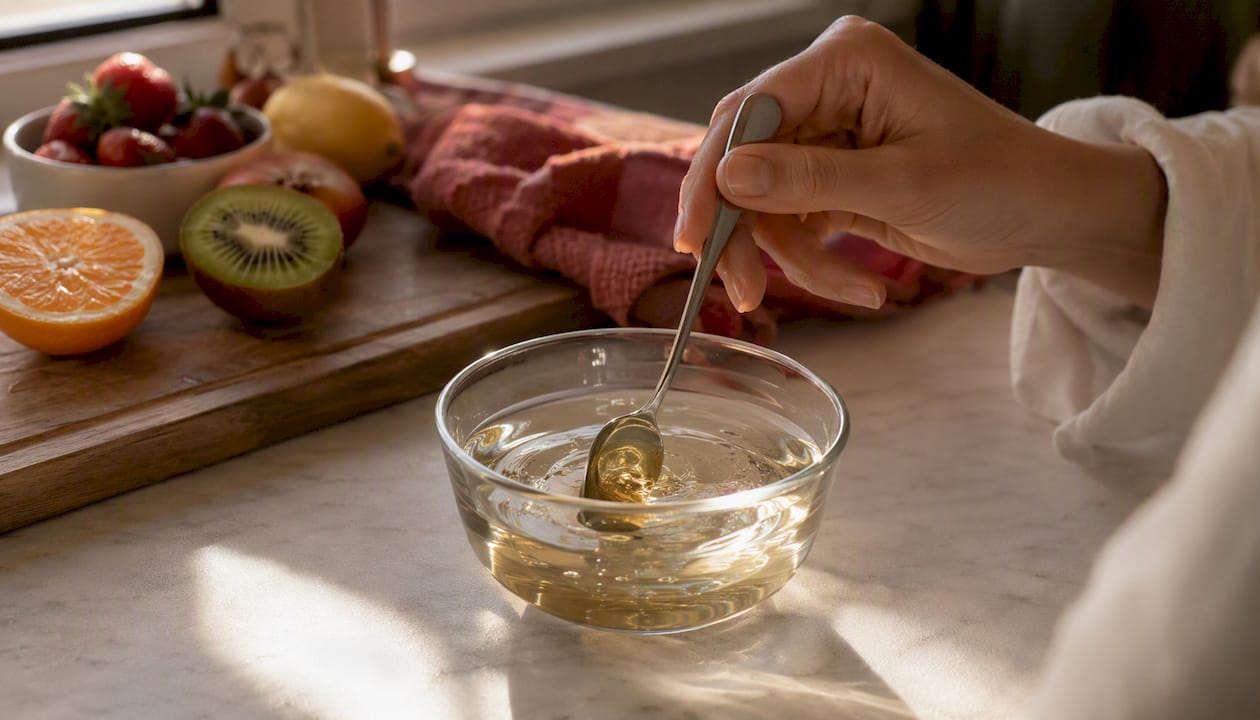
Pro Tip: Warm agave (not hot) flows more slowly and clings to the throat longer than cold agave straight from the fridge. A few seconds in warm water loosens its texture just enough to coat more evenly without thinning it out.
What Else Helps, and When Should You See a Doctor?
Agave is one comfort tool among several, and it’s often more effective paired with other simple remedies than used alone.
- Warm saltwater gargles, several times a day, for mechanical relief of throat irritation.
- A humidifier or steamy shower to keep the air from drying out an already-raw throat.
- Age-appropriate throat lozenges for anyone over four years old.
- Throat sprays formulated for temporary numbing or moisture.
- Warm tea with lemon and ginger, which combines the demulcent effect with hydration.
None of these substitute for medical attention when symptoms point to something more serious. See a doctor promptly if there’s a high fever, difficulty breathing or swallowing, drooling in a young child who normally doesn’t drool, a rash alongside the sore throat, or symptoms that stretch past 48 to 72 hours without improvement. The FDA advises against most over-the-counter cough and cold medicines for children under four, which is exactly why demulcent options like agave, honey, and warm fluids remain the go-to home approach for that age group. When in doubt, a phone call to a pediatrician costs a lot less than a guess.
Why the Sore Throat Study Results Are More Mixed Than They Look
The pediatric agave trial is worth unpacking a little further, because its design explains a lot about why “does agave work” doesn’t have a clean yes or no answer. Researchers split young children into three groups: one received agave syrup, one received a flavored placebo, and one received no treatment. Parents then reported on nighttime cough frequency and how well the child (and often the parent) slept.
Both the agave group and the placebo group improved compared to the no-treatment group. That’s the headline. It’s also the limitation, because it means the trial can’t cleanly separate “agave’s specific effect” from “the effect of giving a child something sweet and comforting at bedtime.” A few design factors matter here: parent-reported outcomes are subjective by nature, sample sizes in trials like this tend to be modest, and short follow-up windows don’t capture whether benefits hold up over a full illness course. Flavoring and formulation differences between the agave product and placebo could have also narrowed any real gap between them, a caveat noted in broader research on demulcent cough remedies.
For adults, no comparable large trial exists, so most of what we know is extrapolated from general demulcent research and honey studies rather than agave-specific data. What would change the picture is a larger, blinded trial isolating agave’s texture and sweetness from other comfort effects, run separately in adults and in children, with objective outcomes beyond parent reporting. Until that exists, the fair takeaway is that agave provides real, if modest and largely nonspecific, comfort.
What a Sore Throat Really Calls For at Home
There’s something almost old-fashioned about reaching for a spoonful of something sweet when someone in the house isn’t feeling well. Long before we had trial data on demulcent effects, families were doing exactly this: warming a mug of tea, stirring in a little something golden, sitting with the person who’s under the weather instead of just treating the symptom and walking away. That instinct, to gather around care rather than rush past it, is worth protecting even when the remedy itself is modest.
Sweetness has always had a place in how we tend to each other, and it doesn’t need to come with a health claim attached to earn that place. A slower morning with tea and honey or agave on the counter, a blanket on the couch, someone checking in every hour, does more for a scratchy throat than any single ingredient will. The syrup is a small gesture inside a bigger act of care.
If your family already keeps a sweetener close at hand for mornings and mishaps alike, it’s worth choosing one that fits the rest of how you eat without a second thought. Yakonow’s yacon syrup has a naturally low glycemic footprint and a mild, caramel-like sweetness that works the same way agave does in a cup of tea, without asking you to think any harder about it than you already are.
A Gentler Syrup for the Family Table
There’s no medical claim here, just a practical swap worth knowing about. Wherever agave or honey shows up in your kitchen, from tea to toast to the spoon you reach for when someone’s throat feels rough, Yakonow’s yacon syrup slides into that same spot with a gentler, low-glycemic sugar profile.

Yacon syrup comes from a root grown in the Peruvian Andes, hand-harvested and bottled in an FDA-compliant facility in Texas, with a mild sweetness that works as easily in warm tea as it does over pancakes on a slow Saturday. If you’re curious how it stacks up against agave for everyday use, this comparison of yacon and agave walks through the details. For the family that wants something on hand for both breakfast and the occasional scratchy throat, the single 6oz bottle is an easy place to start, and the pack of two keeps a spare on hand for busier weeks.
Frequently Asked Questions
Is agave good for a sore throat in adults? Yes, in a limited way. It coats the throat and offers temporary comfort thanks to its thick texture, similar to honey, but it doesn’t address the underlying cause of the irritation.
Is agave soothing for a cough at night? It can be. Clinical data in young children found agave improved nighttime cough and sleep compared with no treatment, though a flavored placebo worked just as well in the same study.
Can I give agave syrup to a baby for a cough? No. Skip added sugars, including agave, for infants under 12 months regardless of botulism risk, which is specific to honey rather than agave.
Is agave better than honey for a sore throat? They’re comparable for physical comfort, but honey generally has a slight edge because it retains antioxidant and mild antimicrobial compounds that processed agave typically lacks.
How much agave should I use for throat relief? One teaspoon to one tablespoon as needed is a reasonable, conservative amount for adults and older children, taken straight or stirred into warm tea.
This article is general information, not a substitute for advice from a qualified doctor. Consult a qualified healthcare professional about your own circumstances before acting on anything here.
Sources
These sources anchor the clinical and nutritional claims in this article, drawn from a registered pediatric trial, major health reporting, a nutrition database, and peer-reviewed context on cough remedies.