

Why Some Fibers Are Not Absorbed: A Family Guide
Some fibers pass straight through your small intestine without being absorbed at all, and that is exactly the point. The reason comes down to one biochemical mismatch: human digestive enzymes (called α-glucosidases) are built to break α-glycosidic bonds, the kind found in starch. Many dietary fibers are held together by β-glycosidic bonds, which those same enzymes simply cannot cut. So the fiber travels on, intact, to the colon, where gut bacteria take over.
Here is what that means in practice:
- Enzyme limitation: α-glucosidases digest starch but leave most fiber untouched.
- Three fiber classes: soluble (gel-forming), insoluble (bulking), and fermentable/prebiotic (microbiome fuel).
- Colon fermentation: gut bacteria convert unabsorbed fibers into short-chain fatty acids (SCFAs) that support the gut lining and metabolic health.
- Yakonow yacon syrup is a real-food example: its prebiotic FOS fiber resists digestion by design, feeding beneficial bacteria rather than spiking blood sugar.
Table of Contents
- Why some fibers are not absorbed: the plain-language chemistry
- How do soluble, insoluble, and prebiotic fibers behave differently?
- What actually happens after fiber reaches the colon?
- How to add prebiotic fiber safely for the whole family
- How Yakonow yacon syrup fits into a family-first table
- When should you check with a clinician first?
- Key Takeaways
- The table is the whole point
- Bring a little more to the breakfast table
- Useful sources for curious parents
Why some fibers are not absorbed: the plain-language chemistry
The digestive tract is a sequential system. Chewing breaks food into smaller pieces, stomach acid softens it further, and the small intestine is where most nutrients cross into the bloodstream. The small intestine is efficient at absorbing sugars, fats, and proteins. Fiber, though, is a different structure entirely.
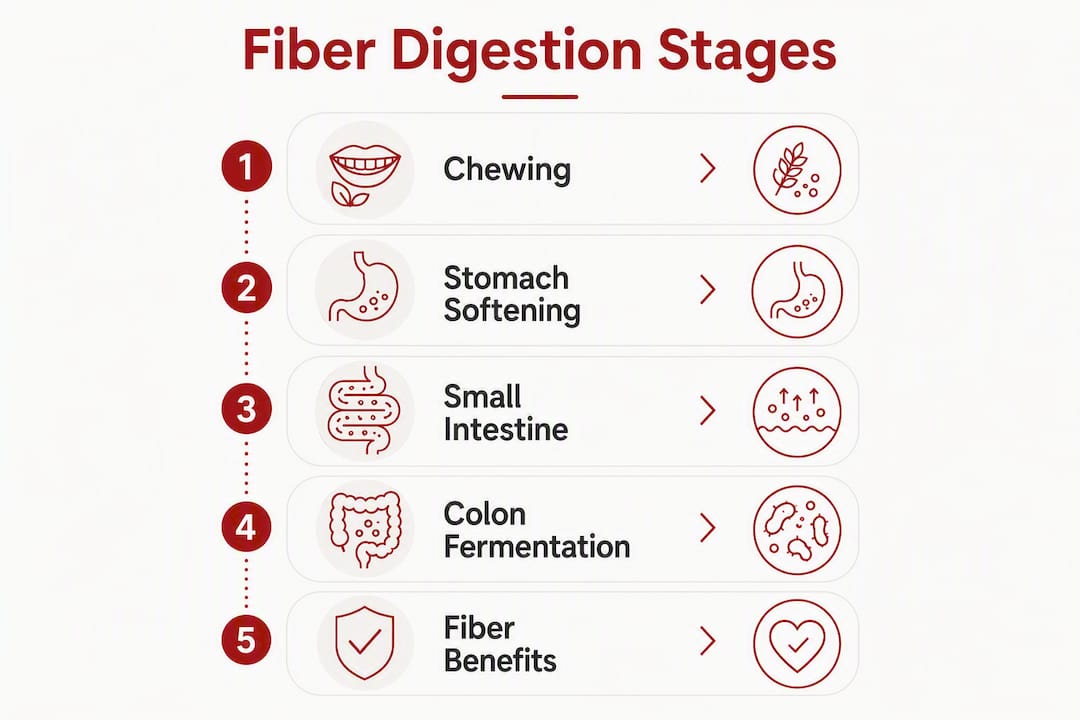
Think of it like a lock-and-key problem. Starch is a chain of glucose units linked by α-1,4 bonds, and your body carries the right key (α-glucosidases) to unlock it. Cellulose, the fiber in vegetable cell walls, uses β-1,4 bonds instead. No matching key exists in the human gut, so the chain stays intact. Inulin and fructooligosaccharides (FOS), the prebiotic fibers found in yacon root and chicory, work the same way: β-linked chains that human enzymes cannot hydrolyze.
Physical structure adds another layer. Intact plant cell walls can physically shield even digestible starch from enzymes, slowing breakdown and creating what nutritionists call resistant starch behavior. Less-processed foods tend to preserve this structure, which is part of why a whole apple behaves differently than apple juice.
- Cellulose (vegetables, whole grains): β-1,4 bonds, completely indigestible.
- Inulin and FOS (yacon, chicory, onions): β-linked fructose chains, fermentable but not absorbed.
- Resistant starch (less-processed grains, legumes): physically protected from enzymes by intact cell walls.
How do soluble, insoluble, and prebiotic fibers behave differently?
The “not absorbed” label covers three distinct fiber personalities, and each one does something different at the family table.
| Fiber type | Food examples | What happens in the gut | Practical effect |
|---|---|---|---|
| Soluble | Oats, apples, beans, lentils | Dissolves in water, forms a gel, slows digestion | Smoother blood sugar after meals, lower LDL cholesterol |
| Insoluble | Whole wheat, vegetables, nuts | Adds bulk, speeds transit | Keeps digestion regular, reduces constipation |
| Fermentable (prebiotic) | Yacon, chicory, onions, garlic | Feeds beneficial gut bacteria in the colon | Produces SCFAs, supports microbiome diversity |
Soluble fiber forms that gel by attracting water in the intestinal lumen, which physically slows how fast carbohydrates reach the bloodstream. Insoluble fiber does the opposite: it adds bulk and moves things along. Prebiotic fibers like FOS do neither of those things in the small intestine because they arrive in the colon completely intact, ready to feed the microbiome.
- Viscosity (soluble): the gel effect is what smooths post-meal glucose, not systemic absorption.
- Bulking (insoluble): more stool volume, faster transit, less time for waste to sit.
- Fermentability (prebiotic): the colon’s microbial community converts these fibers into SCFAs like butyrate.
What actually happens after fiber reaches the colon?
Non-absorption is not a failure of digestion. It is the delivery mechanism. Fiber reaches the colon intact where the microbiota ferment it into metabolites, particularly SCFAs, that nourish colon cells and influence metabolic signaling throughout the body. Butyrate, one of those SCFAs, is the primary fuel for the cells lining the colon wall.
The benefits that follow are real and well-documented:
- SCFA production: butyrate and other SCFAs support the gut lining and reduce inflammation.
- Blood sugar modulation: viscous soluble fibers delay gastric emptying and reduce post-meal glucose spikes, which matters at a pancake breakfast.
- Cholesterol support: soluble fibers bind bile acids in the gut, pulling them out before they can be reabsorbed, which tends to lower LDL cholesterol over time.
- Stool regularity: insoluble fiber adds bulk; fermentable fiber feeds bacteria that also contribute to healthy transit.
For families, the most immediate effect is at the table. A breakfast that includes prebiotic fiber, like a drizzle of yacon syrup over oatmeal, tends to produce a gentler blood sugar curve than one built on refined sugar alone.
Pro Tip: If your family is new to fermentable fibers, pair them with lower-fermentability foods (like cooked carrots or rice) at first. This keeps the meal satisfying while giving the gut time to adjust without excess gas. A low-FODMAP approach can be a helpful reference for sensitive family members.
How to add prebiotic fiber safely for the whole family
Start low and slow. That is the one rule that matters most when introducing fermentable fibers, especially for kids. Gas and bloating are normal early responses as the microbiome adjusts; they are not a sign something is wrong.
- Start small. Begin with about one teaspoon for children and one to two teaspoons for adults per serving.
- Wait 48–72 hours before increasing the amount, so the gut has time to adapt.
- Increase gradually over two to three weeks until you reach a comfortable daily amount.
- Drink more water. Fiber, especially soluble and fermentable types, works better when well-hydrated.
- Pause if needed. Acute GI discomfort (cramping, significant bloating) is a signal to pull back and try again more slowly.
Family-friendly ways to work prebiotic fiber into meals without making it a project:
- Drizzle Yakonow yacon syrup over pancakes or waffles instead of maple syrup.
- Stir a teaspoon into plain yogurt with fresh fruit for a weekend breakfast bowl.
- Add it to oatmeal alongside sliced banana for a slow Saturday morning.
- Use it as a light drizzle over a fruit salad at brunch.
How Yakonow yacon syrup fits into a family-first table
Yakonow is a single-ingredient syrup, nothing but pure Peruvian yacon root, hand-harvested and bottled in an FDA-compliant facility in Texas. It is naturally sweet, with no added sugar, no glucose, and no artificial sweeteners.
Up to 50g of prebiotic FOS fiber per 100g — compared to a glycemic index of just 1, versus 54 for maple syrup.
What that means at breakfast: a small drizzle adds a gentle sweetness and a dose of prebiotic FOS without the blood sugar spike that follows conventional syrups. The FOS passes through the small intestine unabsorbed (for the reasons explained above) and feeds beneficial bacteria in the colon.
- Very low glycemic index (reported at 1): suitable for the whole family, including those watching blood sugar.
- Up to 50g FOS per 100g: a meaningful prebiotic contribution in a small serving.
- Zero added sugar, colorants, or artificial sweeteners: the label is clean.
- Vegan, gluten-free, and additive-free: works across most family dietary needs.
For more on how FOS is counted on nutrition labels, Celeste’s guide on FOS label reading is worth a few minutes.
When should you check with a clinician first?
Most healthy families can introduce prebiotic fiber gradually without any issues. A few situations call for a conversation with a doctor or registered dietitian before adding more fermentable fiber to the diet.
- IBS or SIBO: fermentable fibers can worsen symptoms for people with irritable bowel syndrome or small intestinal bacterial overgrowth. A clinician or dietitian can help identify which fiber types are tolerable. Understanding what causes IBS can help frame that conversation.
- Toddlers under two: fiber needs for very young children differ significantly from older kids and adults; follow pediatric guidance rather than adult serving suggestions.
- Certain medications: some fibers can affect how medications are absorbed. If anyone in the family takes daily medication, a quick check with a pharmacist is a sensible step.
- Persistent or severe GI symptoms: bloating that does not resolve after two weeks of gradual introduction, or any symptoms that feel unusual, warrant a professional opinion.
This article is general information, not medical advice. For your family’s specific situation, a registered dietitian or your pediatrician is the right resource.
Key Takeaways
Many fibers are not absorbed because human enzymes lack the ability to break β-glycosidic bonds, so those fibers travel intact to the colon where gut bacteria ferment them into health-supporting SCFAs.
| Point | Details |
|---|---|
| Enzyme mismatch is the cause | α-glucosidases digest starch but cannot break β-glycosidic bonds in most dietary fibers. |
| Three fiber types, three roles | Soluble fibers smooth blood sugar; insoluble fibers add bulk; fermentable fibers feed the microbiome. |
| Colon fermentation is the benefit | Gut bacteria convert unabsorbed fibers into SCFAs like butyrate, which nourish the colon lining. |
| Introduce fiber slowly | Start with one teaspoon for kids, one to two teaspoons for adults, and increase over two to three weeks. |
| Yakonow at the family table | Yakonow yacon syrup offers up to 50g FOS per 100g and a glycemic index of 1, making it a gentle prebiotic option for family breakfasts. |
The table is the whole point
There is something worth sitting with here: the fact that fiber is not absorbed is not a gap in human biology. It is a feature. Our bodies evolved to pass certain plant compounds straight to the colon, intact, so that the microbial community living there could do something useful with them. The science is elegant, but what strikes me most is how naturally it maps onto the way families have always eaten — slowly, together, with real food on the table.
The pressure to turn every meal into a nutrition intervention is real, and it misses the point. A slow Saturday breakfast with good syrup, fresh fruit, and people you love is already doing something right. The fiber is just along for the ride.
Bring a little more to the breakfast table
If you have been looking for a syrup that works as hard as you do without drawing attention to itself, Yakonow is worth keeping on the counter. It is naturally sweet, low-glycemic, and rich in prebiotic FOS — the kind of small detail that makes a family breakfast feel a little more intentional without any extra effort.

Choose the size that fits your household:
- Yakonow Yacon Syrup · Single 6oz Squeezable Bottle — The Breakfast Syrup Your Kids Love. A great way to try it first.
- Yakonow Yacon Syrup · Pack of 2 · 6oz Squeezable Bottles — For Busy Family Mornings. Keep one on the table, one in the pantry.
- Yakonow Yacon Syrup · Pack of 4 · 6oz Squeezable Bottles — For The Family That Doesn’t Run Out. The choice for households that have made it a staple.
Order directly at yakonow.co and have it at your table by the weekend.
Useful sources for curious parents
- Oregon State University — Fiber (Micronutrient Information Center): the clearest explanation of fiber biochemistry and enzyme specificity available online.
- Harvard T.H. Chan School of Public Health — The Nutrition Source: Fiber: practical overview of fiber types, food sources, and health effects.
- Mayo Clinic — Dietary fiber: Essential for a healthy diet: accessible summary of soluble vs. insoluble fiber with food examples.
- Cleveland Clinic — Soluble vs. insoluble fiber: quick, parent-friendly breakdown of prebiotic FOS and fermentation.
- Frontiers in Nutrition — Intestinal microbiota-mediated dietary fiber bioavailability: peer-reviewed research on how gut bacteria process fiber and produce SCFAs.
- NCBI Bookshelf — Dietary fiber and health: foundational chapter on fiber’s local gut actions and systemic effects.
- MedlinePlus — Soluble vs. insoluble fiber: a reliable government-backed reference for families.
- Yakonow blog — Prebiotic FOS in Yacon Syrup: What the Science Actually Says: Celeste’s deep-dive on yacon syrup science for families.