

Families: Start Yacon Syrup on Fruit at 1 tsp for Slow Mornings
Yes, yacon syrup works beautifully on fresh fruit. It’s a gentle, low-glycemic drizzle that adds sweetness without drowning what’s already good on the plate. Start small, with a small drizzle amount like a teaspoon to a tablespoon, and treat it more like a finishing touch than a pour. If your stomach tends to be sensitive, sample a little first before you commit to a full bowl.
TL;DR:
- A teaspoon to a tablespoon of yacon syrup is sufficient for a single serving of fruit, and adjustments should be made based on fruit sweetness and serving size.
- Yacon syrup is best used as a finishing drizzle on cooked or fresh fruit rather than incorporated into baking or simmered for long periods to preserve its prebiotic qualities.
- Long-term studies suggest yacon syrup may improve metabolic markers like insulin and LDL cholesterol when used consistently over weeks, but immediate glycemic responses vary.
- People with fructan sensitivity or IBS should start with very small amounts and monitor digestive reactions to avoid bloating or discomfort.
- The best storage method is at room temperature or refrigerated after opening, keeping the product pure and fresh without added ingredients.
Table of Contents
- How Much Yacon Syrup on Fruit Actually Works?
- How to Use Yacon Syrup on Specific Fruits
- Balancing Yacon Syrup With Acid, Fat, and Spice
- What Does the Research Say About Yacon Syrup and Blood Sugar?
- Does Yacon Syrup Cause Digestive Issues?
- How to Introduce Yacon Syrup to Your Family’s Fruit Routine
- Easy Fruit-Forward Ideas to Try Tonight
- How Should You Store Yacon Syrup?
- A Slow Morning With Fruit and Yacon
- Which Yakonow Yacon Syrup Fits Your Family?
- Sources
How Much Yacon Syrup on Fruit Actually Works?
Measuring by feel is fine once you know the range. A single bowl of berries works well with about a teaspoon of syrup. For a shared platter, a tablespoon or slightly more may suit the group size. Family-style servings just scale from there.
When substituting yacon syrup for maple syrup, honey, or agave, start with an approximate 1:1 ratio and adjust to your taste.
- Very sweet fruit (mango, ripe banana, grapes): use 10 to 25 percent less than you’d normally pour, since the fruit is already doing most of the work.
- Tart or mild fruit (berries, green apple, grapefruit): stick with the full 1:1 swap to bring balance.
- Cooked or grilled fruit: brush it on right at the end of cooking rather than early, since yacon behaves more like a finishing syrup than a baking ingredient.
That last point matters more than it sounds. Yacon shines as a drizzle you add right before serving, not something you fold into batter or simmer down for twenty minutes.
How to Use Yacon Syrup on Specific Fruits
Different fruits ask for different handling, and a little technique goes a long way toward making yacon syrup on fruit taste intentional rather than just sweet.
- Berries: toss with a teaspoon of yacon and let them sit for five to ten minutes. The syrup pulls out their natural juice and turns a plain bowl into something closer to a compote.
- Apples and pears: use a thin drizzle only. Too much syrup sits on the surface and makes sliced fruit go soft fast. A squeeze of lemon or orange keeps the flavor bright.
- Stone fruit and grilled fruit: brush it on as a light glaze over warm peaches, plums, or pineapple straight off the grill. The heat brings out the caramel note in the syrup without any real cooking involved.
- Bananas and tropical fruit: go easy here since these fruits are naturally sweet already. A small drizzle paired with nuts or a spoonful of yogurt rounds things out.
- Yogurt bowls and fruit salad: fold the syrup in gently rather than pouring it on top, so the sweetness spreads evenly instead of pooling at the bottom of the bowl.
Balancing Yacon Syrup With Acid, Fat, and Spice
Yacon syrup has a mellow, molasses-like sweetness with a faint caramel edge, quieter than maple and less floral than honey. That subtlety is exactly why it plays so well with contrast. A little citrus wakes it up. A little fat, from nuts, cheese, or yogurt, rounds it out. A pinch of cinnamon or fresh ginger gives it warmth without turning the fruit into a dessert.
Texture is worth thinking about too. Poured cold and thin, yacon syrup slides over sliced fruit the way a light dressing would. Warmed gently for a few seconds, it thickens slightly into more of a glaze, which is nicer over stone fruit. Just don’t let it sit over direct heat too long. Prolonged high heat can break down the fructooligosaccharides that give yacon its prebiotic character, so a brief warm is plenty.
A favorite pairing at our table: fresh ricotta, sliced figs, and a light drizzle of yacon syrup with a few cracks of black pepper. Simple, and it tastes like it took more effort than it did.

What Does the Research Say About Yacon Syrup and Blood Sugar?
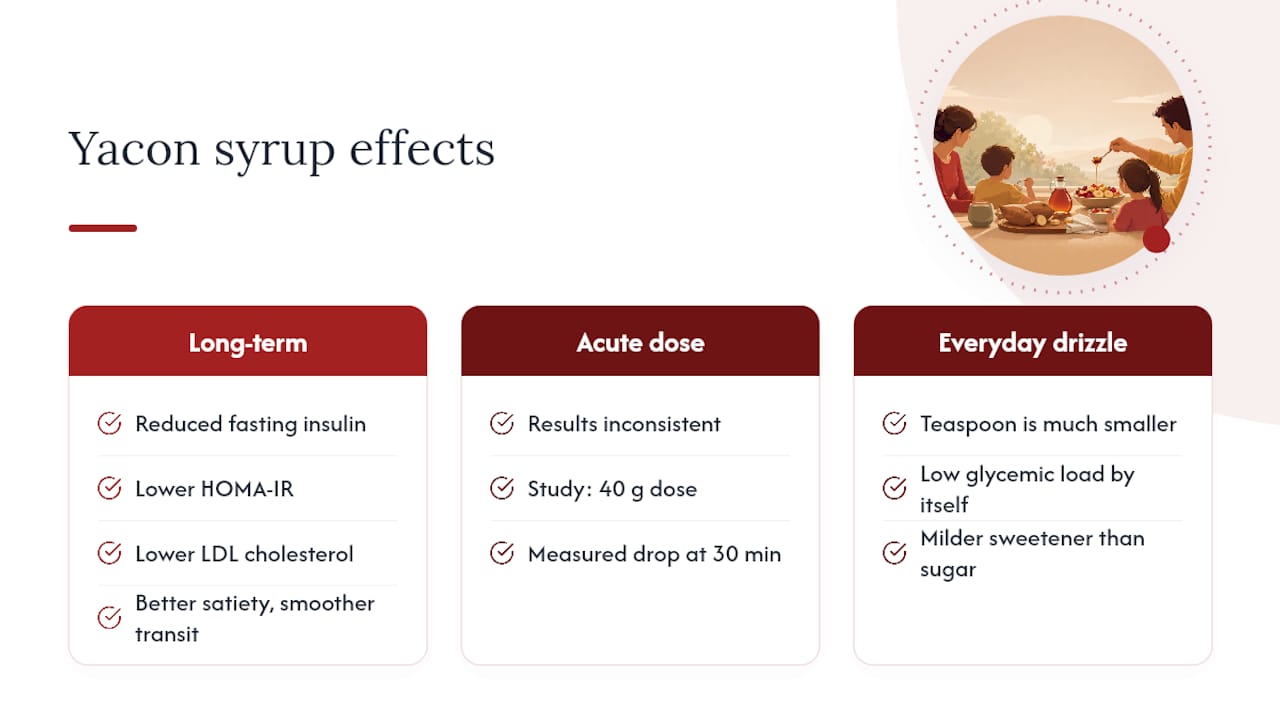
A 2024 systematic review covering seven clinical trials and 161 participants found that longer-term yacon syrup use was linked to reductions in fasting insulin, HOMA-IR, and LDL cholesterol, along with better satiety and smoother intestinal transit in some studies. Acute, single-dose glycemic responses were less consistent, which suggests the metabolic benefits build up over longer periods rather than immediately.
Trial doses tend to run higher than a kitchen drizzle. One study measuring postprandial blood sugar used a single 40 gram dose, roughly two and a half tablespoons, to see a measurable drop at 30 minutes. A teaspoon over your morning fruit bowl is a much smaller amount than that. For everyday use, a light drizzle carries a low glycemic load on its own and simply gives you a gentler way to sweeten fruit than table sugar or a high-glycemic syrup.
Does Yacon Syrup Cause Digestive Issues?
Yacon syrup is rich in fructans, a type of fiber your body doesn’t digest in the small intestine. Instead, it ferments in the colon, which is exactly why some people notice bloating, gas, or looser stools after eating more than they’re used to.
- Start with a small amount, such as a teaspoon, and monitor your tolerance before increasing the serving size.
- If you are sensitive to FODMAPs or have IBS symptoms, begin with very small amounts of yacon syrup and avoid it when your digestive health is already compromised.
- Watch for a pattern rather than a single reaction. Occasional mild gas is common; ongoing discomfort is a sign to scale back or talk to your doctor.
According to the Cleveland Clinic, these digestive effects are common enough that people with known fructan sensitivity should be cautious, even in small servings.
Pro Tip: Keep a plain sweetener on hand the first week you try yacon, so you can compare how your family feels with and without it before making it your everyday drizzle.
How to Introduce Yacon Syrup to Your Family’s Fruit Routine
Easing in beats diving in, especially with kids.
- Days 1 to 3: half a teaspoon on one fruit serving per day, ideally with a meal rather than on an empty stomach.
- Days 4 to 7: move up to a full teaspoon per serving if things feel comfortable.
- Days 8 to 10: adults can try a tablespoon on shared dishes; kids usually do best staying closer to a teaspoon.
Jot down anything unusual, like bloating or a change in bathroom habits, so you can spot a pattern instead of guessing. If discomfort sticks around past the first week or two, check in with your pediatrician or doctor rather than pushing through it.
Easy Fruit-Forward Ideas to Try Tonight
A few of these live in regular rotation in our own kitchen.
- Macerated strawberries with lemon zest and a teaspoon of yacon syrup, rested for ten minutes.
- Grilled peach halves brushed with a yacon glaze, served warm over ricotta.
- Yogurt bowl with sliced banana, chopped walnuts, and a light yacon drizzle.
- Citrus fruit salad with a tablespoon of yacon whisked into the dressing for a shared table.
- A quick smoothie swap: use a small splash of yacon instead of your usual sweetener.
You’ll find more ideas, including a full set of yacon syrup recipes, if mornings call for variety.
How Should You Store Yacon Syrup?
Once opened, keep the bottle at room temperature for short-term use or refrigerate it to extend freshness. Either way, a well-sealed bottle holds up for months. Reach for maple or honey when you need real oven browning or a stable ingredient for jam-making, and reach for yacon when the dish is cold, like fruit, yogurt, or a fresh salad. If you’re comparing bottles at the store, the simplest rule holds: single-ingredient yacon syrup, nothing added, is the easiest label to trust.
A Slow Morning With Fruit and Yacon
Some of my favorite mornings are the unremarkable ones. Bowls of cut fruit on the counter, the kids arguing about who gets the last strawberry, a bottle of yacon syrup passed down the table like it’s always been there. I started with the smallest drizzle I could manage, more out of curiosity than caution, and it became one of those small rituals nobody planned but everybody looks forward to.
Portion still matters, even in a moment that feels casual. Test your own tolerance before you pour freely, and let the kids start light too. Try one of the mini recipes above this weekend. Slow mornings tend to ask for very little, just good fruit, a little sweetness, and everyone at the same table.
— Celeste
Which Yakonow Yacon Syrup Fits Your Family?
Yaconow offers a lower-glycemic way to sweeten fruit without reaching for maple, honey, or a bottle full of ingredients you can’t pronounce. It’s a single-ingredient yacon syrup made from hand-harvested Peruvian yacon syrup, yielding a pure product.

If you’re just testing the waters, the single 6oz bottle is the low-commitment way to see if your family takes to it. Busy households that go through syrup fast tend to like the pack of 2, enough to keep breakfast covered without a mid-week grocery run. And for families who don’t want to think about running out at all, the pack of 4 keeps a steady supply on hand for pancakes, yogurt bowls, and every fruit plate in between. Pick the size that matches your mornings and add it to cart today.
Sources
The systematic review in Nutrients backs the metabolic and satiety claims. The Cleveland Clinic supports the digestive caution and swap guidance. A PubMed trial grounds the dosing comparison, and a Frontiers in Nutrition analysis supports the bowel-related findings.
This article is general information, not a substitute for advice from a qualified doctor. Consult a qualified healthcare professional about your own circumstances before acting on anything here.
- Impacts of Yacon Syrup (Smallanthus sonchifolius) on Human Health: A Systematic Review of Scientific Evidence from the Last Decade
- Is Yacon Syrup Healthy? — Cleveland Clinic
- PubMed trial reporting postprandial effects