

What Is an FDA Compliant Food Facility?
An FDA compliant food facility is one that meets all registration, manufacturing, and documentation requirements set by the U.S. Food and Drug Administration under the Federal Food, Drug, and Cosmetic Act and the Food Safety Modernization Act (FSMA). Compliance means the facility is registered with the FDA, follows Current Good Manufacturing Practices (CGMP) under 21 CFR Part 117, and maintains a written Food Safety Plan with documented preventive controls. For food industry professionals and entrepreneurs, understanding what is an FDA compliant food facility is the foundation for operating legally, protecting consumers, and building a brand that families can trust. One important clarification up front: FDA registration does not mean FDA approval or endorsement of your products. It means you are known to the agency and operating within its legal framework.
What are the FDA registration requirements for food facilities?
FDA registration is the first and most visible step in compliance for food facilities. The FDA requires registration from any facility that manufactures, processes, packs, or holds food for consumption in the United States. That definition is broad by design. It covers ingredient processors, co-packers, bottlers, and warehouses, not just finished-product manufacturers.

Certain categories are exempt. Farms, restaurants, retail food establishments, and nonprofit food facilities that prepare food for immediate consumption do not need to register. If your operation crosses into processing or packing food that will be sold through retail or wholesale channels, registration is mandatory.
The registration process itself is free and must be done electronically through the FDA’s Unified Registration and Listing System (FURLS). Renewals happen every two years, specifically during october 1 through december 31 of even-numbered years. Any change to facility information must be updated within 60 days. The FDA also assigns a Unique Facility Identifier (UFI) to each registered facility, which functions as a permanent tracking number across inspections and records.
Key registration facts every food professional should know:
- Registration is free and completed through FDA’s FURLS portal
- Biennial renewal windows open october 1 and close december 31 of even-numbered years
- Changes to facility details must be submitted within 60 days of the change
- Farms, restaurants, and certain retail operations are exempt
- Failure to register is a prohibited act under federal law
Pro Tip: Register your facility before you begin production, not after. Operating without registration exposes you to enforcement action even if your products are perfectly safe.
What are Current Good Manufacturing Practices (CGMP) under 21 CFR Part 117?
CGMP is the operational backbone of FDA food facility compliance. The regulations under 21 CFR Part 117 replaced the older 21 CFR Part 110 standards and introduced a risk-based food safety system that requires proactive hazard identification, not just reactive sanitation. That shift matters enormously. Under the old framework, a clean facility was largely sufficient. Under Part 117, you must document and control hazards before they occur.
CGMP covers five core areas that every compliant facility must address:
- Personnel hygiene. All employees who handle food or food-contact surfaces must follow documented hygiene practices. This includes handwashing protocols, illness reporting, and restrictions on jewelry or other contamination sources.
- Facility design and maintenance. Buildings must be constructed to prevent contamination, with adequate lighting, ventilation, and pest control. Floors, walls, and ceilings must be cleanable and in good repair.
- Equipment standards. Food-contact equipment must be designed for easy cleaning, made of non-toxic materials, and maintained on a documented preventive schedule.
- Sanitation procedures. Facilities must have written sanitation programs that address cleaning frequency, chemical use, and allergen control between production runs.
- Process controls. Temperature, time, pH, and other critical parameters must be monitored and recorded during production.
Non-compliance with CGMP carries a legal consequence that surprises many new operators. Products made in violation of CGMP are legally classified as “adulterated” under federal law, regardless of whether any consumer was actually harmed. The FDA can act on a regulatory violation alone.
Pro Tip: Treat your CGMP documentation as a living system. Outdated sanitation logs or missing equipment maintenance records are among the most common triggers for FDA warning letters.
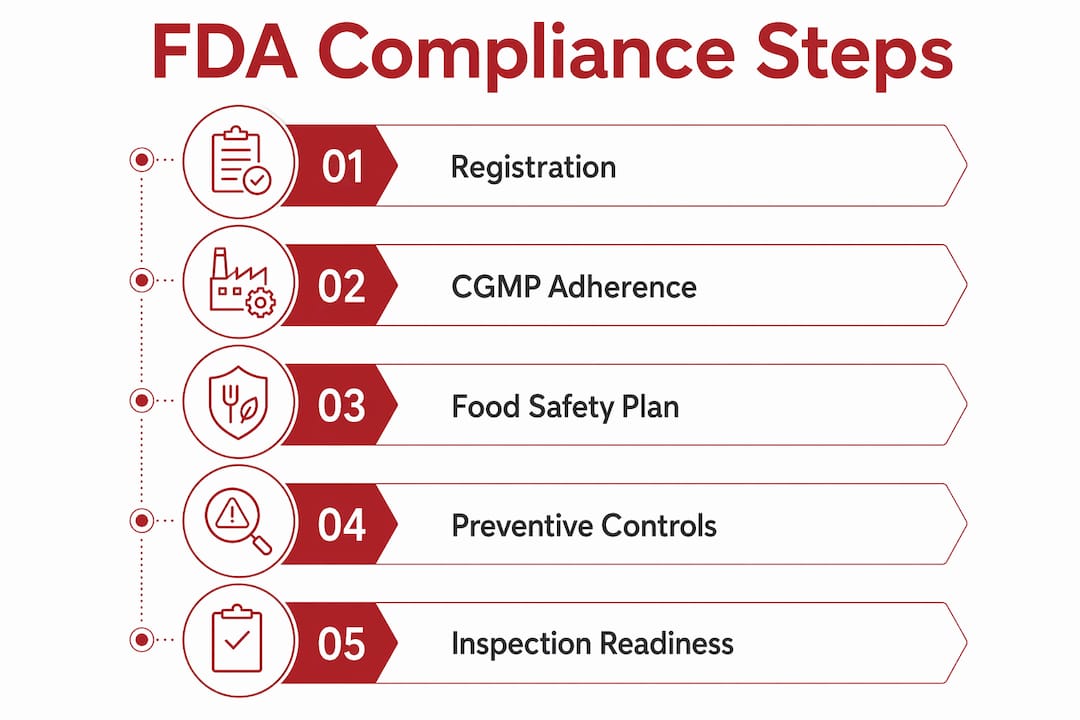
What is a Food Safety Plan under FSMA and how does it relate to FDA compliance?
A written Food Safety Plan is mandatory for most facilities covered by FSMA. It is the document that proves your facility has systematically identified every hazard in your production process and put controls in place to prevent them. Think of it as your facility’s safety argument, written down and verifiable.
The plan must cover four categories of hazards: biological (bacteria, viruses, parasites), chemical (pesticides, cleaning agents, allergens), physical (glass, metal, bone), and radiological. For each hazard, the facility must determine whether it requires a preventive control and, if so, document what that control is.
| Food Safety Plan Component | What it requires |
|---|---|
| Hazard analysis | Written assessment of all biological, chemical, physical, and radiological risks |
| Preventive controls | Documented process, sanitation, allergen, and supply-chain controls |
| Monitoring procedures | Scheduled checks with assigned personnel and frequency |
| Corrective actions | Written steps for when a control fails or a deviation occurs |
| Verification and validation | Evidence that controls actually work as intended |
| Recordkeeping | All records retained for at least 2 years as legal evidence |
The recordkeeping requirement deserves special attention. Under FDA standards, an action that was not recorded is treated as an action that did not happen. That principle applies to training sessions, equipment calibrations, sanitation runs, and corrective actions. Two years of clean, complete records is the minimum standard. Many compliance professionals recommend retaining records longer for facilities with complex supply chains.
A Food Safety Plan also requires a Preventive Controls Qualified Individual (PCQI) to oversee its development and review. This person must complete FDA-recognized training, such as the FSPCA Preventive Controls for Human Food course. Assigning a qualified individual is not optional; it is a named requirement under 21 CFR Part 117.
How do FDA inspections and enforcement actions impact food facility compliance?
FDA inspections test whether your written plans match your actual operations. Inspectors review both paperwork and physical facility conditions, and deficiencies in basic hygiene such as pest control, sanitation, and allergen management often trigger enforcement regardless of how well-written your Food Safety Plan is. A binder full of perfect documentation does not protect a facility where the floor drains are clogged or pest activity is visible.
Common compliance pitfalls that inspectors flag include:
- Incomplete or unsigned training records
- Gaps in temperature monitoring logs
- Allergen controls not documented between production runs
- Pest control logs that are outdated or missing
- Equipment maintenance records that do not match the actual maintenance schedule
Enforcement actions escalate based on severity. The FDA can issue a Form 483 with observations, followed by a Warning Letter if corrections are not made. More serious violations can result in product seizures, injunctions against production, and financial penalties. Failure to register or maintain documentation is a prohibited act under the Federal Food, Drug, and Cosmetic Act, and the agency does not require proof of consumer harm to act.
“A robust written Food Safety Plan without physical CGMP compliance on the floor is insufficient to pass FDA inspections. Daily floor operations are scrutinized as heavily as paperwork, and inspectors assess personnel hygiene, allergen management, and temperature control in real time.”
Preparing for an inspection means treating every production day as if an inspector is present. That mindset, more than any single document, is what separates facilities that pass from those that receive warning letters. Assign someone to walk the floor daily with a checklist that mirrors FDA inspection criteria. Correct small issues before they compound.
Key Takeaways
An FDA compliant food facility requires registration, documented CGMP adherence, a written Food Safety Plan, and at least two years of complete records to satisfy FDA inspection standards.
| Point | Details |
|---|---|
| Registration is mandatory | Most food manufacturers, packers, and holders must register electronically through FDA’s FURLS before production begins. |
| CGMP covers daily operations | Personnel hygiene, sanitation, equipment maintenance, and process controls must all be documented and practiced consistently. |
| A Food Safety Plan is required | The written plan must address all hazard categories and be overseen by a trained PCQI. |
| Records equal compliance | Training logs, batch records, and equipment logs must be retained for at least 2 years as legal evidence. |
| Registration is not approval | FDA registration identifies your facility to the agency but does not constitute FDA endorsement of your products. |
Why compliance culture matters more than compliance paperwork
The facilities I have seen struggle most with FDA compliance are not the ones with bad intentions. They are the ones that treat compliance as a documentation project rather than a daily practice. A binder gets assembled, a Food Safety Plan gets written, and then the real work of production takes over. Six months later, the training records are unsigned, the sanitation logs have gaps, and the equipment maintenance schedule has drifted.
The shift from 21 CFR Part 110 to Part 117 was not just a regulatory update. It was a philosophical one. The FDA moved from asking “Is your facility clean?” to asking “Can you prove you identified every risk and controlled it before it became a problem?” That is a harder question to answer, and it requires a different kind of organizational commitment.
What actually works, in my experience, is embedding compliance into the rhythm of production rather than treating it as a separate function. When the person who runs the sanitation cycle is also the person who signs the log, compliance becomes a habit. When the PCQI walks the floor weekly instead of only before an inspection, gaps get caught early. The FDA compliant labeling conversation is the same: it only holds up if the facility producing the product is already operating with that same level of care.
The facilities that pass inspections consistently are the ones where compliance is not a department. It is a culture.
— Celeste
Yakonow: a product born from compliant production
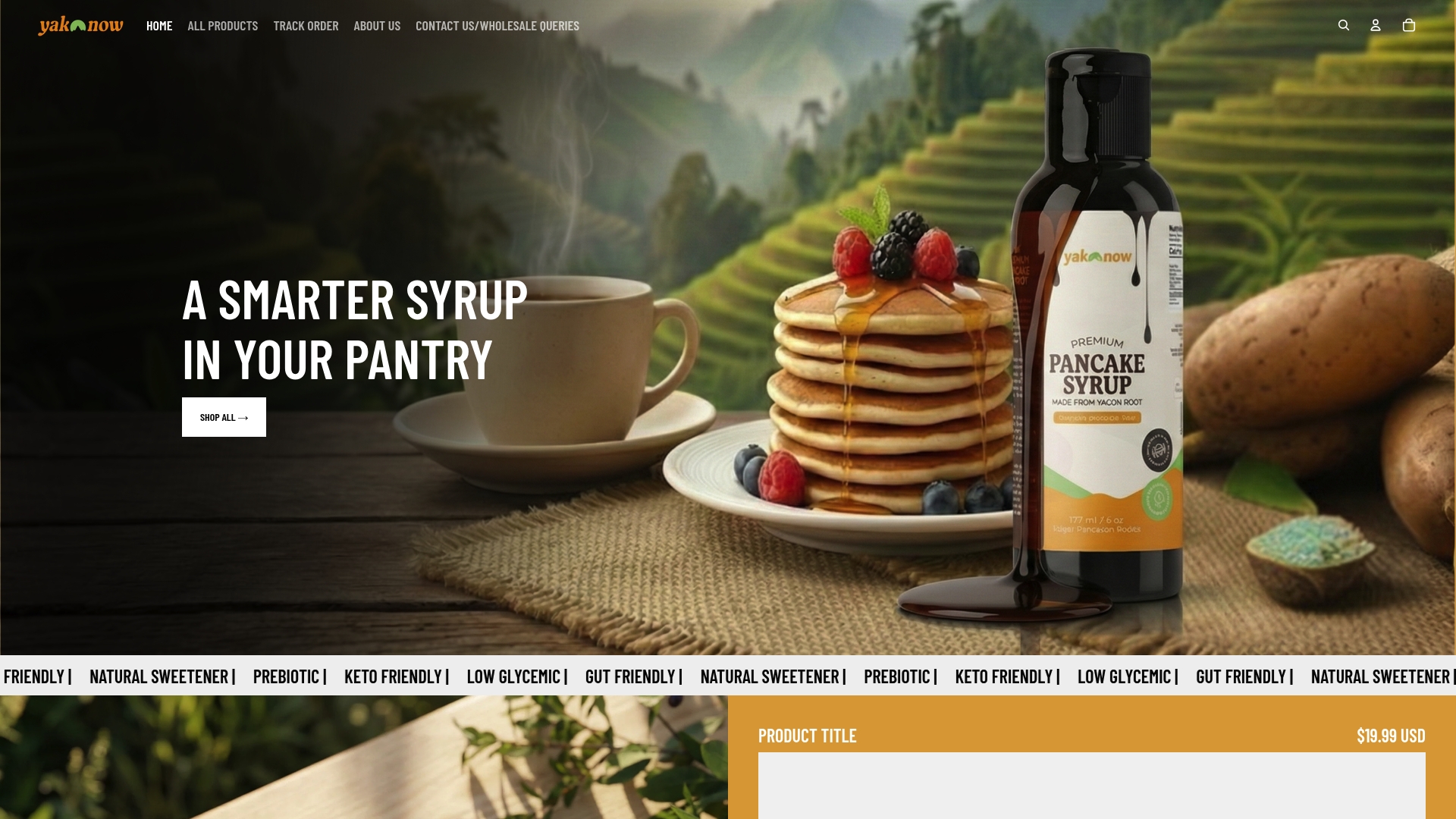
Yakonow yacon syrup is bottled in an FDA-compliant facility in Texas, which means every squeeze bottle that reaches your breakfast table has passed through the same registration, CGMP, and Food Safety Plan requirements described in this article. That is not a marketing claim. It is the baseline that makes Yakonow worth trusting for your family’s mornings.
For food professionals who want to understand what compliant production looks like in practice, Yakonow is a working example. For families who simply want a better syrup for slow Sunday pancakes, the compliance is the quiet guarantee behind every pour. Try the single 6oz bottle and taste what careful sourcing and compliant production actually feel like on the table.
FAQ
What is an FDA compliant food facility?
An FDA compliant food facility is one that is registered with the FDA, follows Current Good Manufacturing Practices under 21 CFR Part 117, and maintains a written Food Safety Plan with documented preventive controls and at least two years of records.
Does FDA registration mean my facility is FDA approved?
No. FDA registration identifies your facility to the agency but does not constitute FDA approval, certification, or endorsement of your facility or its products.
Who is exempt from FDA food facility registration?
Farms, restaurants, retail food establishments, and nonprofit facilities that prepare food for immediate consumption are generally exempt from FDA food facility registration requirements.
What happens if a food facility fails an FDA inspection?
The FDA can issue a Form 483 with observations, escalate to a Warning Letter, and pursue enforcement actions including product seizures, injunctions, and financial penalties for serious or repeated violations.
How long must food facilities keep compliance records?
FDA regulations under 21 CFR Part 117 require facilities to retain records for at least 2 years. Unrecorded actions are treated as non-compliant during inspections.