

Why Fructooligosaccharides Count Differently on Labels
Fructooligosaccharides, commonly called FOS, are classified differently in nutrition labeling because their chemical structure and regulatory status determine whether they count as dietary fiber or simply as carbohydrates. The answer is not purely biological. It is a legal determination shaped by the FDA’s fiber classification criteria, regional labeling standards, and the molecular properties of FOS itself. For anyone reading a nutrition label on a FOS-containing product, understanding these distinctions changes how you interpret what you are actually eating and how it affects your gut.
Why fructooligosaccharides count differently: the FDA’s role
The FDA does not automatically classify every non-digestible carbohydrate as dietary fiber. For isolated or synthetic fibers like FOS, the agency requires evidence of a beneficial physiological effect before a manufacturer can list them as fiber on a Nutrition Facts panel. That requirement is the core reason why FOS counting varies from product to product.
The FDA evaluates a defined list of fiber types, and inulin, oligofructose, and FOS are among the 26 fiber types under review. Each must meet the agency’s standard for demonstrating health benefits, such as lowering blood glucose, reducing cholesterol, or improving bowel function. Without that evidence on file, a manufacturer cannot legally call FOS “fiber” on the label, even if the ingredient is chemically non-digestible.
This is where the legal and biological definitions part ways. A fiber classification is a legal labeling decision, not simply a reflection of how the body processes the ingredient. Manufacturers must submit GRAS (Generally Recognized as Safe) notices or clinical evidence to support their fiber claims. Two products containing the same FOS ingredient can show different fiber counts if one manufacturer has completed that regulatory process and the other has not.
- FOS must demonstrate a beneficial physiological effect to appear as fiber on US labels.
- The FDA reviews safety and efficacy data submitted by manufacturers, not just the ingredient’s chemical structure.
- Products without approved fiber status list FOS under total carbohydrates only.
- Inulin and oligofructose fall under the same review framework as FOS.
Pro Tip: When you see “chicory root extract” or “oligofructose” in an ingredient list, check whether the Nutrition Facts panel lists dietary fiber. If it does not, the manufacturer may not have completed FDA fiber approval for that specific product.
How do US and international labels count FOS differently?
The United States and the United Kingdom use fundamentally different methods to count carbohydrates and fiber on food labels. That difference directly affects how FOS appears on the packaging of products sold in each market.

The US uses a method called carbohydrate by difference. Total carbohydrates are calculated by subtracting fat, protein, moisture, and ash from the total weight of the food. Fiber is then listed as a subset within that total carbohydrate number. This means FOS, when classified as fiber, still contributes to the total carbohydrate count you see on a US label.
The UK and EU take a different approach. Fiber is listed separately from carbohydrates and is not included in the total carbohydrate figure at all. A product with 20g of total carbohydrates and 8g of fiber would show 20g carbs on a US label and 12g carbs on a UK label for the same food. That gap confuses shoppers who compare products across borders or follow international dietary guidance.
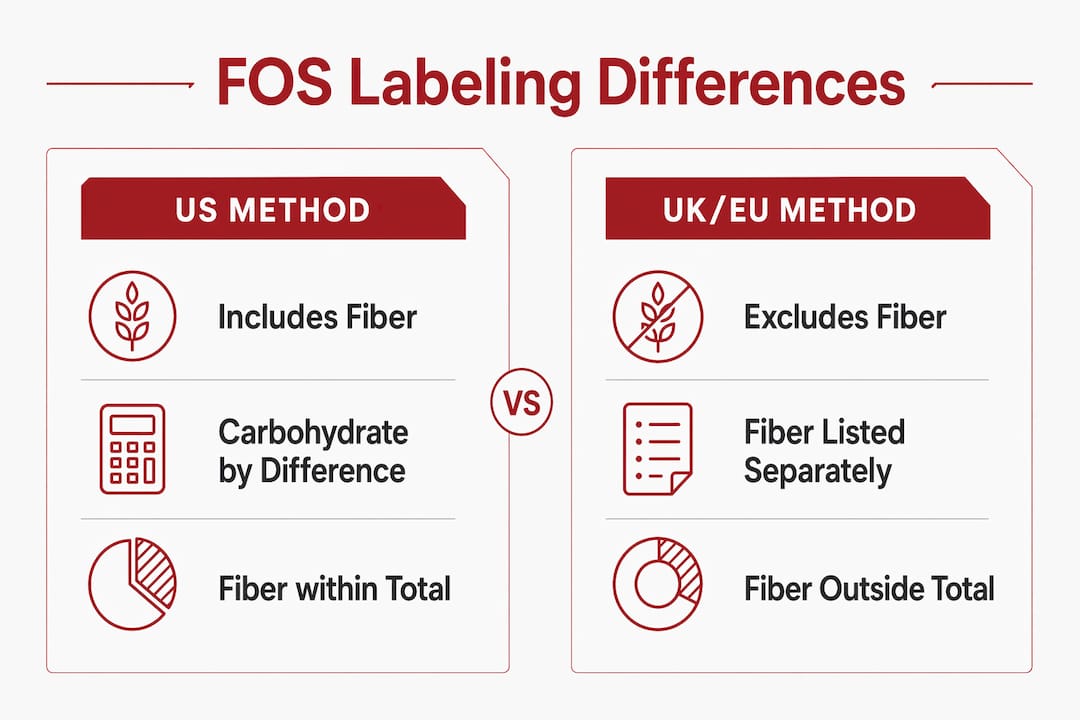
| Label element | US method | UK/EU method |
|---|---|---|
| Total carbohydrates | Includes fiber | Excludes fiber |
| Fiber declaration | Subset of total carbs | Separate line, not in carbs |
| Net carbs calculation | Subtract fiber from total carbs | Not an official label term |
| FOS appearance | Inside total carb count | Outside total carb count |
Net carb calculations add another layer of confusion. In the US, subtracting fiber from total carbs is a common practice for people managing carbohydrate intake, and FOS fiber counts toward that subtraction. In the UK, fiber is already excluded from the carbohydrate total, so subtracting it again would undercount actual carbohydrates. For a FOS-rich product like yacon syrup, this distinction matters when you are comparing labels across different markets.
Pro Tip: If you are comparing a US product with an imported one, always check which labeling standard applies. A UK label showing 10g of carbs may be equivalent to a US label showing 18g of carbs for the same food, once fiber is accounted for.
What makes FOS behave differently from other fibers?
FOS is not a single molecule. It is a family of short-chain fructan compounds that vary in chain length, and that variation drives real differences in how the body processes them. Understanding this helps explain why the differences in FOS measurement go beyond regulatory paperwork.
Short-chain FOS ferments faster in the colon than longer-chain inulin. Faster fermentation means quicker effects on gut bacteria, but it also means more gas production in a shorter window of time. Longer-chain inulin moves further into the colon before fermenting, which spreads the fermentation load and tends to cause fewer immediate digestive symptoms. The chain length of the FOS in a product directly affects both its gut impact and, in some cases, how it is classified.
FOS fermentation also produces short-chain fatty acids (SCFAs) like butyrate, propionate, and acetate. These SCFAs supply some caloric energy to the body, even though FOS is not absorbed as glucose. That caloric contribution creates ambiguity in metabolic labeling. FOS is not sugar, but it is not calorie-free either. The energy it provides comes indirectly through fermentation, which is why its caloric value is difficult to pin down on a standard label.
Two FOS products with identical ingredient names can show different fiber content on US labels depending on the FDA approval status and the chain length of the specific fructans used. This is not a labeling error. It reflects the genuine complexity of how FOS interacts with regulatory definitions and human physiology at the same time.
- Short-chain FOS ferments faster, producing more gas but quicker prebiotic effects.
- Longer-chain inulin ferments more slowly, with a gentler digestive profile.
- FOS fermentation yields SCFAs that provide indirect calories, complicating caloric labeling.
- Chain length variation means “FOS” on two different labels may describe chemically distinct compounds.
- Prebiotic benefits, including feeding beneficial gut bacteria like Bifidobacterium, depend on the specific FOS chain length present.
How to read FOS on labels and manage your intake
Reading a nutrition label for FOS content takes a little more attention than scanning for sugar or protein. The prebiotic label reading process starts with the ingredient list, not just the fiber line.
Look for terms like “fructooligosaccharides,” “oligofructose,” “chicory root extract,” or “inulin” in the ingredient list. Then check whether the Nutrition Facts panel lists dietary fiber. If the fiber line is present and the product is sold in the US, the manufacturer has met FDA requirements for that fiber claim. If no fiber is listed despite the ingredient being present, the FOS in that product counts only toward total carbohydrates.
For gut health, typical FOS doses range from 3–10 grams per day. Side effects become more common above 10–15 grams per day, including bloating, gas, and loose stools. These effects are more pronounced in people with irritable bowel syndrome (IBS) or those following a low-FODMAP diet, since FOS is a high-FODMAP fiber by nature. A fiber label does not guarantee digestive gentleness, and FOS’s high-FODMAP characteristics mean that sensitive individuals need to pay attention to dose, not just classification.
Here is a practical approach for reading FOS on labels:
- Check the ingredient list for FOS-related terms before looking at the fiber line.
- Confirm whether dietary fiber appears on the Nutrition Facts panel for that product.
- Note the serving size and estimate your total FOS intake across the day, keeping it within 3–10 grams for most people.
- If you have IBS or follow a low-FODMAP protocol, treat FOS-containing products with the same caution as other high-FODMAP foods.
- For international products, identify whether the label follows US or UK/EU standards before comparing carbohydrate counts.
Yakonow yacon syrup contains up to 50g of prebiotic FOS fiber per 100g, sourced from yacon root grown in Peru. Because it is bottled in an FDA-compliant facility in Texas, its labeling follows US standards. The FOS in Yakonow is naturally occurring, not isolated or synthetic, which places it in a different regulatory category than added FOS ingredients. That distinction matters when you are reading the label and comparing it with other sweeteners.
Pro Tip: Start with a small drizzle of any FOS-containing product if you are new to prebiotic fibers. Your gut microbiome adapts over time, and a gradual introduction reduces the chance of early digestive discomfort.
Key Takeaways
FOS counts differently on nutrition labels because its classification is a legal determination by the FDA, not just a biological fact, and because labeling methods differ fundamentally between the US and the UK.
| Point | Details |
|---|---|
| FDA fiber classification | FOS must show a beneficial physiological effect to appear as fiber on US Nutrition Facts labels. |
| US vs. UK labeling | US labels include fiber within total carbs; UK labels list fiber separately, creating different carb counts for the same food. |
| Chain length matters | Short-chain FOS ferments faster than inulin, producing different gut effects and affecting how products are categorized. |
| Caloric ambiguity | FOS fermentation yields SCFAs that provide indirect calories, complicating standard metabolic labeling. |
| Practical intake guidance | Most people tolerate 3–10 grams of FOS per day; above 10–15 grams, digestive side effects become more likely. |
Why I think the FOS labeling conversation is worth having at the table
When I first started paying attention to prebiotic fibers, I assumed that a fiber was a fiber. If the label said “dietary fiber,” I trusted it. What I did not realize is that the fiber line on a US Nutrition Facts panel is the result of a regulatory process, not just a chemical test. Two products sitting side by side on a grocery shelf can contain the same ingredient and show completely different fiber counts, depending on what paperwork the manufacturer has filed.
That realization changed how I read labels, but it also changed how I think about food choices for my family. The goal is not to become a label detective at every meal. The goal is to understand enough to make calm, confident choices. When I reach for Yakonow yacon syrup on a slow Sunday morning, I am not running a biochemistry calculation. I am choosing something that comes from a single ingredient, grown in the Andes, with a naturally gentle profile that fits the way we eat as a family.
The nuances of how FOS supports digestion matter most not as a technical exercise but as a reason to slow down and pay attention to what we put on the table. Food that nourishes quietly, without drama or side effects, is the kind worth gathering around. Understanding FOS classification is one small piece of that larger practice of eating with intention.
— Celeste
Yakonow at the family table: a naturally sweet place to start
Yakonow yacon syrup brings up to 50g of naturally occurring prebiotic FOS fiber per 100g to your table, with a glycemic index of just 1 and zero added sugar. It is hand-harvested from yacon root in Peru and bottled in an FDA-compliant facility in Texas, so the labeling is clear and the sourcing is traceable.

Drizzle it over pancakes, waffles, oatmeal, or yogurt on a slow family morning. The FOS fiber feeds your gut gently, the sweetness is real and natural, and the label is honest. For families who want a sweetener that earns its place at the table, the single 6oz bottle is the easiest place to start.
FAQ
What does it mean that FOS counts differently on labels?
FOS appears as dietary fiber on some US labels and only as total carbohydrates on others, depending on whether the manufacturer has met FDA requirements for fiber classification. The difference is regulatory, not just chemical.
Why are FOS counted differently in the US vs. the UK?
The US includes fiber within total carbohydrates using the carbohydrate-by-difference method, while the UK lists fiber separately and excludes it from the total carb count. The same FOS-containing product will show different carbohydrate numbers depending on which standard applies.
How much FOS is safe to eat per day?
Most people tolerate 3–10 grams of FOS per day for gut health benefits. Side effects like bloating and gas become more common above 10–15 grams per day, particularly for people with IBS or FODMAP sensitivity.
Is FOS the same as inulin on a label?
FOS and inulin are related but not identical. FOS refers to shorter-chain fructans that ferment faster in the gut, while inulin typically refers to longer-chain versions with a slower fermentation rate and a gentler digestive profile.
Does naturally occurring FOS in yacon syrup count the same as added FOS?
Naturally occurring FOS from whole food sources like yacon root falls under a different regulatory category than isolated or synthetic FOS added to processed foods. The FDA’s physiological effect requirement applies primarily to isolated and synthetic non-digestible carbohydrates.