

The Gut-Friendly Breakfast Ingredient List for Families
Every morning is a small chance to feed your family well. The gut-friendly breakfast ingredient list that actually works is shorter than you think: rolled oats, plain yogurt or kefir, fresh berries, a ripe banana, chia or flaxseed, avocado, a small handful of nuts, and a drizzle of Yakonow yacon syrup. Those eight things, rotated and combined, cover the main categories your digestive system asks for: soluble fiber, prebiotics, live cultures, resistant starch, healthy fats, and gentle protein.
A quick start: stir together overnight oats with a spoonful of plain yogurt, a handful of blueberries, a teaspoon of chia seeds, and a light drizzle of Yakonow. That one bowl delivers probiotics, prebiotic fiber, and polyphenols in about three minutes of prep the night before.
Your morning checklist:
- Rolled oats or steel-cut oats
- Plain yogurt or kefir (with live cultures)
- Berries (blueberries, raspberries, strawberries)
- Banana or kiwi
- Chia seeds or ground flaxseed
- Avocado or a drizzle of olive oil
- Walnuts, almonds, or pumpkin seeds
- Yakonow yacon syrup (low-glycemic, prebiotic sweetener)
Key Takeaways
A gut-friendly breakfast ingredient list built around fiber, prebiotics, and live cultures, rotated across the week, is one of the most practical ways to support digestive wellness for the whole family.
| Point | Details |
|---|---|
| Core ingredient categories | Combine fiber, prebiotics, probiotics, resistant starch, healthy fats, and gentle protein at breakfast for broad gut support. |
| Pair prebiotics with probiotics | Oats with yogurt or chia with kefir delivers more benefit than either food alone, as confirmed by intervention research. |
| Introduce fiber gradually | Add one new high-fiber ingredient per week to avoid bloating; most GI discomfort resolves as gut bacteria adapt. |
| Rotate plant foods | Variety across the week builds microbial diversity more reliably than repeating the same bowl every morning. |
| Yakonow as a low-glycemic sweetener | Yakonow yacon syrup (glycemic index of 1, prebiotic FOS fiber) is a pantry-friendly way to sweeten breakfasts without added sugar. |
Table of Contents
- What makes a breakfast ingredient gut-friendly?
- The complete gut-friendly breakfast ingredient list, by category
- How to adapt this list if you have IBS or a sensitive gut
- Five quick gut-friendly breakfast recipes
- Practical rules for building gut-friendly breakfasts that stick
- What the research actually says about oats and FOS
- How to store and prep gut-friendly ingredients for the week
- A morning worth gathering around
- Yakonow yacon syrup: the sweetener that earns its place at the table
- Sources
What makes a breakfast ingredient gut-friendly?
Not every “healthy” food earns its place on a gut-health list. The ones that do tend to work through one of five mechanisms, and understanding them briefly makes the ingredient choices feel less arbitrary.
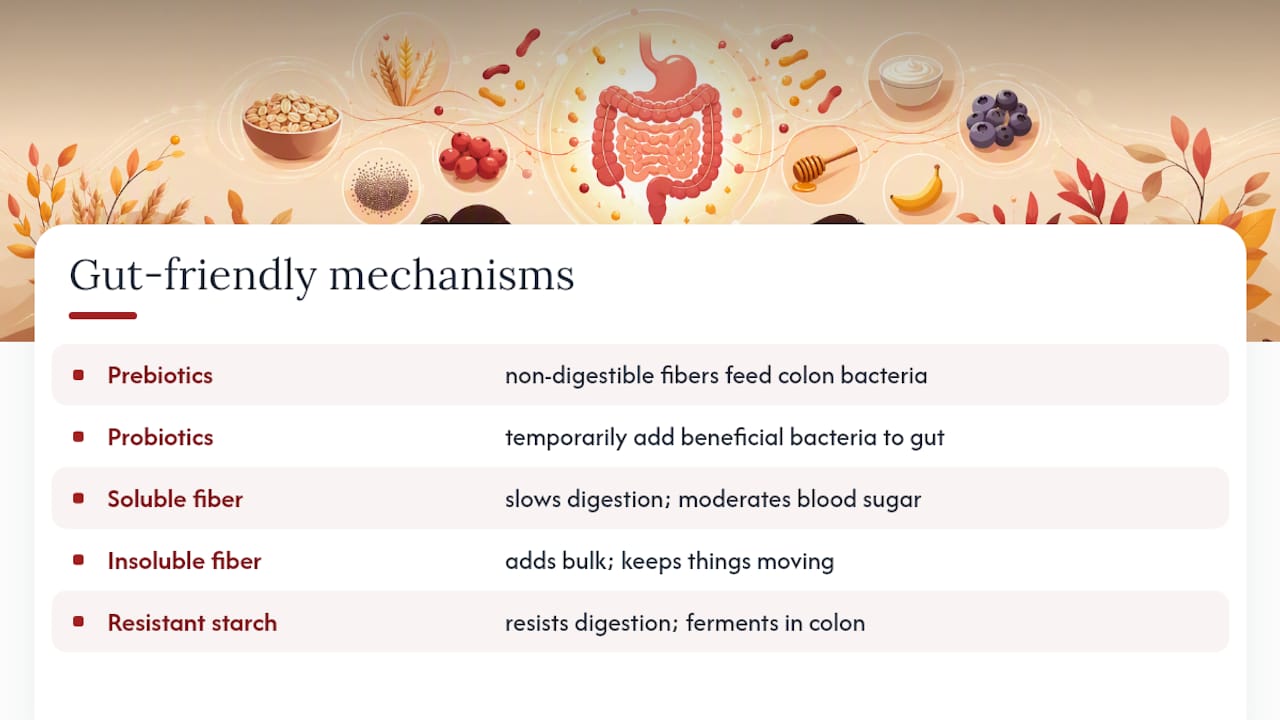
Prebiotics are non-digestible fibers that feed beneficial bacteria already living in your colon. Think oats, banana, and yacon syrup. Probiotics are live microorganisms found in fermented foods such as plain yogurt and kefir that temporarily add beneficial bacteria to your gut. Soluble fiber (found in oats, chia, and apples) dissolves in water, slows digestion, and moderates blood sugar. Insoluble fiber (found in whole-grain bread and flaxseed) adds bulk and keeps things moving. Resistant starch (found in cooled cooked oats, chilled rice, or firm bananas) resists digestion in the small intestine and ferments in the colon, feeding bacteria that produce short-chain fatty acids.
Those short-chain fatty acids, particularly butyrate, are what the gut lining runs on. When colonic bacteria ferment prebiotic fibers, they produce butyrate and other SCFAs that nourish the cells lining your intestine and support a healthy gut barrier. A clinical study on short-chain oat beta-glucan found robust SCFA production at doses up to 20 g/day with good tolerability, which is encouraging for oat-forward breakfasts.
Beta-glucan callout: Oat beta-glucan is one of the best-studied prebiotic fibers in breakfast foods. It slows gastric emptying, moderates postprandial glucose, and feeds colonic bacteria that produce butyrate.
Two practical implications: choose plain yogurt with “live and active cultures” on the label (not heat-treated after fermentation), and favor rolled or steel-cut oats for their higher content of beta-glucan.
The complete gut-friendly breakfast ingredient list, by category
This is the grocery-ready version. Use it to stock your pantry once a week and rotate freely.
Whole grains and cereals
- Rolled oats — soak overnight for easier digestion; the beta-glucan content is highest in less-processed forms
- Steel-cut oats — slower to cook but more intact fiber; batch-cook on Sundays
- Quinoa — a complete protein and good source of insoluble fiber; works warm or cold
- Whole-grain sourdough bread — the fermentation process partially breaks down gluten and phytic acid, making it gentler on digestion
- Whole-grain wheat cereal — a crossover human study found it increased bifidobacteria and lactobacilli, confirming a genuine prebiotic effect
Probiotic dairy and alternatives
- Plain whole-milk yogurt — look for “live and active cultures”; avoid flavored versions with added sugar
- Kefir — more diverse bacterial strains than most yogurts; works well in smoothies
- Coconut yogurt (unsweetened) — a dairy-free option that still delivers live cultures if labeled accordingly
Prebiotic fruits and vegetables
- Blueberries, raspberries, strawberries — polyphenols feed beneficial bacteria. Berries are also lower in sugar than tropical fruits
- Banana (slightly underripe) — higher resistant starch content than fully ripe; riper bananas are sweeter but lower in resistant starch
- Kiwi — a gentler option for sensitive guts; contains actinidin, an enzyme that supports protein digestion
- Apple (with skin) — pectin is a soluble fiber with a different fermentation profile than beta-glucan, adding microbial diversity
- Spinach or baby greens — easy to blend into smoothies; adds inulin-type fibers
Seeds and nuts
- Chia seeds — swell into a gel that slows digestion; 1–2 tablespoons per serving is plenty
- Ground flaxseed — grind fresh or buy pre-ground; whole seeds pass through largely undigested
- Walnuts — polyphenols and omega-3s; research links regular walnut consumption to more diverse gut bacteria
- Pumpkin seeds — zinc and magnesium alongside fiber; good for topping yogurt bowls
Healthy fats
- Avocado — nearly 10 grams of fiber per fruit; slice onto toast or blend into smoothies
- Extra-virgin olive oil — a small drizzle on eggs or toast adds oleic acid and polyphenols
Resistant starch options
- Cooled cooked oats — reheating after chilling increases resistant starch content slightly
- Chilled cooked sweet potato — works sliced cold or warmed gently; pairs well with yogurt and cinnamon
- Firm (slightly green) banana — the most convenient resistant starch source in a breakfast context
Proteins and quick add-ins
- Eggs — easy protein that keeps hunger steady; pair with avocado toast and seeds for a complete gut-friendly plate
- Yakonow yacon syrup — a single-ingredient Peruvian syrup with a glycemic index of just 1 and up to 50g of prebiotic FOS fiber per 100g; drizzle over oat bowls, stir into yogurt, or use on pancakes instead of maple syrup
Pantry staples to keep stocked: rolled oats, chia seeds, ground flaxseed, plain yogurt, kefir, frozen berries, walnuts, avocado, whole-grain sourdough, Yakonow yacon syrup.
Pro Tip: Frozen berries are just as rich in polyphenols as fresh and often cheaper. Keep a bag in the freezer so a gut-friendly breakfast is always within reach, even on rushed mornings.
How to adapt this list if you have IBS or a sensitive gut
Tolerability varies more than most ingredient lists acknowledge. Many of the foods above are high in FODMAPs (fermentable oligosaccharides, disaccharides, monosaccharides, and polyols), which can trigger bloating, cramping, or loose stools in people with IBS-like sensitivities. The good news: most of the gut benefits are still reachable with a few swaps and smaller portions.
Low-FODMAP swaps for common breakfast ingredients:
- Replace ripe banana with kiwi or firm strawberries (lower fructose load)
- Choose lactose-free yogurt or kefir over regular dairy if lactose is a trigger; kefir is often better tolerated because fermentation reduces lactose content
- Limit apple to a small portion (half a medium apple) or swap for blueberries
- Use oats in moderate portions (half a cup dry); oats are low-FODMAP at standard serving sizes
- Start with 1 teaspoon of Yakonow yacon syrup rather than a full tablespoon; yacon is rich in FOS, which is a FODMAP at higher doses. The FOS meta-analysis notes that mild bloating is the most common side effect at higher doses, so starting small is the sensible approach
- Avoid large servings of chicory-based products (inulin powder, chicory root coffee) if you are sensitive
Red flags to watch for: new or worsening severe abdominal pain, significant changes in bowel habits that persist beyond two weeks, or blood in stool. These warrant a conversation with a clinician, not a dietary tweak.
For daily prebiotic routines with IBS, the general guidance is to introduce one new prebiotic food at a time, in small amounts, and give your gut two to three weeks to adjust before increasing the portion.
Pro Tip: Pair a new prebiotic food with a probiotic food in the same meal. Practitioners find that combining them, say chia seeds stirred into kefir, tends to reduce the gas and bloating that sometimes comes with introducing prebiotics alone.
Five quick gut-friendly breakfast recipes
These five combos use ingredients from the list above. Three are make-ahead; two come together in under ten minutes on a busy morning.
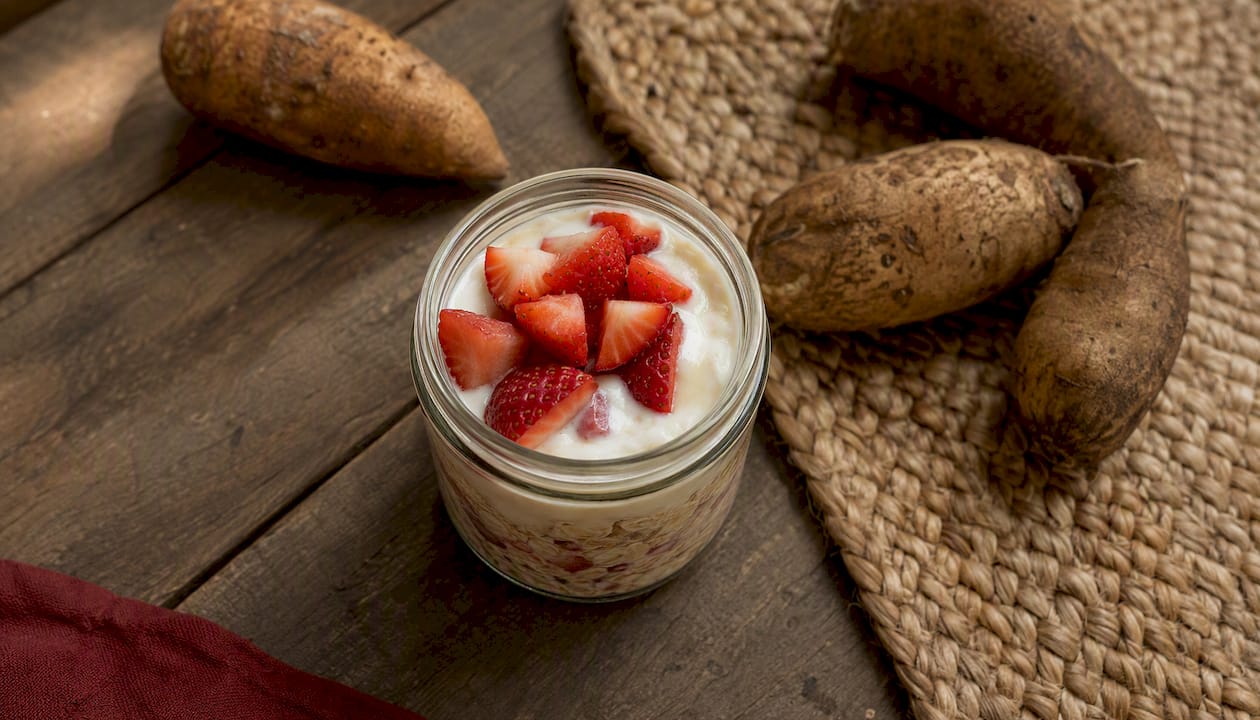
1. Overnight oats with yogurt and berries (make-ahead, 5 minutes prep) Combine ½ cup rolled oats, ½ cup plain yogurt, ½ cup kefir, 1 tablespoon chia seeds, and a handful of frozen blueberries in a jar. Refrigerate overnight. Drizzle with Yakonow yacon syrup before serving. The yogurt-and-oats combination delivers both probiotic and prebiotic benefit in a single bowl.
2. Kefir smoothie with banana, spinach, and chia (quick, 5 minutes) Blend 1 cup kefir, 1 small firm banana, a large handful of baby spinach, 1 tablespoon ground flaxseed, and a few ice cubes. The banana adds resistant starch; the kefir brings live cultures; the flax adds omega-3s and insoluble fiber.
3. Chia pudding with berries and Yakonow (make-ahead, 3 minutes prep) Stir 3 tablespoons chia seeds into 1 cup unsweetened coconut milk. Refrigerate for at least four hours or overnight. Top with raspberries and a light drizzle of Yakonow. Swap coconut milk for oat milk if preferred.
4. Sourdough avocado toast with seeds and sauerkraut (quick, 8 minutes) Toast a slice of whole-grain sourdough. Mash half an avocado on top with a squeeze of lemon. Add a tablespoon of sauerkraut on the side (or on top), a sprinkle of pumpkin seeds, and a pinch of chili flakes. The sauerkraut adds live cultures; the sourdough and avocado deliver fiber and healthy fat.
- Sensitivity swap: skip the sauerkraut if fermented foods cause bloating; add a spoonful of plain yogurt on the side instead.
5. Warm apple-cinnamon oats with flax and yacon syrup (quick, 10 minutes) Cook ½ cup rolled oats in water or oat milk. Stir in half a diced apple (skin on), ½ teaspoon cinnamon, and 1 tablespoon ground flaxseed. Finish with a small drizzle of Yakonow yacon syrup. The apple’s pectin and the oat beta-glucan offer two different fiber fermentation profiles, which supports microbial diversity.
Practical rules for building gut-friendly breakfasts that stick
Good intentions at the grocery store don’t always survive a Tuesday morning. These rules are designed to be simple enough to actually use.
- Rotate your plants across the week. Gastroenterologists emphasize that variety, not any single superfood, builds a resilient microbiome. Aim for a different fruit or grain each day rather than the same bowl every morning.
- Pair a prebiotic with a probiotic in the same meal. Oats with yogurt. Chia pudding with kefir. The combination is more useful than either alone.
- Increase fiber gradually. Adding too much too fast is the most common reason people give up on gut-friendly eating. Add one new high-fiber ingredient per week.
- Keep portions moderate. A tablespoon of chia seeds, not three. Half an avocado, not a full one. More is not always better when it comes to fermentable fibers.
- Hydrate alongside fiber. Soluble fiber absorbs water; without enough fluid, it can slow digestion rather than support it. A glass of water with breakfast is not optional.
- Use the cool-then-reheat trick for resistant starch. Cook oats or sweet potato the night before, refrigerate, then warm gently in the morning. Cooling increases resistant starch content.
- Batch-prep on Sundays. Cook a large pot of steel-cut oats, pre-portion chia seeds and flax into small jars, and wash berries. Mornings get easier when the work is already done.
- Keep plain yogurt in single-serve containers. It removes the friction of measuring and makes it easy for kids to grab their own.
Pro Tip: When adding a new prebiotic food, start with half the standard serving for the first week. Most GI discomfort from fiber is temporary and resolves as gut bacteria adapt, but starting small makes the transition much more comfortable.
What the research actually says about oats and FOS
Two ingredients on this list have the strongest evidence behind them, and both are worth understanding briefly.
Beta-glucan from oats
Oat beta-glucan is a soluble, viscous fiber that slows gastric emptying, moderates the glucose response after eating, and feeds colonic bacteria that produce butyrate and other short-chain fatty acids. A clinical study on short-chain oat beta-glucan found it was well tolerated at doses up to a high amount in healthy adults, with robust SCFA production, suggesting that oat fiber can be both functional and gentle on the gut. Trials generally use 3–6 grams of beta-glucan per day, which is roughly what you get from a standard half-cup serving of rolled oats.
Research note: A fiber-forward breakfast increased the proportional abundance of bifidobacteria and butyrate-producing bacteria compared to a higher-protein morning meal in a randomized trial, supporting the case for oat-centered breakfasts.
FOS from yacon and chicory
Fructooligosaccharides (FOS) are the prebiotic fibers found in yacon syrup, chicory root, and some fruits. A systematic review and meta-analysis found that FOS supplementation reliably increases Bifidobacterium counts in the colon, with stronger effects observed at higher doses and longer durations. Mild bloating was the most commonly reported side effect at higher doses.
Practical takeaways from the evidence:
- Both oat beta-glucan and FOS support gut health for most people, but introduce them slowly
- Standard breakfast portions (half a cup of oats, one teaspoon of yacon syrup) are well within tolerable ranges for most adults
- Effects on the microbiome can be transient and individual; consistency over weeks matters more than any single serving
How to store and prep gut-friendly ingredients for the week
The way you store and prepare these ingredients affects how much benefit they actually deliver.
Oats: Store rolled and steel-cut oats in an airtight container in a cool, dry pantry. They keep for up to 12 months. Soaking oats overnight in water or milk before cooking softens the fiber and makes it easier to digest, particularly for people with sensitive stomachs.
Yogurt and kefir: Keep refrigerated and consume before the use-by date. Heat destroys live cultures, so never microwave yogurt or add it to hot food. Stir it into warm (not hot) oats after they’ve cooled slightly.
Berries: Fresh berries are best used within three to four days. Frozen berries retain their polyphenol content well and are a practical pantry staple. Thaw overnight in the fridge or add directly to smoothies from frozen.
Chia and flaxseed: Whole flaxseeds pass through the gut largely undigested. Buy pre-ground flax or grind small batches in a coffee grinder. Store ground flax in the freezer to prevent the oils from going rancid. Chia seeds keep at room temperature for up to two years in a sealed container.
Avocado: Ripen at room temperature, then refrigerate once ripe. A cut avocado keeps better with the pit left in and a squeeze of lemon juice over the surface; press plastic wrap directly against the flesh to slow browning.
Yakonow yacon syrup: Store at room temperature before opening. Once opened, refrigerate and use within a few months. The syrup’s natural FOS content remains stable when stored correctly.
Walnuts and seeds: Keep in the freezer if you buy in bulk. The oils in nuts and seeds oxidize quickly at room temperature, especially in warm kitchens.
A morning worth gathering around
There is something quietly satisfying about a breakfast table that feels considered. Not elaborate, just intentional. A jar of overnight oats waiting in the fridge. A small pitcher of Yakonow on the counter next to the yogurt. The kids reaching for berries while you pour the coffee.
These small choices, a spoonful of kefir here, a drizzle of prebiotic syrup there, don’t need to be announced or explained. They just become part of the rhythm of the morning. And the morning, when it’s unhurried enough to be shared, is its own kind of nourishment. Try one of the combos from this list at your table this week. Start with the overnight oats. See how the morning feels.
Yakonow yacon syrup: the sweetener that earns its place at the table

Yakonow is a single-ingredient syrup made from hand-harvested Peruvian yacon root, bottled in Texas with nothing added. Its glycemic index sits at just 1, and it contains up to 50g of prebiotic FOS fiber per 100g, making it a genuinely different kind of sweetener: one that feeds your gut rather than spiking your blood sugar. It’s vegan, gluten-free, and free of colorants or artificial sweeteners.
For breakfast, it works three ways: drizzled over pancakes or waffles instead of maple syrup, stirred into a bowl of plain yogurt with berries, or blended into a kefir smoothie for a touch of natural sweetness. The flavor is mild and caramel-adjacent, which means kids take to it easily.

Ready to try it? The single 6oz bottle is a good starting point for a family morning, and the pack of two keeps the pantry stocked for the week without running out mid-recipe.
Sources
- The gut health breakfast doctors recommend
- Effects of Fructooligosaccharides (FOS) on gut microbiota and gastrointestinal symptoms (systematic review and meta-analysis)
- scOat Fiber tolerability and functional effects study
This article is general information, not a substitute for advice from a qualified doctor. Consult a qualified healthcare professional about your own circumstances before acting on anything here.