

Yacon Syrup Dosage: Keep Family Under 4 Teaspoons and Avoid GI Upset
For most families, the sweet spot is simple: one teaspoon for kids, one to two teaspoons for adults on a single pancake stack or bowl of oatmeal, with an occasional tablespoon if you love a heavier drizzle. Keep the whole household under about four teaspoons a day total, since more than that is where digestive upset tends to show up. This is culinary guidance for the breakfast table, not the larger amounts used in clinical research.
TL;DR:
- Most families should limit yacon syrup to one to two teaspoons per person daily to avoid digestive upset caused by fermentable prebiotic fiber.
- Introducing yacon syrup gradually over two weeks helps prevent gas, bloating, and loose stools, especially in children and sensitive stomachs.
- For regular breakfast use, a single 6-ounce bottle can last several weeks with modest daily amounts, while larger families may prefer multi-pack options.
- The typical culinary dose is well below the 20 to 40 grams used in clinical research, which is intended for experimental purposes rather than daily family servings.
- Yacon syrup’s flavor resembles caramel more than honey or maple, making it suitable as a topping or flavor enhancer rather than a one-to-one substitute in baking.
Table of Contents
- How Much Yacon Syrup Per Day Is Right for a Family?
- How Do You Introduce Yacon Syrup Without Upsetting Little Stomachs?
- Where Does Yacon Syrup Actually Belong on the Table?
- What Does Yakonow Actually Put in the Bottle?
- A Closer Look at Getting the Amount Right
- Which Yakonow Bottle Fits Your Breakfast Table?
- Sources
- FAQ
How Much Yacon Syrup Per Day Is Right for a Family?
A teaspoon of yacon syrup weighs about 5 grams. A tablespoon is three teaspoons, roughly 15 grams, though exact weight shifts slightly by batch since syrup density isn’t perfectly uniform. Once you know that, measuring becomes second nature, no kitchen scale required.
For a single serving, most families land here:
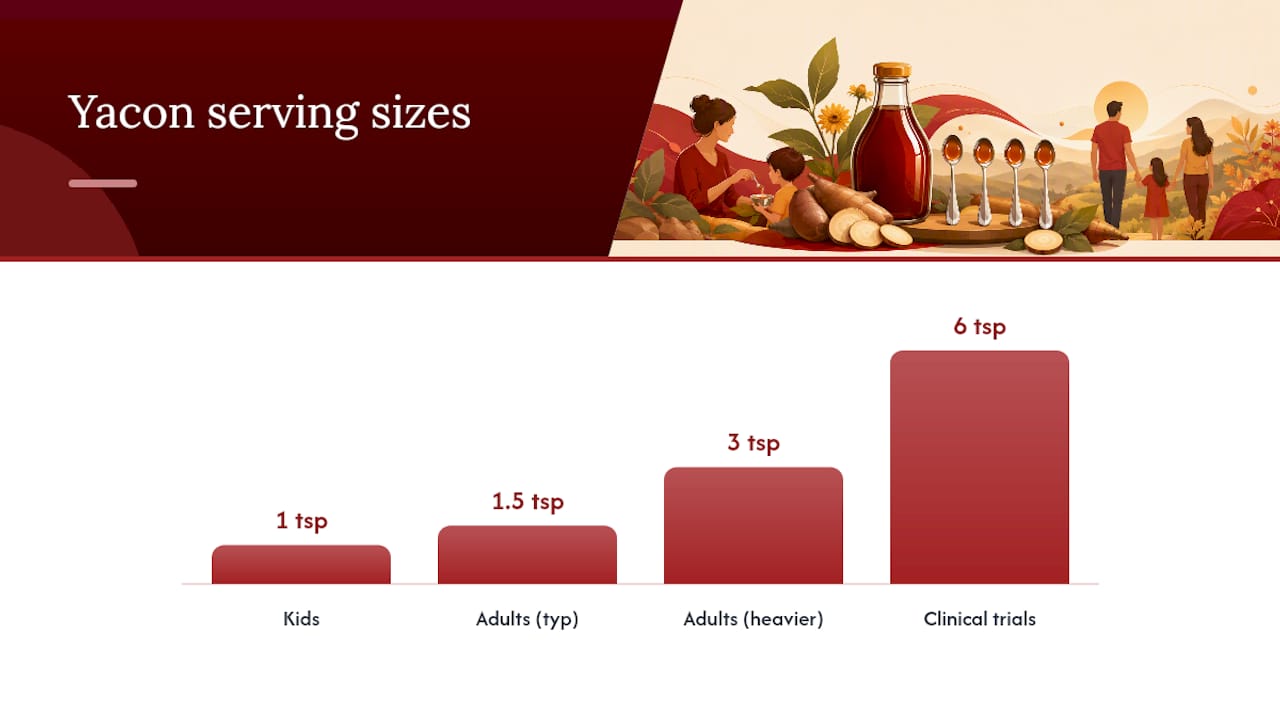
- Kids: 1 teaspoon on pancakes, oatmeal, or yogurt
- Adults: 1 to 2 teaspoons is typical; up to 1 tablespoon if you prefer a heavier drizzle
- Shared servings: 1 tablespoon split across two kids’ plates works well for pancakes or waffles
Pro Tip: If you’re measuring by eye instead of a spoon, one drizzle around the edge of a small bowl is close to a teaspoon. Two full loops is closer to a tablespoon.
Here’s a comparison worth keeping in your back pocket: yacon syrup carries about 20 calories per tablespoon, compared to roughly 54 for maple syrup. That’s a meaningful difference if you’re pouring syrup over breakfast several mornings a week, even though nobody at your table needs to think about it that way.
One more thing worth knowing before you reach for a bigger pour: the clinical trials behind yacon syrup’s research typically used 20 to 40 grams a day, which is four to eight teaspoons, given as part of controlled studies measuring specific health markers. Those numbers matter for researchers. They don’t apply to a Tuesday morning breakfast, and treating them as a target is where confusion (and stomachaches) start. Family serving sizes are built for taste and comfort, not study protocols.
How Do You Introduce Yacon Syrup Without Upsetting Little Stomachs?
Yacon syrup carries prebiotic fiber that your gut bacteria ferment, and fermentation, in any amount that outpaces your tolerance, means gas and bloating. The fix isn’t avoidance. It’s patience.
Start small, for everyone at the table, adults included:
- Day 1: A quarter to half teaspoon, stirred into oatmeal or dabbed onto a pancake corner.
- Days 2 to 4: Hold steady at that same small amount while you watch how everyone responds.
- Days 4 to 7: If all is well, move up to a half teaspoon to a full teaspoon.
- Week 2: Increase by another half teaspoon every three to four days, until you reach the comfortable one to two teaspoon range for adults, one teaspoon for kids.
Watch for bloating, extra gas, or looser stools along the way. If you notice any of that, pause where you are for a few more days rather than pushing forward. If a child has a stronger reaction, or symptoms that feel severe or don’t ease up, scale back and check in with your pediatrician before trying again.
Timing is flexible, and mostly about what fits your morning. Some people like a teaspoon 30 to 60 minutes before a meal, a habit borrowed from how other timed-nutrition approaches structure intake around meals. For most families, though, pouring it directly onto the plate at breakfast is easier and just as enjoyable. There’s no wrong way to fit it into the morning you already have.
Where Does Yacon Syrup Actually Belong on the Table?
This is where yacon syrup earns its place, not in a measuring spoon on a countertop, but in the small, ordinary moments that make a Tuesday breakfast feel like something worth sitting down for.
A few ways it shows up at real family tables:
- Pancakes or waffles: one tablespoon shared across two kids’ plates, or a teaspoon poured over each child’s stack
- Oatmeal: one to two teaspoons stirred in while it’s still warm, so the caramel notes bloom
- Yogurt and fresh fruit: one teaspoon per bowl, especially good over berries or sliced peaches
- Dessert drizzle: one teaspoon over a slice of pound cake or a scoop of vanilla ice cream
If you’re swapping it in for honey or maple syrup in a recipe, don’t assume a one-to-one trade. Yacon tastes different, more like caramel than floral sweetness, so start with half the amount your old recipe calls for and taste before adding more. For baking, treat yacon syrup as a topping or a no-bake ingredient rather than a batter replacement. If you do want to fold it into batter, cut back on other liquids slightly and test a small batch first, since it behaves differently under heat than maple or corn syrup.
A simple weekend idea: warm a spoonful in a small pan for thirty seconds, then swirl it over French toast with sliced bananas. It takes less effort than syrup from a bottle usually gets credit for.

What Does Yakonow Actually Put in the Bottle?
The syrup starts as yacon root, hand-harvested in Peru, then bottled in the US. That’s not a footnote. It’s the reason the syrup tastes the way it does and pours the way it does, batch after batch.
A few things worth knowing before your first pour:
- Yakonow carries a low glycemic index, which is a quiet reassurance rather than the main event. Nobody needs a lecture at breakfast.
- The glycemic load per tablespoon stays modest, which is worth knowing if a family member watches blood sugar closely.
- On the Yakonow blog, the team recommends starting with one to two teaspoons stirred into oatmeal, the same conservative range this guide lands on.
- Flavor-wise, expect something closer to caramel than honey, with less overt sweetness. That’s useful to know before you swap it in for a recipe that calls for a sweeter syrup.
None of this needs to be studied before Sunday brunch. It’s simply good to know the syrup in your cabinet has a real origin story behind it, not just a label.
A Closer Look at Getting the Amount Right
The instinct with any new ingredient is to either overdo it or ignore the guidance entirely, and yacon syrup gets caught by both mistakes constantly. Parents see “prebiotic fiber” on a label and assume more is better, the same logic that gets applied to fiber supplements and green powders. It doesn’t hold up here. The digestive upset that shows up at higher intakes isn’t a rare side effect. It’s a predictable response to fermentable fiber outpacing what a gut is used to, and it happens at doses well below what most trials used.
What gets underestimated is how little this actually requires from a busy parent. You don’t need a ramp-up spreadsheet or a food journal. You need a teaspoon, a little patience for the first week, and a willingness to notice how your family responds. The conventional advice online often either buries this in clinical language borrowed from research trials, or ignores tolerance altogether and just says “drizzle to taste.” Neither serves a parent standing at the counter at 7 a.m.
Start smaller than feels necessary. Let taste, not a target number, guide how far you go from there.
— Celeste
Which Yakonow Bottle Fits Your Breakfast Table?
If you’re pouring one to two teaspoons a few mornings a week, a single bottle goes further than you’d expect, and it’s the easiest way to find out if yacon syrup earns a permanent spot in your kitchen. At that pace, a 6oz bottle can realistically stretch across several weeks of oatmeal and pancake mornings.

For households where breakfast happens daily, and syrup gets pulled out for weekend waffles too, a single bottle disappears fast. That’s where a two-pack makes more sense: one bottle open on the counter, one in reserve, so you’re never mid-pour when it runs dry. Families with a full house, multiple kids, weekend guests, a merienda habit that happens most afternoons, tend to reach for the four-pack instead, simply so nobody has to ration.
A few practical notes: keep the bottle refrigerated after opening if the label recommends it, store it near your breakfast station rather than buried in a pantry, and browse the Yakonow blog for recipe ideas beyond the basics.
If you’re trying it for the first time, start with the single 6oz bottle. If breakfast is already a daily ritual in your house, go straight to the pack of two or the pack of four so your mornings never stall waiting on a reorder.
Sources
The Nutrients systematic review is the most thorough look at clinical yacon syrup trials, useful if you want to understand where research doses come from. Cleveland Clinic offers a clear, consumer-facing rundown of calories and suggested culinary timing. Healthline covers practical starting amounts and tolerance, useful if you’re introducing yacon syrup to a sensitive stomach for the first time.
- Impacts of Yacon Syrup (Smallanthus sonchifolius) on Human Health: A Systematic Review of Scientific Evidence from the Last Decade
- Is Yacon Syrup Healthy? — Cleveland Clinic
FAQ
How Much Yacon Syrup Should a Child Have Per Day?
Most families keep kids at around one teaspoon per serving, once or twice a day, starting with less and increasing slowly over a couple of weeks.
What’s the Safe Daily Amount for Adults?
A conservative daily range is one to two teaspoons per serving, staying under roughly four teaspoons total per day to avoid digestive discomfort.
Can Too Much Yacon Syrup Cause Side Effects?
Yes. Amounts beyond a comfortable daily range can cause bloating, gas, or loose stools, since the syrup’s prebiotic fiber ferments in the gut faster than some digestive systems adjust to.
Is Yacon Syrup Dosage the Same as What’s Used in Studies?
No. Clinical trials often used 20 to 40 grams a day, far more than the one to two teaspoons recommended for everyday family cooking.
What’s the Best Time to Use Yacon Syrup?
Most families simply add it at mealtime, on pancakes, oatmeal, or yogurt, though some prefer a teaspoon 30 to 60 minutes before eating as a smaller, optional habit.