

Yacon Syrup in Pregnancy? 60% Report Gas, Keep Family Breakfasts Safe
Short answer: avoid yacon syrup during pregnancy and check with your clinician before using it while breastfeeding. The research behind the safety of yacon syrup during pregnancy simply does not exist yet. Every major human trial excludes pregnant and lactating participants, and the syrup’s known side effects, mainly gas and bloating, are dose-dependent and worth flagging to your doctor before you add it to your table.
TL;DR:
- Yacon syrup’s safety during pregnancy is unproven because all human studies exclude pregnant participants, and no specific safety data exist for this group.
- The syrup commonly causes gas and bloating, especially in sensitive individuals or those with gastrointestinal conditions, which could worsen during pregnancy.
- Clinical doses studied range from 20 to 40 grams daily, but no safe upper limit for pregnant women has been established since no research includes this population.
- Pregnant and breastfeeding individuals should consult their healthcare provider before considering yacon syrup, starting with very small amounts if approved.
- Animal studies show no toxicity at high doses, but they do not replace the need for pregnancy-specific research, so caution remains essential.
Table of Contents
- What Is Yacon Syrup and Why Is Pregnancy Data Missing?
- What Do the Human Trials Actually Show?
- Could Yacon Syrup Cause Problems During Pregnancy?
- How Should You Talk to Your Doctor About This?
- What Should You Know About Yakonow’s Yacon Syrup?
- Does Yacon Syrup Affect a Baby’s Development or Breast Milk?
- Is There a Safe Amount of Yacon Syrup During Pregnancy?
- A Note on Keeping the Table Sweet Without the Guesswork
- Bring Yakonow Back to the Table When You’re Ready
- Sources
- FAQ
What Is Yacon Syrup and Why Is Pregnancy Data Missing?
Yacon syrup comes from the root of a South American plant in the sunflower family, and its main active ingredient is a prebiotic fiber called fructooligosaccharide, or FOS. FOS passes through the small intestine mostly undigested and ferments in the colon, which is the mechanism behind both its gut-health reputation and its gas-producing side effects.
Clinical researchers have studied yacon syrup in adults for its effects on blood sugar, cholesterol, and digestion, but the dosing varies quite a bit study to study. Common intakes in the research include:
- A single 40 g dose supplying about 14 g of FOS, used in short acute trials
- 20 g per day, delivering roughly 6.4 g of FOS, over several weeks
- 40 g per day (8.74 g FOS) sustained for two weeks in a pilot trial on blood lipids and glucose
- Longer 120-day interventions using 0.14 to 0.29 g of FOS per kilogram of body weight, per the systematic review in Nutrients
Every one of those studies lists pregnancy and lactation as an exclusion criterion. That is standard practice for a functional food that has not been through pregnancy-specific safety testing, but it also means there is no clinical evidence describing how yacon syrup behaves in a pregnant body.
What Do the Human Trials Actually Show?
The evidence on yacon syrup is a mixed bag, even for the non-pregnant adults it was tested on. A 2025 systematic review pooling seven human studies and 161 participants found some improvements in insulin resistance markers like HOMA-IR and modest LDL cholesterol reductions in a few trials, alongside consistent effects on gut transit time. None of it amounts to a green light for pregnancy use, since the review’s own authors note the pregnant and lactating exclusion across the board.
One trial found that roughly 60% of participants taking yacon syrup reported flatulence, compared with about 10% on placebo, according to Drugs.
That statistic matters because it shows the side effect profile is real and common, not a rare fluke. The pattern holds across the research:
- Acute single-dose studies (around 40 g) showed little effect on appetite hormones like ghrelin, with mild gastrointestinal discomfort noted
- Two-week trials at roughly 8.74 g of FOS per day reported no meaningful shifts in lipids or glucose, per the 2019 pilot study
- Longer 120-day studies found improved satiety and colonic transit in some women, suggesting the gut effects may soften with sustained use
Sample sizes in most of these trials run small, often a few dozen participants, and none of them tell us how a pregnant digestive system, already more sensitive to bloating and reflux, would respond. Our breakdown of yacon syrup side effects covers the gas and bloating pattern in more detail if you want the full picture.
Could Yacon Syrup Cause Problems During Pregnancy?
The honest answer is: nobody knows, and that uncertainty is itself the risk. Gastrointestinal intolerance is the most consistent finding in yacon research, and pregnancy already comes with a slower gut, more reflux, and heightened sensitivity to bloating in most people. Layering a fermentable fiber like FOS on top of that can make an already uncomfortable trimester worse, even without any deeper concern.
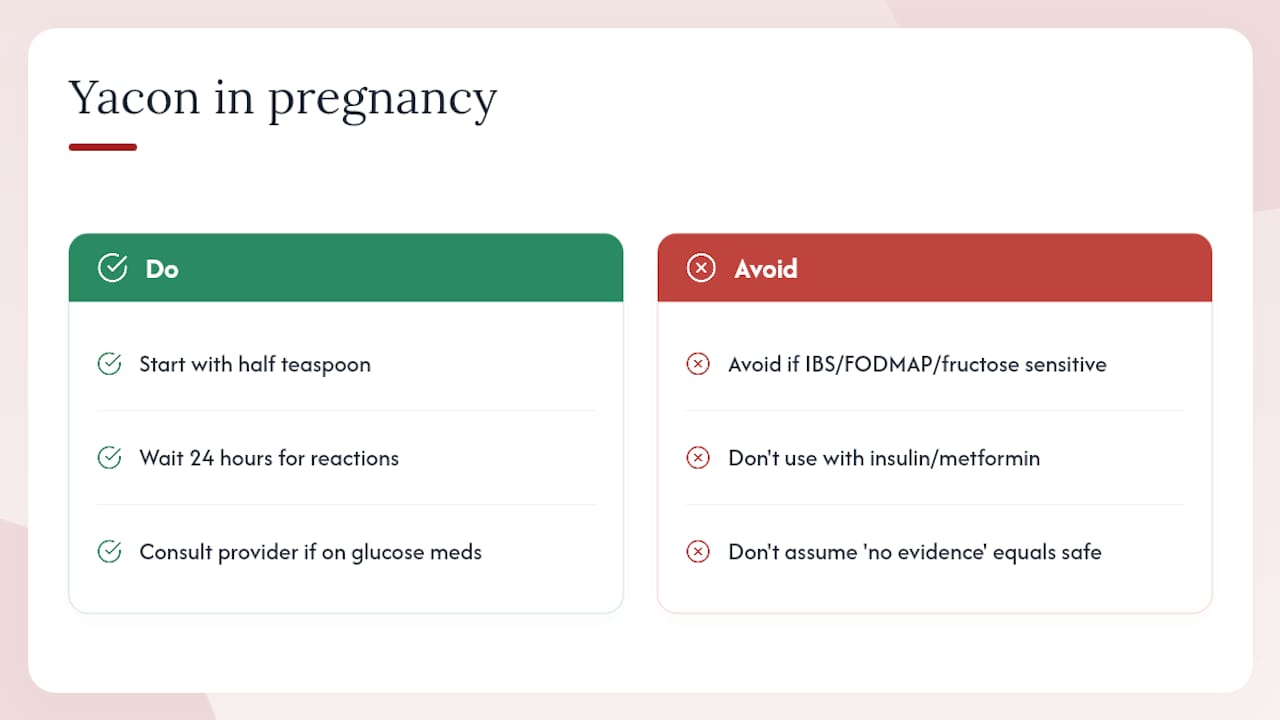
If you deal with irritable bowel syndrome, fructose malabsorption, or general FODMAP sensitivity, you are more likely to feel those effects, according to Cleveland Clinic’s overview of yacon syrup. Pregnancy hormones can amplify digestive sensitivity even in people who normally tolerate FOS-rich foods without issue.
Pro Tip: If your clinician does clear a small taste during breastfeeding, start with a half teaspoon rather than a full serving, and wait 24 hours to watch for gas or loose stools before trying more.
If you manage gestational diabetes or take any glucose-lowering medication, talk to your provider before considering yacon syrup at all. The syrup carries a low glycemic profile, but combining any glucose-active food with insulin or metformin without medical guidance is not a decision to make solo.
No study has flagged a teratogenic effect, meaning nothing in the animal or human research points to birth defects or developmental harm. But absence of a red flag is not the same as proof of safety, and that distinction is exactly why clinicians default to caution here. Readers managing fructose sensitivity may also find our yacon syrup and FODMAP guide useful context, separate from the pregnancy question.
How Should You Talk to Your Doctor About This?
Bring specifics, not just the general question. A short checklist before your appointment saves time and gets you a more useful answer:
- Note your trimester and any history of GI issues like IBS or reflux
- Mention whether you have gestational diabetes or take glucose-related medication
- List current supplements or sweeteners you already use, including any known allergies
- Ask your provider directly whether the current evidence supports any use during your pregnancy or while breastfeeding
- If they are open to it, ask what a reasonable starting amount would look like and what symptoms should prompt you to stop
Good questions to bring: What does the evidence actually say about FOS and pregnancy? Does yacon interact with anything I am taking? Is there a serving size you would consider low-risk? What should I watch for if I try it while nursing?
In the meantime, you do not have to give up the ritual of a sweet Sunday breakfast. A few thin slices of ripe banana or peach over oatmeal, a drizzle of the syrup you already know your body tolerates, or simply a warmer bowl and a slower morning can carry the same feeling of care without introducing something unvetted.
What Should You Know About Yakonow’s Yacon Syrup?
Some yacon syrups are made from yacon root harvested in Peru and bottled in FDA-compliant facilities in the US. These syrups typically have a low glycemic index and contain prebiotic FOS fiber without added sugars, glucose, colorants, or artificial sweeteners.
Families use it the way they’d use any breakfast syrup: drizzled over pancakes and waffles, stirred into oatmeal or yogurt, spooned over fresh fruit, or folded into a weekend baking project. None of that changes the guidance above. If you are pregnant or breastfeeding, the same caution applies to Yakonow as to any other yacon syrup on the market: talk to your clinician first.
- Single origin: yacon root grown and hand-harvested in Peru
- Bottled in an FDA-compliant facility in Texas
- Low glycemic index
- High FOS prebiotic fiber content with no added sugars
Does Yacon Syrup Affect a Baby’s Development or Breast Milk?
This is the question most pregnant and nursing readers actually want answered, and the honest response is that there is no dedicated research to answer it. No published human study has measured yacon syrup’s effect on fetal development, placental transfer, or breast milk composition, because every clinical trial to date has excluded pregnant and lactating participants by design.
What exists instead is a small body of animal toxicology. A subchronic four-month oral toxicity study in rats looked at extended exposure to dried yacon root and did not find significant organ toxicity at the doses tested. That is useful background, but animal toxicology studies are built to catch major red flags in a different species, not to establish a safe human dose during pregnancy. Nothing about that study substitutes for pregnancy-specific human data.
The concern clinicians raise isn’t a documented harm to fetal development, since none has been reported. It’s the absence of any monitoring at all. Nobody has tracked FOS levels crossing into breast milk, checked for shifts in infant gut flora tied to a nursing parent’s yacon intake, or measured outcomes in pregnancies where yacon syrup was part of the diet. Until that research exists, the FOS mechanism explainer is a good primer on how the fiber behaves in the body generally, but it is not pregnancy-specific guidance.
Is There a Safe Amount of Yacon Syrup During Pregnancy?
There is no established safe maximum for yacon syrup during pregnancy, because no study has set one. Every dosing range in the clinical literature, from a single 40 g dose to 120-day trials using 0.14 to 0.29 g of FOS per kilogram of body weight, comes from research that excluded pregnant and breastfeeding people entirely. That means there is no ceiling, no floor, and no monitored range to point to.
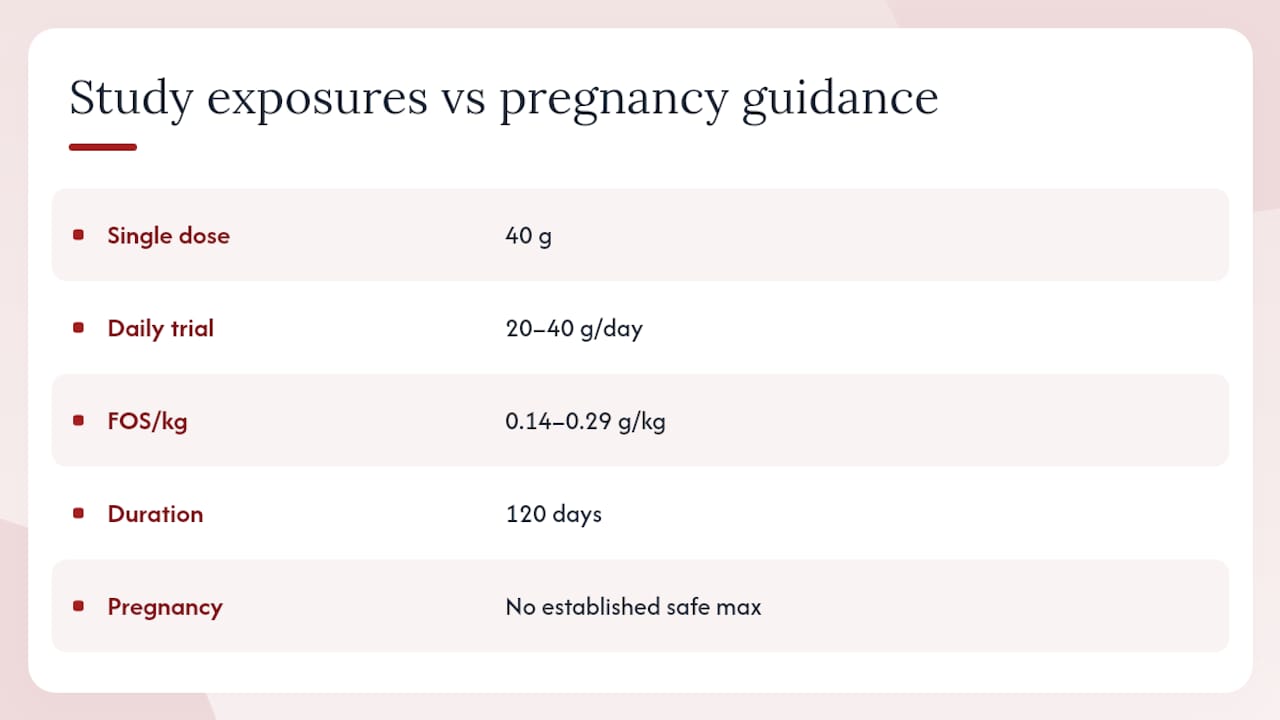
Trial doses also tend to run higher than a typical drizzle over pancakes. Most studies use 20 to 40 g of syrup per day, several teaspoons to multiple tablespoons, which is more than most families use in a single sitting. A smaller culinary serving may carry a different risk profile than a clinical trial dose, but nothing in the current evidence defines what that safer culinary amount would be during pregnancy.
Until pregnancy-specific research exists, the most defensible guidance is straightforward: during pregnancy, skip it. While breastfeeding, if your clinician approves any amount, start small, a teaspoon at most, and watch your baby and your own digestion closely for the first few days. This is not a syrup to introduce quietly on your own timeline.
A Note on Keeping the Table Sweet Without the Guesswork
Pregnancy asks you to hold two things at once: the instinct to keep your family’s rituals intact, and the discipline to pause on anything unproven. I don’t think those have to fight each other. A ripe pear fanned over yogurt, a cinnamon-dusted bowl of oatmeal, a slower Sunday where the syrup matters less than the company around the table, all of that keeps the ritual alive while you wait for your clinician’s go-ahead. Ask the question, get the answer, and let the table wait for you.
— Celeste
Bring Yakonow Back to the Table When You’re Ready
For everyone else at your table, the ones not pregnant or nursing, Yakonow is a simple swap for the syrup bottle you already reach for. It’s a single ingredient, hand-harvested from yacon root in Peru, with a glycemic index around 1 and up to 50 g of prebiotic FOS fiber per 100 g, no added sugar, no artificial anything.

If your clinician has cleared you to try it while breastfeeding, or you’re stocking the pantry for the rest of the family now and saving your own taste test for later, the single 6oz bottle is the easiest way to start. Busy mornings tend to go through syrup fast, so many households pick up the pack of two to keep breakfast moving without a mid-week grocery run. And if pancakes, oatmeal, and weekend baking are a standing ritual in your house, the pack of four keeps you from ever running dry. Order the size that fits your table, and let the rest of the family enjoy it while you wait for your own green light.
This article is general information, not a substitute for advice from a qualified doctor. Consult a qualified healthcare professional about your own circumstances before acting on anything here.
Sources
- Drugs
- Impacts of Yacon Syrup on Human Health: A Systematic Review (Nutrients, 2025)
- Subchronic 4-month oral toxicity study of dried Smallanthus sonchifolius roots — PubMed
- Effect of yacon syrup on blood lipid, glucose and metabolic endotoxemia in healthy subjects — pilot trial (2019 DOI)
FAQ
Is yacon syrup safe to use during pregnancy?
Current evidence does not support using yacon syrup during pregnancy, since every clinical trial excludes pregnant participants and safety data simply do not exist for this group.
Who should avoid yacon syrup?
Pregnant and breastfeeding people, anyone with IBS or fructose malabsorption, and people managing gestational diabetes or taking glucose-lowering medication should avoid yacon syrup or check with a clinician first.
Which syrup is better during pregnancy, yacon or maple?
Neither has pregnancy-specific safety research behind it, but maple syrup has a long history of ordinary food use at typical serving sizes, while yacon syrup’s prebiotic fiber content makes it more likely to cause gas or bloating in sensitive people.
Is yacon syrup healthier than honey?
Yacon syrup has a much lower glycemic index than honey and contains prebiotic FOS fiber that honey lacks, but neither has been studied specifically for pregnancy safety, so the comparison doesn’t change the guidance to consult your clinician first.