

Glycemic Load 3–4 per Tbsp: Yacon Syrup Nutrition for Families
Yacon syrup is concentrated juice from the yacon root, thickened into a syrup that’s unusually rich in fructooligosaccharides, or FOS, a fiber your body can’t fully digest. That fiber content is why it carries fewer usable calories than table sugar and a low glycemic impact per serving. Clinical trials link it to better satiety and faster colonic transit, with some longer studies showing improved insulin markers, though results aren’t uniform across every study. Start with small amounts. The gut needs a few days to adjust.
TL;DR:
- Yacon syrup can improve insulin markers over four months of consistent daily use, especially in individuals managing insulin resistance or excess weight.
- Its FOS content varies widely between brands, ranging from 17% to 50%, which significantly impacts fiber and metabolic effects.
- Most benefits, including faster colonic transit, appear within two weeks, while metabolic improvements require longer, sustained consumption.
- Higher FOS doses may accelerate transit and insulin markers but also increase the risk of gastrointestinal discomfort.
- A typical starting dose for most adults is one teaspoon daily, gradually increasing to one to two tablespoons, with attention to digestive tolerance.
Table of Contents
- Yacon Syrup Nutrition Facts: Calories, FOS, and Glycemic Load
- What’s Actually in Yacon Syrup? A Full Nutrition Breakdown
- How Does Yacon Syrup’s Fiber Affect Digestion and Metabolism?
- What Do Clinical Trials Say About Yacon Syrup’s Health Benefits?
- Who Actually Benefits From Yacon Syrup?
- How Much Yacon Syrup Should You Take, and What Are the Side Effects?
- Simple Ways to Use Yacon Syrup at the Family Table
- Why the Nutrition Story on Yacon Syrup Is More Interesting Than the Marketing
- Try Yacon Syrup at Your Own Table
- Sources
Yacon Syrup Nutrition Facts: Calories, FOS, and Glycemic Load
A tablespoon of yacon syrup runs lighter than the same spoonful of table sugar, and the reason comes down to one thing: a large share of its carbohydrate content is FOS, a fiber your digestive enzymes can’t break down the way they break down sucrose or glucose. Your body absorbs only a fraction of those FOS calories, which is why the usable energy per serving lands below what a nutrition label for sugar or honey would show for an equivalent pour.
Here’s what a standard tablespoon (about 20 grams) typically delivers, based on compositional analyses of yacon syrup:
- Calories: Roughly thirty to forty per tablespoon, generally lower than those in the same amount of maple syrup or honey.
- FOS content: Commonly 17% to 50% of total composition, depending on the cultivar and processing method.
- Simple sugars: Fructose and glucose make up most of the remaining digestible carbohydrate.
- Glycemic load: About 3 to 4 per tablespoon.
A tablespoon of Yakonow yacon syrup carries a glycemic load between 3 and 4 — for comparison, a tablespoon of honey or maple syrup typically lands closer to 10, because more of their carbohydrate content converts quickly to blood sugar. Glycemic load matters more than glycemic index alone here, because it accounts for the actual serving size people use. A syrup can have a moderate glycemic index but a low glycemic load if you only use a tablespoon at a time, which is exactly the case with yacon.
Scaled up to 100 grams, the picture holds the same shape: lower calories than sugar, honey, or maple syrup gram for gram, and a meaningfully higher fiber content than any of the three. Table sugar contributes zero fiber. Honey and maple syrup contribute close to none. Yacon syrup, depending on the batch, can carry a real fiber load in that same 100 grams, which is the entire reason its calorie count runs lower than a pure sugar comparison would predict.
If you’re swapping into a recipe that calls for maple syrup, the honest comparison between yacon and maple syrup comes down to this: similar pour consistency, a milder caramel note, and meaningfully less impact on blood sugar per serving.
What’s Actually in Yacon Syrup? A Full Nutrition Breakdown
The nutritional value of yacon syrup depends heavily on how much of its carbohydrate content is FOS versus simple sugar, and that ratio varies more between brands than most shoppers expect. A compositional study using NMR and mass spectrometry found FOS levels around 17% in one syrup sample, while other analyses of concentrated syrups report FOS climbing toward 40% to 50%. That’s not a small spread. It means two bottles labeled “yacon syrup” can behave differently in your body, one leaning closer to a standard sugar syrup, the other functioning much more like a fiber supplement with sweetness attached.
| Component | Typical range per 100g | Notes |
|---|---|---|
| Calories | Generally between 150 and 250 kcal | Lower than honey or maple syrup due to FOS content |
| FOS (prebiotic fiber) | Varied amounts typically from around 17 g up to 50 g | Varies by cultivar and processing; resists small-intestine digestion |
| Simple sugars (fructose, glucose) | Commonly 17% to 50% of total composition | Digested and absorbed like regular sugar |
| Chlorogenic acid | Measurable trace amounts | Contributes antioxidant activity |
| Potassium | Measurable trace amounts | Naturally occurring mineral from the yacon root |
The mineral and phenolic content is where yacon syrup differs from refined sweeteners beyond fiber. Analyses report measurable chlorogenic acid and potassium in yacon syrup, compounds largely absent in table sugar or corn syrup and present only in trace amounts in honey or maple syrup. This doesn’t turn yacon syrup into a supplement, but it does mean the nutritional value of yacon syrup extends past “lower calorie sugar substitute” into something closer to a minimally processed root extract that happens to taste sweet.
A few practical notes worth knowing before you start comparing labels:
- FOS percentage varies widely between products, so two bottles can differ significantly in fiber content even at the same serving size.
- Darker, more concentrated syrups generally carry higher FOS and lower simple-sugar ratios than thinner, lighter-colored versions.
- Processing temperature affects FOS stability. Excessive heat during production can break FOS chains down into simple sugars, which is part of why single-ingredient, minimally processed syrups tend to test higher on fiber content.
- Because cultivar and harvest conditions shift the numbers, treat any specific gram figure as a range, not a guarantee, unless the producer publishes its own compositional testing.
If a label doesn’t disclose FOS percentage or offer any compositional testing, that’s worth noticing. Transparency on this one number tells you a lot about whether you’re buying a fiber-forward syrup or a sweetener that happens to have “yacon” on the front of the bottle.
How Does Yacon Syrup’s Fiber Affect Digestion and Metabolism?
The mechanism behind yacon syrup’s effects starts in a place most sweeteners never reach: your colon. FOS passes through the small intestine largely undigested, then reaches the large intestine, where resident bacteria ferment it. That fermentation produces short-chain fatty acids, mainly acetate, propionate, and butyrate, compounds that do far more than just get excreted.
Short-chain fatty acids interact with the gut lining in ways that can influence satiety hormones like GLP-1 and PYY, and some research points to a role in improving insulin sensitivity over time. This is the biological thread connecting a spoonful of syrup to the outcomes researchers actually measure in clinical trials: fullness, blood sugar handling, and how quickly food moves through the digestive tract. A review of yacon’s fructooligosaccharides describes this prebiotic action directly. FOS selectively feeds beneficial bacteria like bifidobacteria and lactobacilli, shifting the balance of the gut microbiome in a way plain sugar never touches.
Here’s where it gets more personal than most sweetener discussions ever go: your results depend on your existing gut bacteria. That helps explain why one person swears by yacon syrup for steadier energy and better digestion, while another notices nothing beyond the taste. It’s not inconsistency in the product. It’s variation in the gut doing the fermenting.
This mechanism also explains two separate outcomes that show up in the clinical literature:
- Faster colonic transit. FOS fermentation increases stool bulk and softens transit time, which is measurable within about two weeks in trial settings.
- Improved fasting insulin markers. This effect shows up over much longer timelines, closer to four months of consistent daily intake, suggesting the metabolic benefit builds gradually rather than kicking in overnight.
Pro Tip: If you’re introducing yacon syrup to see how your gut responds, keep a simple one-line note each morning: how much you had, and how you felt by midafternoon. Two weeks of that gives you a clearer signal than guessing.
What Do Clinical Trials Say About Yacon Syrup’s Health Benefits?
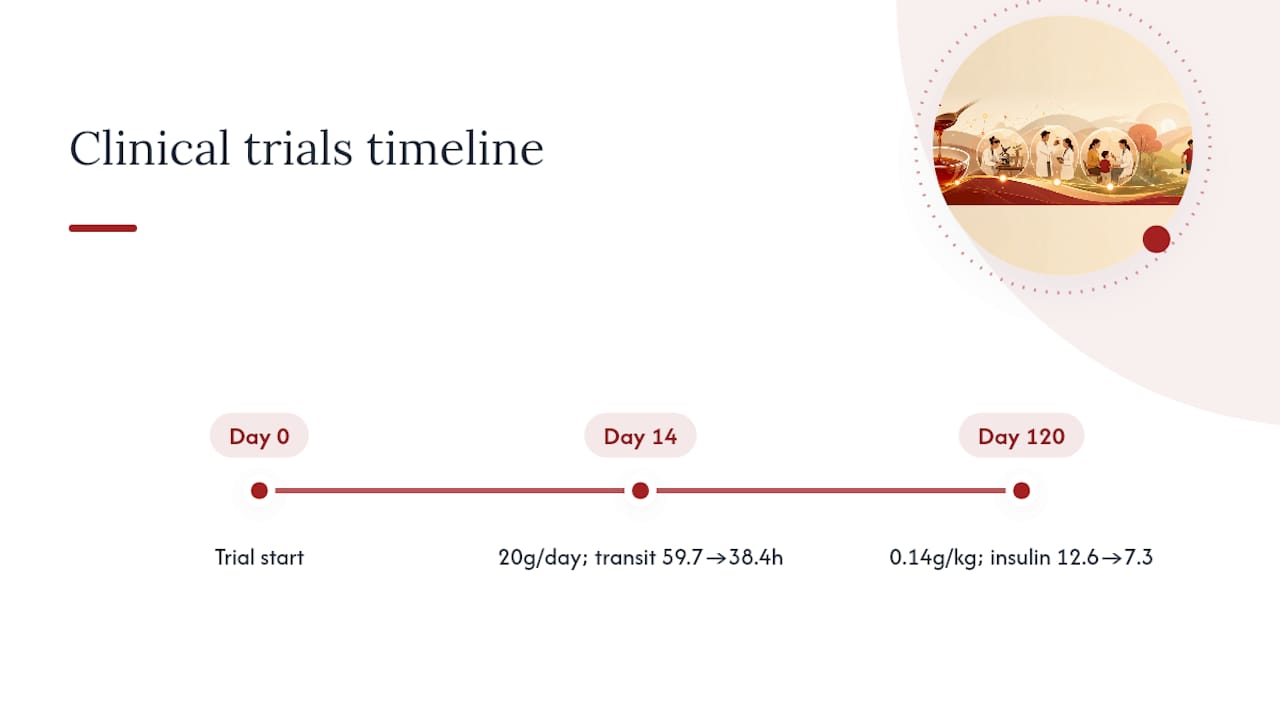
The clinical picture on yacon syrup is more specific than most sweetener research, and more mixed than marketing copy usually admits. A randomized, placebo-controlled trial followed obese women taking yacon syrup at roughly 0.14 grams of FOS per kilogram of body weight daily for 120 days. Fasting insulin dropped from 12.6 to 7.3 mUI/mL over that period, alongside measurable improvements in the HOMA insulin resistance index. That’s a meaningful shift, but it took four months of daily, consistent use to show up. This wasn’t a quick fix; it was a slow, cumulative change.
Gut transit responds much faster. A placebo-controlled crossover study gave healthy volunteers 20 grams of yacon syrup daily, about 6.4 grams of FOS, for two weeks. Mean colonic transit time dropped from 59.7 hours to 38.4 hours, a substantial acceleration that lines up with what you’d expect from a fermentable fiber source hitting the colon in a concentrated dose.
Not every trial finds a clean win. A two-week, double-blind pilot trial gave healthy subjects about 8.74 grams of FOS daily and found no significant change in blood glucose or lipid profiles. Healthy participants with normal metabolic function may simply have less room to improve than the obese women in the longer trial, and two weeks may not be enough time regardless of dose.
A systematic review covering trials through October 2024 pulls these threads together across seven studies and 161 participants. The pattern that emerges:
Satiety and intestinal transit improvements show up consistently across studies. Metabolic benefits, particularly around insulin and fasting glucose, appear more reliably in longer interventions than in short, acute trials. Acute glycemic effects, meanwhile, remain inconsistent from one study to the next.
That’s a more honest summary than “yacon syrup lowers blood sugar,” and it’s also more useful. The review’s own framing suggests duration matters as much as dose: give the fiber time to reshape gut fermentation patterns, and metabolic markers tend to follow. Rush it, and you may only notice the fiber’s more immediate effect, faster transit and a fuller feeling after eating.
Dose matters too, and not always in the direction you’d expect. Higher FOS intake accelerated transit and improved metabolic markers in the trials above, but it also raised the odds of gastrointestinal discomfort, a pattern worth understanding before you pour a generous serving on your first morning.
Who Actually Benefits From Yacon Syrup?
The clearest winners in the research are people managing insulin resistance or carrying excess weight, the exact population studied in the 120-day trial that showed measurable insulin improvement. If you’re simply looking for a lower-calorie sweetener without any particular metabolic concern, you’ll still get fewer calories per tablespoon than sugar or honey, but you’re less likely to notice a dramatic personal effect the way the studied population did.
It helps to be clear about what yacon syrup is not. It isn’t a fast-acting metabolic fix, and the research doesn’t support treating it as one. The insulin improvements documented in trials took four months of daily use to appear. Confounding factors like background diet, activity level, and existing microbiome composition all shape how much benefit any one person sees, which is exactly why trial results vary from person to person in the real world too.
A few things worth keeping in view:
- People with insulin resistance or higher body weight showed the clearest metabolic improvements in trials, over months, not days.
- Healthy individuals with no metabolic concerns are less likely to notice dramatic changes, based on the short-trial data.
- Gut bacteria composition, not just dose, predicts how strongly someone responds.
- The most consistent, fastest-appearing benefit across trials is digestive: colonic transit time improved within two weeks in controlled studies, well before any metabolic marker moved.
If your goal is a realistic one, swapping a spoonful of sugar or a squeeze of honey for a fiber-rich alternative at breakfast, track your own response over a few weeks rather than expecting a single dramatic before-and-after. Note tolerance, note energy, and if you’re monitoring blood sugar for clinical reasons, loop in your provider rather than relying on trial averages that may not reflect your own numbers.
How Much Yacon Syrup Should You Take, and What Are the Side Effects?
Trial data gives a useful range for how much FOS most people tolerate well, and where things start to go sideways. The 120-day trial that showed fasting insulin improvement used around 0.14 grams of FOS per kilogram of body weight daily, a dose tolerated without significant side effects over four months. A higher dose around 0.29 grams per kilogram led to more gastrointestinal discomfort. For an average adult, the lower, well-tolerated dose corresponds approximately to one to two tablespoons of yacon syrup daily, depending on FOS content and body weight. That’s not a precise prescription. It’s a starting range grounded in what trial participants actually took without trouble.
- Start with one teaspoon daily for three to five days and pay attention to how your gut responds.
- Increase gradually, adding roughly one teaspoon every three to five days if you’re tolerating the current amount well.
- Level off around one to two tablespoons daily, which lines up with the dose used in the trial showing insulin improvement.
- Watch for bloating, gas, or looser stools, especially in the first week. These typically ease as your gut bacteria adjust to the new fiber source.
- Pull back if symptoms persist past two weeks, and consider whether you started at too high a dose too quickly.
This gradual approach mirrors practical tolerance strategies described in FOS research, where a slow ramp reduces the abrupt digestive symptoms that showed up in trials using a higher starting dose from day one.
If you already manage irritable bowel syndrome or follow a low-FODMAP approach, FOS is a fermentable carbohydrate that can trigger symptoms in a sensitive gut, so introduce it in much smaller amounts than you would otherwise and stop if symptoms flare. Anyone monitoring blood sugar for diabetes should treat yacon syrup the same way they’d treat any new carbohydrate source: check with a provider and track your own numbers rather than assuming trial results transfer directly, and the same caution applies to anyone managing chronic constipation or GI sensitivity who’s adjusting fiber intake for the first time.
Pro Tip: Take yacon syrup with a meal rather than on an empty stomach for the first week or two. Food slows fermentation just enough to make the adjustment period gentler.
Simple Ways to Use Yacon Syrup at the Family Table
A tablespoon of yacon syrup drizzled over warm pancakes disappears the same way maple syrup does, quietly, without announcing itself, which is exactly the point. It pours a shade thinner than maple, carries a milder caramel note, and works just as well stirred into plain yogurt, spooned over oatmeal, or drizzled across a bowl of sliced peaches on a Sunday morning when nobody’s in a hurry.
Substituting yacon syrup for honey or maple syrup in most recipes is a near one-to-one swap by volume, though yacon syrup brings less moisture and a gentler sweetness, so you may want a touch more than the recipe calls for in baked goods. It’s not the right choice for high-heat baking or yeast breads, where sustained heat can break down the FOS content and where yeast needs the kind of simple sugar structure yacon syrup doesn’t fully provide. Save it for the applications where it shines: cold or gently warmed foods, morning bowls, and no-bake desserts.
- Drizzle over pancakes, waffles, or French toast in place of maple syrup.
- Swirl into plain or Greek yogurt with fresh berries.
- Stir into warm oatmeal alongside cinnamon and chopped nuts.
- Blend into a morning smoothie for natural sweetness without the sugar spike.
- Use in no-bake desserts where a milder sweetness suits the other ingredients.
There’s a particular kind of Sunday that starts with someone padding into the kitchen before anyone else is awake, pouring syrup over a plate they’ve already decided to share. That small, unhurried gesture is where a sweetener actually earns its place at the table, not in a nutrition panel, but in the moment it makes possible.
Why the Nutrition Story on Yacon Syrup Is More Interesting Than the Marketing
Most sweetener marketing wants you to believe in a single number, one glycemic index score or one calorie count that settles the question. The actual research on yacon syrup refuses to cooperate with that kind of simplicity, and I think that’s the most honest thing about it. The insulin improvements took four months to appear. The transit improvements showed up in two weeks. A short trial in healthy people found nothing at all. That’s not a product failing to perform. That’s biology behaving the way biology actually behaves, unevenly, over time, differently depending on who’s eating it.
What gets lost in most coverage of yacon syrup is the fiber transparency problem. That’s why sourcing and single-ingredient purity matter more here than with almost any other sweetener. This yacon syrup is bottled in an FDA-compliant facility in Texas, hand-harvested from yacon root grown in Peru, where the plant has been part of Andean food tradition for generations. One ingredient, one source, no added sugar, no fillers to dilute what the root actually provides.
The glycemic load of 3 to 4 per tablespoon isn’t a marketing claim invented for this article. It’s a measurable, low number precisely because so little of that tablespoon converts quickly to blood sugar. I’d rather a family understand that number honestly, low but not magic, gentle but not a cure, than reach for it expecting a transformation the evidence doesn’t promise.
— Celeste
Try Yacon Syrup at Your Own Table
The nutrition case for yacon syrup is real: fewer usable calories than table sugar, a glycemic load of just 3 to 4 per tablespoon, and prebiotic fiber that plain sugar, honey, and maple syrup simply don’t offer. What that means for you is simple. This is a sweetener you can pour without a second thought over the pancakes on a Saturday morning.

Yakonow makes that easy to try without committing to a full pantry overhaul. The single 6oz bottle is a low-pressure way to see how your family takes to it, one breakfast at a time, before deciding it’s a regular fixture in your kitchen. If it earns its spot fast, and for most families drizzling it over Sunday waffles, it does, the 2-pack keeps busy weekday mornings covered without a mid-week grocery run. For the household that goes through syrup faster than anyone expects, the 4-pack means you’re never reaching for an empty bottle on a Sunday. Start small, pour it over whatever’s on the table this weekend, and see where it lands.
This article is general information, not a substitute for advice from a qualified doctor. Consult a qualified healthcare professional about your own circumstances before acting on anything here.
Sources
- Yacon syrup: Beneficial effects on obesity and insulin resistance in humans. Clinical Nutrition. 2009
- Yacon syrup reduces colonic transit time in healthy volunteers. Digestion. 2008
- Impacts of Yacon Syrup (Smallanthus sonchifolius) on Human Health: A Systematic Review. Nutrients. 2025
- Evaluation of nutritional and chemical composition of yacon syrup using 1H NMR and UPLC-ESI-Q-TOF-MSE. Food Chemistry. 2017
- Effect of yacon syrup on blood lipid, glucose and metabolic endotoxemia in healthy subjects: a randomized, double-blind, placebo-controlled pilot trial. SciELO Brazil