

Family Yogurt Bowls: Low Sugar Toppings and a 1–2 tsp Drizzle
Want yogurt toppings without added sugar? Reach for low-sugar fruits like berries, a small handful of nuts or seeds, freeze-dried fruit, cacao nibs, or a savory combination built on olive oil and herbs. Start with plain, unsweetened yogurt as your base, watch your portions on nuts and seeds, and save flavored syrups for a teaspoon at most.
TL;DR:
- Berries, especially fresh or frozen, provide natural sweetness and fiber without increasing added sugar in yogurt bowls.
- Two tablespoons of ground seeds or nuts, such as chia or walnuts, add fiber and healthy fats that enhance satiety and support probiotics.
- Checking granola labels for more than six grams of added sugar per serving is essential, as many marketed healthy options contain high sugar levels.
- Using a small amount of low-glycemic syrup like Yakonow yacon syrup, starting with one or two teaspoons, offers a controlled way to add sweetness without a sugar spike.
- Savory toppings with fats and salty flavors, such as avocado or smoked salmon, serve as nutritious, sugar-free options that can replace breakfast or serve as a light meal.
Table of Contents
- Best Sugar-Free Yogurt Toppings to Keep on Hand
- How to Build a Low-Sugar Yogurt Bowl That Actually Fills You Up
- Why Chia and Flax Make Yogurt Work Harder for You
- Savory Yogurt Bowls for When You Don’t Want Anything Sweet
- Pantry Swaps: Getting a Little Sweetness Without Reaching for Sugar
- The Small Ritual of a Low-Sugar Family Yogurt Bowl
- A Small Drizzle Worth Keeping in the Fridge
- Sources
- FAQ
Best Sugar-Free Yogurt Toppings to Keep on Hand
The easiest way to build healthy yogurt toppings is to think in categories: fruit, crunch, and a little richness. Once you have one option from each on hand, breakfast stops being a decision and starts being a habit.
Berries do more work than almost any other fruit topping without sugar. Fresh or unsweetened frozen strawberries, raspberries, blackberries, and blueberries bring natural sweetness and fiber without spiking the bowl’s sugar content, and nutrition guidance points to fresh or frozen berries as one of the simplest staples for exactly this reason. Frozen berries also thaw into a slightly saucy texture that mimics a fruit compote, minus the added sugar most compotes carry.
Nuts and seeds add the crunch and staying power. A small handful of almonds, walnuts, or pecans is enough. Any more and you’re adding a lot of calories for the return in crunch, so treat nuts like a garnish, not a base layer. Seeds pull a similar amount of weight in less space: chia, hemp, flax, and pumpkin seeds each bring their own texture and a dose of fiber that keeps you full longer.
A short list of go-to picks:
- Fresh or frozen berries — strawberries, raspberries, blackberries, blueberries
- Almonds, walnuts, or pecans — stick to 1 to 2 tablespoons per bowl
- Chia, hemp, flax, or pumpkin seeds — a tablespoon adds crunch and fiber
- Freeze-dried fruit — concentrated flavor, zero added sugar, no sogginess
- Cacao nibs — real chocolate flavor with nothing sweet added
- Low-sugar granola, if you use it at all — check the label for more than 6 grams of added sugar per serving
That last point matters more than people expect. Plenty of granolas marketed as “healthy” carry as much added sugar as a candy bar portion, so the label check isn’t optional if you’re trying to keep the bowl genuinely low-sugar.
How to Build a Low-Sugar Yogurt Bowl That Actually Fills You Up
Start with the yogurt itself, because that single choice sets the sugar ceiling for everything else. Plain Greek yogurt tends to offer more protein per cup and a thick texture that holds toppings well. Plain regular yogurt is thinner and milder, a good pick for kids easing into unsweetened yogurt. Unsweetened plant-based yogurt (coconut, almond, oat) works for anyone avoiding dairy, though it tends to run lower in protein, so pairing it with seeds or nuts becomes more important, not less.
Registered dietitians tend to frame the goal simply: prioritize protein, fiber, and healthy fats over sweetness so the bowl reads as a real meal, not dessert wearing a yogurt costume. That’s the whole balance formula: protein from the yogurt, healthy fat from nuts or seeds or a few slices of avocado, fiber from berries or ground flax, and only then a small drizzle if you want a touch more sweetness.
Three combos worth memorizing:
- Snack version: plain Greek yogurt, a handful of blueberries, 1 tablespoon chopped walnuts
- Breakfast version: plain Greek yogurt, sliced strawberries, 1 tablespoon chia seeds, a dash of cinnamon
- Dessert-swap version: plain yogurt, raspberries, cacao nibs, a small drizzle of a low-glycemic syrup
Frozen fruit thaws softer and juicier, which is nice for a dessert-style bowl. Fresh fruit holds its shape better if you want texture and crunch to stay distinct rather than melting into the yogurt.
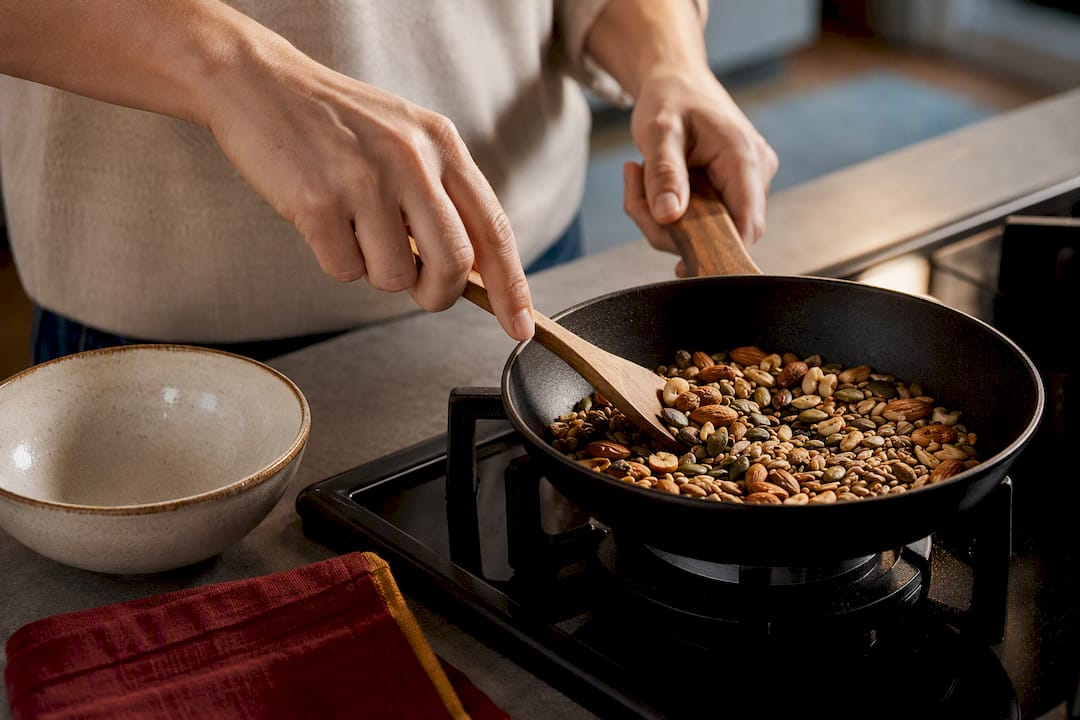
Pro Tip: Toast your nuts or seeds in a dry skillet for two to three minutes before topping. It deepens the flavor enough that you’ll reach for the syrup less often.
Why Chia and Flax Make Yogurt Work Harder for You
Yogurt on its own brings probiotics. Add a prebiotic fiber like chia or flax, and you get what’s called a synbiotic pairing, meaning the fiber essentially feeds the live bacteria already in the yogurt. Chia’s prebiotic fiber supports the probiotics in yogurt, and the two work better together than either does alone.
The method is simple: stir 1 to 2 tablespoons of chia seeds into a cup of yogurt and let it sit for 10 to 15 minutes before eating. That short rest softens the seeds, which improves both digestibility and texture so you’re not left with a gritty bowl. Flax seeds need one extra step: buy them ground, or grind whole seeds yourself, since whole flax often passes through the digestive tract without breaking down.
A few reasons this combination earns its spot in the rotation:
- Chia and flax both slow digestion slightly, which tends to translate into steadier energy through the morning
- The added fiber contributes to satiety, so a bowl with seeds tends to hold you over longer than the same bowl without
- Letting chia hydrate first makes the seeds noticeably gentler to eat, not just a nutritional add-on
Savory Yogurt Bowls for When You Don’t Want Anything Sweet
Not every yogurt bowl needs to taste like breakfast. Savory versions lean on fat, salt, and umami instead of sweetness, and they hold up just as well as a lunch or afternoon snack.
- Cucumber, fresh dill, and a drizzle of olive oil — light, cooling, closer to a tzatziki than a snack
- Pumpkin seeds, sliced avocado, and a touch of chili oil — richer, with real staying power
- Smoked salmon, capers, and a squeeze of lemon — the most meal-like of the three, good alongside toast
Savory combinations like these work because fat and salt satisfy appetite in a completely different way than sugar does. Serve any of them with whole-grain toast, over a grain bowl, or with raw vegetable sticks on the side and you’ve got something closer to lunch than a topped yogurt cup.
Pantry Swaps: Getting a Little Sweetness Without Reaching for Sugar
Granola is the most common sneaky-sugar trap in a yogurt bowl, but it’s not the only fix worth knowing. Freeze-dried fruit and cacao nibs give you the same crunch granola promises, with concentrated fruit flavor or real chocolate bitterness and no added sugar riding along.
For sweetness itself, a few pantry staples go a long way before you even reach for a syrup:
- Vanilla extract — a few drops make plain yogurt taste noticeably sweeter without adding sugar
- Cinnamon — amplifies perceived sweetness, especially paired with berries
- Citrus zest — brightens the bowl and cuts through richer toppings like nuts or avocado
If you do want an actual drizzle, use it sparingly. Start with 1 teaspoon, taste, and add up to another teaspoon if you want more, which mirrors how Yakonow recommends using its yacon syrup on yogurt. A similar approach to flavoring with vanilla and cinnamon shows up across most lower-sugar syrup swaps, and it’s worth applying here too.
Pro Tip: Read the ingredient list on dried fruit and granola before the nutrition label. If sugar, syrup, or juice concentrate appears in the first three ingredients, put it back.
The Small Ritual of a Low-Sugar Family Yogurt Bowl
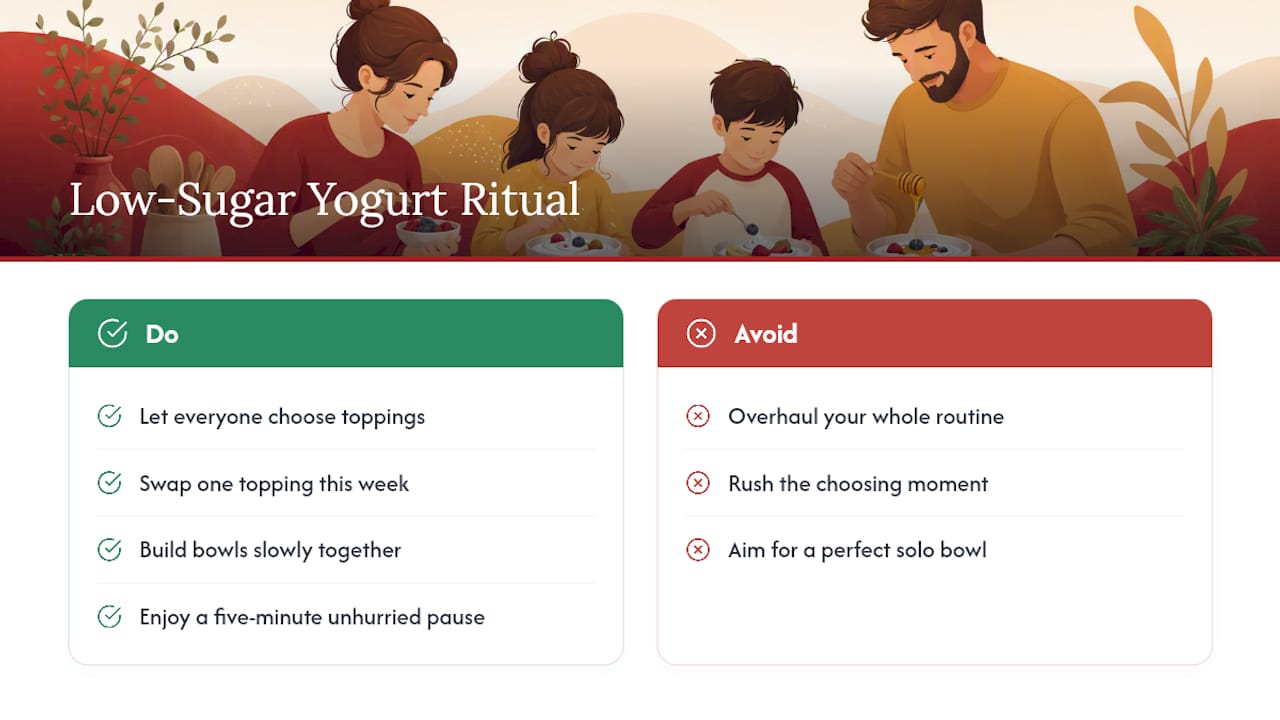
There’s a particular kind of morning quiet that happens when everyone’s at the counter choosing their own toppings. Someone reaches for berries, someone else wants the cacao nibs, and nobody’s rushing. That five minutes of choosing is the whole point, not a hurdle before the real breakfast starts.
You don’t need to overhaul the routine to change it. Swap one topping this week. Let the rest follow. A bowl built slowly, together, is worth more than one built perfectly alone.
— Celeste
A Small Drizzle Worth Keeping in the Fridge
For the mornings when a bowl of berries and seeds wants just a touch more sweetness, Yakonow yacon syrup is worth having in the fridge door. It’s a single-ingredient syrup, hand-harvested from yacon root in Peru and bottled in an FDA-compliant facility in Texas, with a naturally low glycemic profile and prebiotic FOS fiber built in rather than added on.

Use it the way you’d use any good finishing touch: 1 to 2 teaspoons over yogurt, paired with berries or a dusting of cinnamon, kept small so the fruit and seeds still lead. For solo mornings or first-time tries, the single 6oz bottle is the easy starting point. Families who go through breakfast syrup fast tend to land on the pack of 2, and for a household that never wants to run out mid-week, the pack of 4 keeps the shelf stocked. Pick a bottle, put it on the table this weekend, and see who reaches for it first.
Sources
- 20 Healthy Yogurt Toppings That Spice Up Plain Greek Yogurt
- What Happens to Your Gut Health When You Add Chia Seeds to Yogurt
- Naturesturn
- Best yogurt topping ideas (Healthy, Crunchy, Sweet & Savory)
FAQ
What Are the Best Sugar-Free Yogurt Toppings?
Fresh or frozen berries, a small portion of nuts or seeds, freeze-dried fruit, and cacao nibs are the most reliable options, all layered over plain unsweetened yogurt.
Is Granola a Good Sugar-Free Yogurt Topping?
Only if you check the label first. Many granolas carry more than 6 grams of added sugar per serving, so freeze-dried fruit or cacao nibs are safer crunch alternatives.
How Much Chia Seed Should I Add to Yogurt?
Stir 1 to 2 tablespoons of chia into a cup of yogurt and let it hydrate for 10 to 15 minutes before eating for the best texture and digestibility.
Can I Add a Drizzle of Syrup to Sugar-Free Yogurt Toppings?
Yes, in small amounts. A low-glycemic option like Yakonow yacon syrup works well starting at 1 to 2 teaspoons, tasted and adjusted from there.
Are Savory Yogurt Toppings a Good Sugar-Free Option?
Yes. Combinations like cucumber and olive oil, or avocado and pumpkin seeds, are naturally sugar-free and filling enough to work as a light meal.