

Product Teams: Simplify Clean Label Sweeteners With One Yacon Syrup
Clean label sweeteners are plant-derived or minimally processed ingredients, like stevia, monk fruit, allulose, and yacon syrup, that read as familiar on an ingredient list while still hitting taste, texture, and shelf-life targets. There’s no single legal definition of the term, so the real work for product teams is matching the sweetener to the claim, the sensory outcome, and the shopper’s expectation of recognizability. The tradeoffs come next.
TL;DR:
- Recognizability on ingredient lists influences consumer perception more than the technical purity of the sweetener.
- Combining high-intensity sweeteners like stevia or monk fruit with bulking agents such as allulose or erythritol is standard practice to mimic sugar’s taste and texture.
- Single-ingredient options like yacon syrup offer simplifying advantages and meet recognizability standards without blending for food formulators.
- Supply variability, processing conditions, and regulatory changes can impact the feasibility and labeling of clean-label sweeteners.
- Environmental impacts vary among natural sweeteners, with plant-based options generally requiring less land than sugarcane or corn-based sources.
Table of Contents
- What Clean Label Means for Sweeteners (and Why Shoppers Care)
- Common Clean-Label Sweetener Options: Profiles and Formulation Notes
- Choosing and Blending Sweeteners: A Practical Checklist
- Yacon Syrup as a Clean-Label Example Worth Studying
- A Step-by-Step Path to a Clean-Label Sweetener Switch
- Health Benefits and Potential Downsides of Clean Label Sweeteners
- Environmental and Sustainability Considerations of Natural Sweeteners
- Where the Industry Gets Clean-Label Sweeteners Wrong
- Bring Yacon Syrup to Your Own Table
- Sources
What Clean Label Means for Sweeteners (and Why Shoppers Care)
There’s no government checklist that defines “clean label.” That’s the first thing to understand before choosing an ingredient, as explained in this guide on food quality standards. The phrase is a market positioning tool, not a regulatory category, and the lack of a formal definition means brands set their own bar for what counts as recognizable.
In practice, “recognizable” means a shopper can read the ingredient and picture where it came from. Stevia leaf, monk fruit, honey, and yacon root pass that test. A chemical name with six syllables usually doesn’t, even if it’s technically natural. Consumer research backs this up directly: shoppers gravitate toward familiar, minimally processed ingredient lists and reduced added sugar more than any specific sweetener chemistry.
Market momentum reflects that preference. Forecasts point to continued growth in natural sweeteners, with North America representing a substantial share of demand, driven largely by clean-label reformulation and new supply from fermentation-derived ingredients.
Regulatory attention is catching up, too. A proposed House bill would require clearer disclosure when foods contain added artificial or natural noncaloric sweeteners, and it directs Health and Human Services to study the public health impact of rising low- and no-calorie sweetener use. That’s worth tracking even for teams working exclusively with natural options, since labeling rules tend to shift the whole category at once.
A few things product teams should keep in front of them when scoping a clean-label sweetener strategy:
- Recognizability drives perception more than any technical purity standard.
- Reduced added sugar is often the real claim shoppers respond to, not the sweetener name itself.
- Regulatory language around “natural” and “healthy” is actively being revisited.
- Traditional sugar can sometimes outperform novel sweeteners on the recognizability test, depending on the label goal, since some analysts argue sugar itself reads as more natural than an unfamiliar plant extract.
Common Clean-Label Sweetener Options: Profiles and Formulation Notes
Every sweetener on the clean-label shortlist comes with a tradeoff. Here’s how the major options actually behave once they’re in a formulation, not just on a spec sheet.
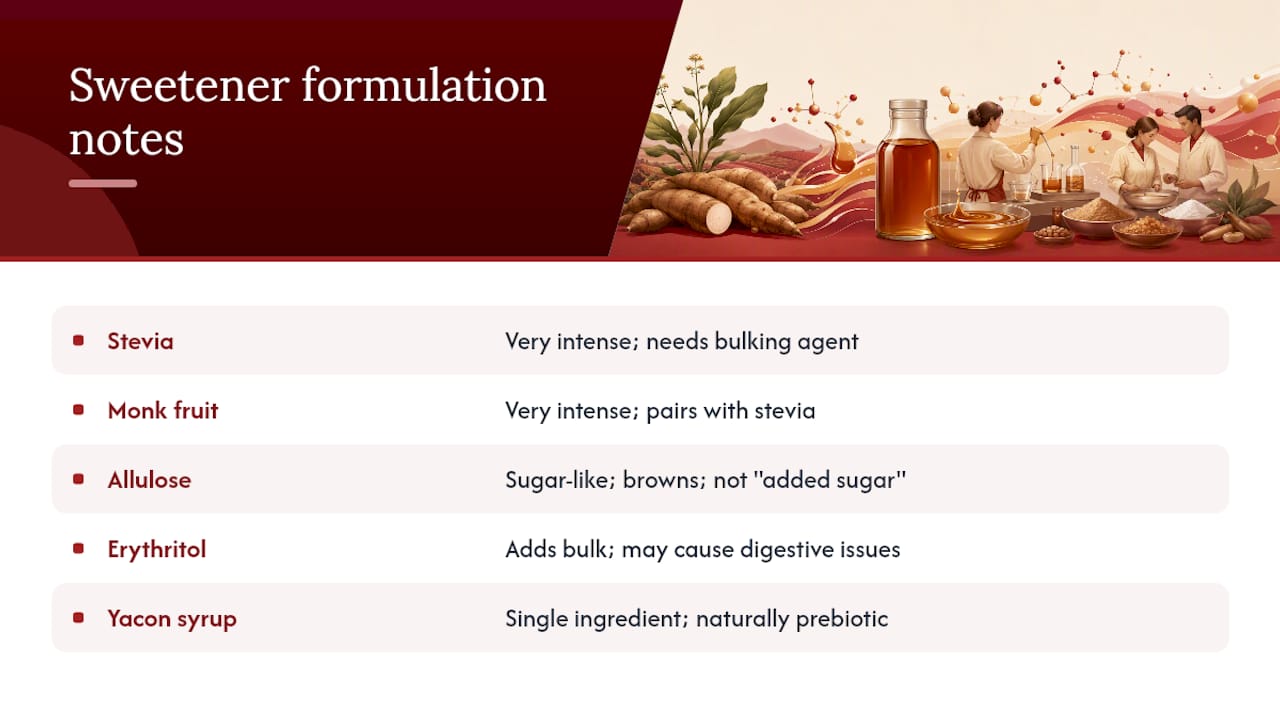
Stevia (often listed as “stevia leaf extract” or “Reb M”) delivers intense sweetness at a tiny inclusion rate, which is exactly why it needs help. Fermentation-derived Reb M has improved the taste profile considerably over older stevia extracts, but most formulators still pair it with a bulking agent or flavor-modulation technology to smooth out the lingering aftertaste. Industry R&D teams describe this as standard practice now, not a workaround.
Monk fruit behaves similarly to stevia: very sweet, very small dose, and prone to off-notes at higher concentrations. It reads well on a label and pairs naturally with stevia in blended systems.
Allulose tastes and behaves almost exactly like table sugar, including browning and mouthfeel, but the body doesn’t metabolize it as a typical sugar. That’s why it can be excluded from “added sugars” on a Nutrition Facts panel even though it functions like a sugar in the formula. Pair that with a plain-language explainer like allulose and glycemic impact if your audience needs more context.
Erythritol and other sugar alcohols provide bulk and mouthfeel that high-intensity sweeteners can’t deliver alone, which makes them common blending partners. The tradeoff: at higher intake, sugar alcohols can cause digestive discomfort, so dosing matters for beverage and snack formats where a single serving might be large.
Honey, maple syrup, and agave are recognizable and beloved, but they carry their own sugar content and glycemic load, and none of them solve for a low-sugar claim on their own.
Tapioca and brown rice syrups function mainly as bulking and texture agents rather than primary sweeteners. They read clean on a label but don’t carry much sweetening power per gram.
Yacon syrup stands apart from that group. It’s a single ingredient, sweet on its own, and it carries prebiotic fiber as a natural part of the root rather than an added functional ingredient.
Pro Tip: If your label copy needs to say “no added sugar,” check whether your sweetener choice is metabolized differently before you write the claim. Allulose and yacon syrup both open that door; maple and honey do not.
Choosing and Blending Sweeteners: A Practical Checklist
Picking a single perfect sweetener rarely happens. Most clean-label products run on a blend, and the selection process is really a set of tradeoffs weighed against each other.
Start with these criteria before testing anything in a lab:
- Taste match. Does the sweetener’s sweetness curve mimic sucrose, or does it hit fast and fade, or linger with bitterness?
- Label recognizability. Would a shopper reading the ingredient panel recognize the word, or does it need an asterisk and an explainer?
- Claim compatibility. Does the choice support “no added sugar,” “low glycemic,” or a reduced-calorie claim without contradicting another ingredient on the label?
- Functional role. Does the product need bulk and viscosity, or just sweetness, or both?
- Cost-in-use. High-intensity sweeteners cost less per unit but need blending partners, which adds formulation complexity and its own line-item cost.
- Supply reliability. Fermentation-derived stevia has improved supply scale, but availability still varies by supplier and season.
Blending strategy usually follows a simple logic: use a high-intensity sweetener (stevia, monk fruit) for the sweetness hit, then bring in a bulking sweetener (allulose, erythritol, tapioca syrup) to replace the volume and mouthfeel sugar would have provided. Suppliers increasingly describe this as a Replace-Rebalance-Rebuild approach, where each stage addresses a different sensory gap left by removing sugar.
Before locking a formula, ask suppliers directly:
- How does this sweetener perform under your specific thermal processing conditions?
- What’s the solubility limit in your target pH and temperature range?
- How does the blend hold up over the product’s full shelf life, not just at launch?
- What documentation exists for the ingredient’s non-GMO or organic status, if that claim matters to your label?
Yacon Syrup as a Clean-Label Example Worth Studying
Yakonow makes a useful case study precisely because it skips the blending conversation entirely. It’s a single ingredient: yacon root syrup, hand-harvested in Peru and bottled in an FDA-compliant facility in Texas. No added sugar, no glucose, no colorants, and nothing that needs a footnote to explain.
On an ingredient list, it reads as exactly what it is: yacon syrup. That’s the whole label. For a product developer weighing recognizability against formulation complexity, a single-ingredient syrup with naturally low glycemic response and up to 50g of prebiotic FOS fiber per 100g solves both problems at once, without asking the shopper to trust an unfamiliar compound name. If ingredient transparency is the goal, it helps to understand what single-ingredient actually means on a food label before comparing options.
The families who reach for Yakonow at the breakfast table aren’t reading a nutrition panel first. They’re pouring it over pancakes on a Saturday morning, watching it soak in, and getting back to the table.
Practical uses stay simple: drizzled over pancakes and waffles, stirred into oatmeal or yogurt, spooned over fresh fruit, or worked into a dessert recipe in place of maple or honey. For anyone comparing it against other familiar sweeteners, this rundown of yacon syrup against agave, stevia, and monk fruit lays out the differences without technical overload.
A Step-by-Step Path to a Clean-Label Sweetener Switch
Reformulating a sweetener system isn’t a single decision. It’s a sequence, and skipping a step usually shows up later as a costly reformulation.
- Define the label goal first. Decide whether you’re chasing “no added sugar,” “low glycemic,” reduced calories, or simple ingredient recognizability. Each goal points toward different sweeteners.
- Map the goal to a claim. Confirm the claim’s regulatory requirements before locking a formula, especially given how FDA labeling rules apply to sweetener-related claims.
- Run lab and sensory testing. Test sweetness curves, off-notes, and mouthfeel side by side with the current formula, not just against a sugar benchmark.
- Pilot at scale. Bench results don’t always hold up under commercial thermal processing or extended mixing times.
- Review labeling and claims language. Verify wording with regulatory counsel, particularly with disclosure rules in flux.
- Validate with real consumers. Internal taste panels miss things a target shopper catches immediately.
Pro Tip: Prioritize recognizability early if the label claim is the main marketing driver. Prioritize formulation performance early if the product category (carbonated beverages, baked goods) has unforgiving processing conditions. Trying to solve both at once from day one usually stalls the whole project.
Common pitfalls include underestimating supply variability for newer ingredients like fermentation-derived stevia, ignoring off-notes until late-stage panels, and miscalculating cost-in-use once a blending partner gets added to the formula.
Health Benefits and Potential Downsides of Clean Label Sweeteners
The upside is straightforward: swapping refined sugar for a plant-derived sweetener often reduces added sugar and calorie counts while keeping the ingredient list short and readable. Fiber-carrying options, including yacon syrup, add a functional benefit that plain sugar never offered.
The downsides are more about degree than danger. Sugar alcohols and certain fermentable fibers can cause digestive discomfort when consumed in large amounts, since the gut processes them differently than simple sugars. High-intensity sweeteners like stevia and monk fruit can carry bitter or licorice-like off-notes at certain concentrations, which is a sensory issue rather than a health one, but it shapes how much of a product people actually enjoy eating. And “clean label” itself isn’t a health guarantee. It’s a recognizability standard. A sweetener can be minimally processed and still contribute meaningfully to a product’s overall sugar or calorie load if used carelessly. The honest takeaway for a shopper or a formulator alike: read past the marketing term and look at the actual ingredient and amount.
Environmental and Sustainability Considerations of Natural Sweeteners
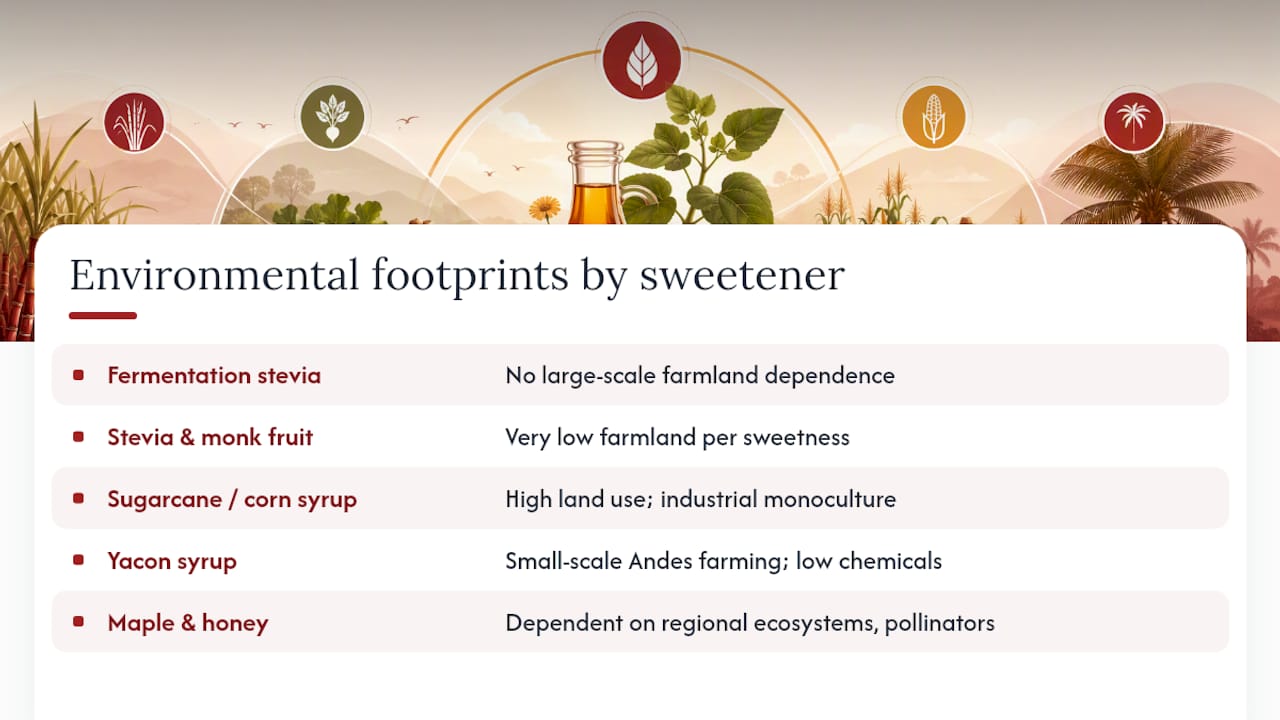
Plant-derived sweeteners don’t all carry the same environmental footprint, and that’s easy to overlook once a formulation team is focused on taste and label copy. Stevia and monk fruit require far less farmland per unit of sweetness than sugarcane or corn syrup, since a small amount of extract delivers the sweetening power of a much larger volume of raw crop. Fermentation-derived stevia adds another layer: it reduces dependence on large-scale agricultural land use altogether by producing the sweet compound through microbial fermentation rather than field cultivation.
Root and tuber-based sweeteners like yacon syrup come from a crop that’s traditionally grown in the Andes without heavy chemical inputs, reflecting a smaller-scale agricultural model rather than industrial monoculture. Maple and honey depend on regional ecosystems and pollinator health, tying their supply directly to climate and habitat conditions in ways that lab-scale sweeteners don’t. None of these factors show up on a nutrition panel, but they increasingly show up in sourcing questions from retailers and consumers who care where an ingredient actually comes from, not just what it says on the front of the label.
Where the Industry Gets Clean-Label Sweeteners Wrong
The conventional advice treats clean label as a formulation problem to be solved with the right blend of stevia, monk fruit, and allulose. That’s only half the picture. The harder problem is that “clean” is a perception, and perception doesn’t always follow the chemistry. A shopper who sees “yacon syrup” trusts it instantly because it sounds like a fruit or a root, something a grandmother might recognize. A shopper who sees “erythritol” hesitates, even though it’s a naturally occurring sugar alcohol found in fruit.
What gets underestimated is how much a single-ingredient product simplifies every downstream decision, from label copy to marketing claims to shelf placement. Multi-sweetener blends solve real formulation problems, but they also multiply the number of things a brand has to explain. The teams that win with clean-label positioning aren’t always the ones with the most sophisticated blend. They’re the ones who picked the simplest ingredient that still does the job, and then didn’t overcomplicate the story around it. Start there before reaching for a five-ingredient sweetener system.
— Celeste
Bring Yacon Syrup to Your Own Table
Reformulating with stevia blends and bulking agents makes sense for large-scale manufacturing, but if you’re a home cook or a family looking for one sweetener that already does the job, you don’t need a lab. Yakonow is a single ingredient, hand-harvested yacon syrup from Peru, bottled in an FDA-compliant facility, with nothing added and nothing to explain on the label.
It’s the syrup for slow Saturday mornings, drizzled over pancakes while the coffee’s still warm, poured over yogurt and berries before the school run. If you’re trying it for the first time, the single 6oz bottle is the easy starting point. Families who go through syrup fast tend to reach for the pack of 4, and households that never want to run out keep the pack of 12 stocked in the pantry. Whichever size fits your table, it’s one bottle, one ingredient, and one less thing to think about before everyone sits down together.
Sources
- Natural sweetener solutions coincide with demand for clean label | Beverage Industry
- H.R.2901 — An example bill text with proposed labeling/reporting requirements
- Clean label sweeteners: Could sugar make a comeback? | FoodNavigator
- How clean label natural sweeteners support product development | Oobli